Apex, eponychium, rebalance, inhibition layer. Nail salons have their own vocabulary, and a few words decide whether you get the set you pictured. This nail glossary explains more than 140 nail terms in plain English, from the parts of the nail to the line items on a salon menu.
It is written for two readers: clients who want to understand what their nail tech is saying, and students learning the language for the first time. Terms are grouped by topic, and many link to a full guide if you want the longer version. Brand names are marked as brands, because a few of them (BIAB, Polygel, Gel-X) have become everyday words.
Nail anatomy
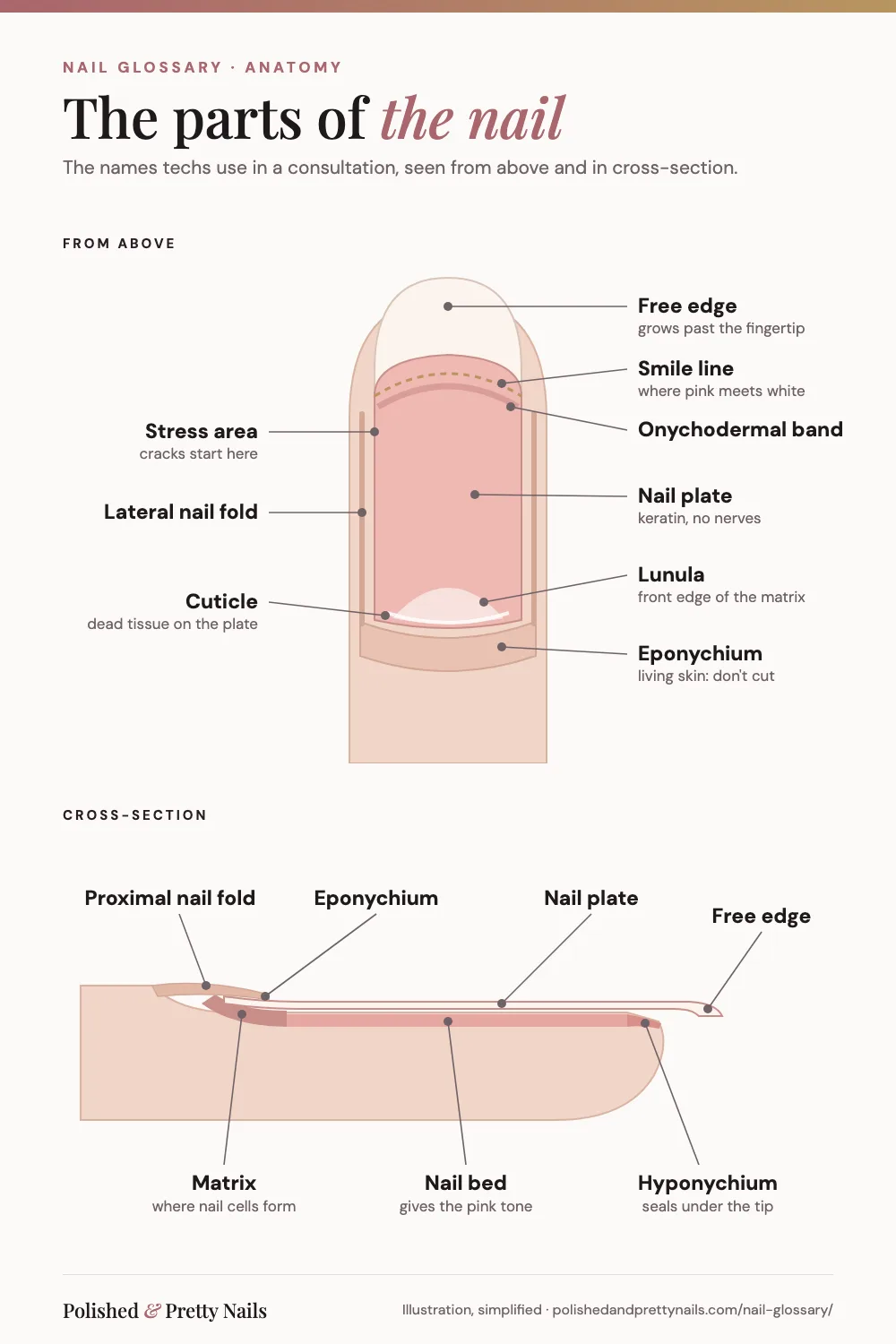
The parts of the nail and the skin around it. These names come up in every good salon consultation.
| Term | What it means |
|---|---|
| Nail plate | The hard, visible part of the nail, built from layers of the protein keratin. It has no nerves or blood supply, which is why filing it doesn't hurt. |
| Nail bed | The skin the nail plate rests on. Blood vessels in the nail bed give a healthy nail its pink tone. |
| Matrix | The living tissue under the skin at the base of the nail where new nail cells are made. An injury here can change how the nail grows for months. |
| Lunula | The pale half-moon at the base of some nails, which is the visible front edge of the matrix. Plenty of healthy nails show little or no lunula. |
| Eponychium | The living fold of skin at the base of the nail. People often call it the cuticle, but it is living tissue and should not be cut. |
| Cuticle | The thin, clear layer of dead tissue that sticks to the nail plate just in front of the eponychium. This is what gets gently pushed back and lifted off the nail during prep. |
| Proximal nail fold | The skin that covers the base of the nail and protects the matrix underneath. |
| Lateral nail folds | The skin along both sides of the nail, also called the sidewalls. Product that floods onto them tends to lift early. |
| Hyponychium | The skin under the free edge where the nail bed meets the fingertip. It seals out bacteria, so digging hard under the nail can do more harm than good. |
| Free edge | The part of the nail that grows past the fingertip. |
| Smile line | The curved line where the pink nail bed ends and the white free edge begins. A French manicure either follows it or paints a new, cleaner one. |
| Onychodermal band | The narrow, slightly darker strip just behind the smile line where the nail plate is sealed firmly to the skin. |
| Stress area | The point on each side where the nail leaves the nail bed. Natural nails and extensions crack here first. |
| Keratin | The tough protein that nails and hair are made of. |
Nail shapes and length
Shape names differ a little between salons, so pair the word with a photo when you book.
| Term | What it means |
|---|---|
| Square | Straight sides and a flat, straight tip with sharp corners. |
| Squoval | A square shape with the corners softened. It is one of the most chip-resistant shapes for short nails. |
| Round | Sides that follow the finger and a tip that curves to match the fingertip. A low-maintenance shape for very short nails. |
| Oval | Straight or gently tapered sides with an egg-shaped tip. It tends to make fingers look longer. |
| Almond | Slim sides that taper to a rounded peak, like the nut. It needs some free edge to work. |
| Stiletto | Sides tapered to a sharp point. Usually done with extensions, since natural nails rarely hold the point. |
| Coffin | Tapered sides with a flat, squared-off tip, also called ballerina. Best on medium to long nails. |
| Lipstick | A tip filed at a slant, like the top of a new lipstick. |
| Flare | A shape that widens toward the tip, sometimes called duck nails. |
| Extra short | Nails filed at or just past the fingertip. |
| Medium length | Roughly a quarter to a half inch of free edge. Salons measure differently, so show a photo. |
| Long / XL | Anything well past medium, usually built with tips or forms. XL and XXL are salon shorthand for extra-long sets. |
Enhancements and nail systems
The products that add strength or length. The trade names in brackets are brands, not categories.
| Term | What it means |
|---|---|
| Enhancement | Any product built on top of the natural nail to add strength or length: acrylic, gel, dip or a tip system. |
| Acrylic | A liquid monomer mixed with a powder polymer that hardens in air. It is strong, and it is filed and soaked off rather than peeled. |
| Monomer | The liquid half of an acrylic system. A tech picks up powder with a brush dipped in monomer to form a bead. |
| Polymer | The powder half of an acrylic system. |
| EMA | Ethyl methacrylate, the monomer used in professional acrylic liquids today. |
| MMA | Methyl methacrylate liquid monomer. The FDA acted against products made of 100 percent MMA monomer after reports of nail damage, and many state boards prohibit it in salons. A strong, unusual smell and very hard-to-remove acrylic are warning signs. |
| Bead | The small ball of mixed acrylic a tech places and shapes on the nail. |
| Mix ratio | How much liquid to powder is in a bead. Too wet and the acrylic is weak; too dry and it can lift or crack. |
| Dip powder | A system where the nail is coated in a bonding liquid, dipped or sprinkled with colored powder, then sealed with an activator. No lamp is needed. |
| Activator | The liquid that hardens dip powder layers. |
| Soft gel | Gel that can be soaked off in acetone, including most gel polish. |
| Hard gel | Gel that does not soak off and has to be filed off. Often used for durable overlays and sculpted extensions. |
| Builder gel | A thicker gel used to build structure and strength instead of just color. |
| BIAB | Short for Builder In A Bottle, a brand name from The GelBottle Inc. People now use it loosely for any brush-on builder gel overlay. |
| Structured manicure | A builder gel overlay shaped with an apex so the natural nail is stronger. Popular for growing out short nails. |
| Polygel | A paste-like hybrid of acrylic and gel that is shaped with a slip solution and cured under a lamp. Polygel is a Gelish brand name; the category is often called acrylic gel. |
| Slip solution | The liquid used to keep polygel from sticking to the brush while it is shaped. |
| Soft gel extensions | Pre-shaped, full-cover tips made of soakable gel and attached with gel adhesive. Gel-X from Aprés is the best-known brand. |
| Tips | Plastic extensions glued to the free edge and blended in, then covered with acrylic, gel or dip. |
| Full-cover tips | Tips that cover the entire nail plate instead of only the free edge. |
| Nail forms | Paper or reusable guides fitted under the free edge so a tech can sculpt length from product instead of using a tip. |
| Sculpted nails | Extensions built from acrylic or gel on a nail form, with no plastic tip. |
| Overlay | Acrylic, gel or dip applied over the natural nail for strength, without adding length. |
| Apex | The highest, thickest point of an enhancement, placed over the stress area. A good apex is why a thin-looking set does not snap. |
| C-curve | The curve of the nail seen straight on from the tip. A deeper C-curve makes long nails stronger. |
| Fill | An appointment to add product to the regrowth gap near the cuticle, usually every two to three weeks. Also called an infill. |
| Rebalance | A fill that also moves the apex back where it belongs as the nail grows out. |
| Backfill | A fill for pink-and-white sets that also rebuilds the white tip line. |
| Pink and white | A French look built into the enhancement itself, using pink and white powders instead of polish. |
| Lifting | When product separates from the natural nail, usually at the cuticle or sides. Lifted product traps moisture and should be fixed, not glued down at home. |
| Encapsulation | Sealing glitter, foil, dried flowers or other art inside a clear layer of acrylic or gel. |
| Press-on nails | Ready-made nails applied at home with glue or adhesive tabs. |
| Nail wrap | Either a thin fabric patch (silk or fiberglass) used to repair a crack, or an adhesive polish sticker applied like a decal. |
| Nail glue | A cyanoacrylate adhesive for tips, press-ons and repairs. Also called resin. |
Polish, gel and finishes
Finish names describe how a surface looks. Our nail polish finishes chart covers them side by side.
| Term | What it means |
|---|---|
| Gel polish | Colored gel applied like polish and cured under a UV or LED lamp. It usually lasts about two to three weeks and is soaked off. |
| Cure | Hardening gel under a UV or LED lamp. An under-cured layer stays soft and can wrinkle, peel or irritate skin. |
| UV lamp | A nail lamp that cures gel with ultraviolet light. Older UV lamps need longer cure times than LED. |
| LED lamp | A nail lamp that uses LEDs tuned to the wavelengths most gels need, so cure times are usually shorter. Check that your gel is made for your lamp. |
| Heat spike | A sudden burning feeling while gel cures, caused by the curing reaction. Thin layers help; pull the hand out briefly if it happens. |
| Inhibition layer | The tacky film left on some gels after curing. It helps the next layer stick and is wiped off at the end. Also called the sticky layer. |
| No-wipe top coat | A gel top coat that cures without a tacky layer, so there is nothing to wipe off. |
| Base coat | The first layer on the nail. It helps color adhere and keeps pigment from staining the nail. |
| Top coat | The final clear layer that adds shine or a matte finish and protects the color underneath. |
| Rubber base | A thick, flexible gel base coat that can even out the nail surface and add some strength. |
| Ridge filler | A thicker base coat that smooths out ridges before polish. |
| Peel-off base | A base coat that lets regular or glitter polish peel away in one piece. |
| HEMA | Hydroxyethyl methacrylate, a common gel ingredient and a known cause of allergy. Gel touching the skin, or not fully cured, raises the risk. |
| "Free" labels | Marketing labels such as 3-free, 7-free or 10-free list ingredients a brand leaves out. There is no single regulated standard behind the numbers. |
| Crème | Solid, opaque color without sparkle. |
| Sheer | Translucent color that lets the natural nail show through. |
| Jelly | A squishy, glass-like translucent color, often built up in layers. |
| Shimmer | Fine reflective particles that give a soft glow rather than distinct sparkle. |
| Glitter | Visible sparkling particles, from fine to chunky. |
| Chrome powder | A fine powder rubbed over cured gel to create a mirror or glazed finish. |
| Cat eye | Magnetic polish whose particles are pulled into a line of light with a magnet. Velvet is a softer, spread-out version of the same effect. |
| Holographic | A finish that throws rainbow reflections, either scattered or in a linear band. |
| Multichrome | A finish that shifts between several colors as the hand turns. |
| Thermal polish | Polish that changes color with temperature, so tips and bases often look different. |
| Matte | A flat finish with no shine, usually from a matte top coat. |
Tools and prep
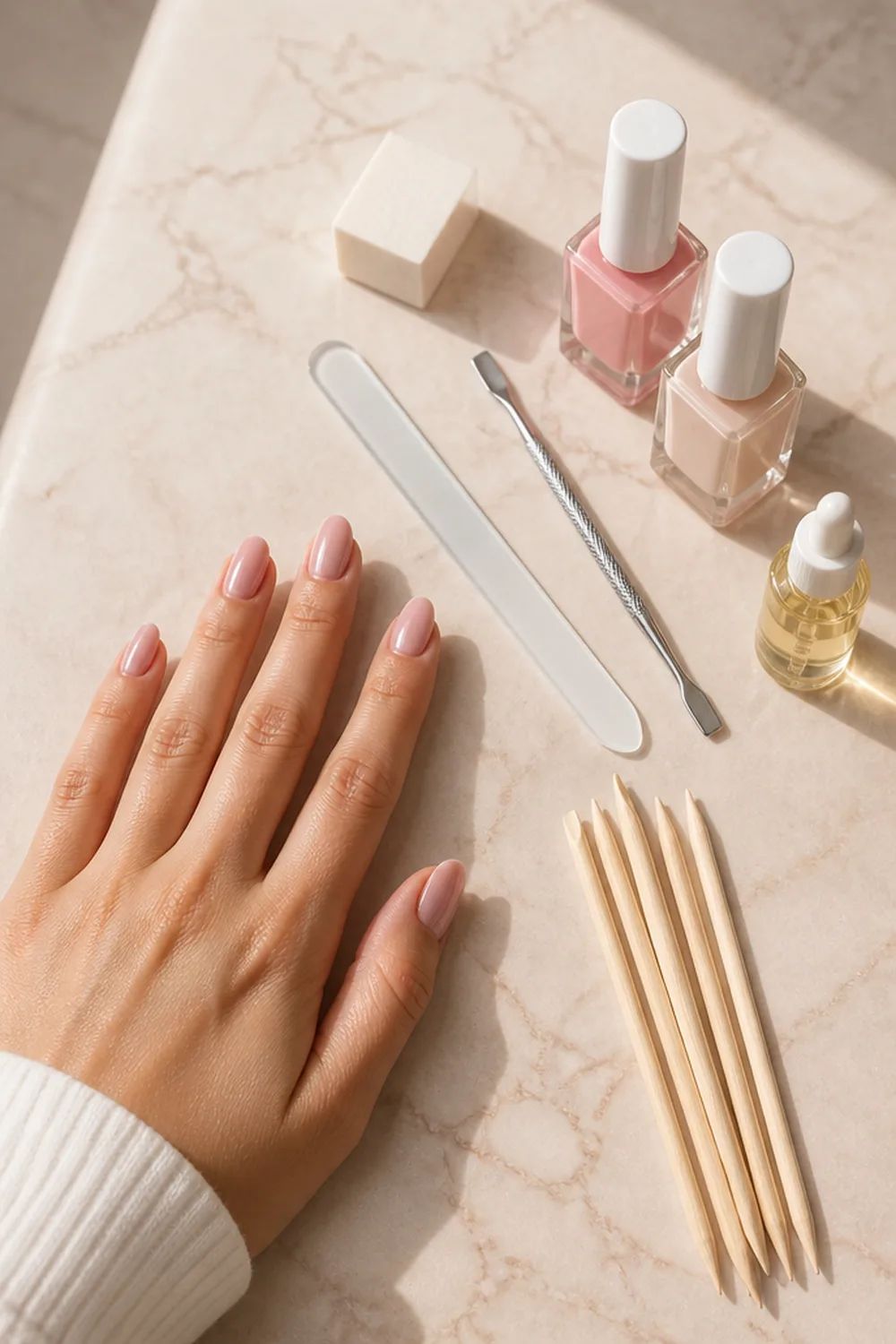
Prep is most of a long-lasting manicure. These are the tools and liquids you will see at the station.
| Term | What it means |
|---|---|
| E-file | An electric file, sometimes called a nail drill, used by trained techs to shape and remove product. Used badly, it can thin or burn the nail. |
| Bits | The interchangeable heads on an e-file: carbide, diamond, ceramic or disposable sanding bands. |
| Grit | How coarse a file is. Lower numbers are rougher: around 80 to 100 for shaping product, 180 for natural nails, 240 and up for smoothing. |
| Buffer | A padded block or file used to smooth the surface or remove shine before product. |
| Glass file | A fine file made of etched glass that seals the free edge as it shapes. Good for natural nails. |
| Cuticle pusher | A metal or wooden tool used to push back the eponychium and lift cuticle off the nail plate. |
| Nippers | Small clippers for trimming hangnails and loose, dead skin. Living skin should not be cut. |
| Orangewood stick | A disposable wooden stick for pushing cuticles, cleaning under nails and fixing mistakes. |
| Dehydrator | A liquid that removes oil and moisture from the nail plate so product sticks. |
| Primer | A liquid that helps product bond to the nail. Acid primers etch; acid-free primers work more like double-sided tape. |
| Bonder | A sticky gel or liquid layer applied before some gel systems to improve adhesion. |
| Lint-free wipes | Wipes that leave no fibers behind, used with alcohol or cleanser on gel nails. |
| Cuticle oil | Oil massaged into the skin around the nail to keep it flexible. Daily use helps both natural nails and enhancements. |
| Detail brush | A fine brush for lines and small art. Liner and striper brushes are longer versions for straight lines. |
| Dotting tool | A tool with a ball on the end for perfect dots and small flowers. |
| Stamping plate | A metal plate etched with designs. Polish fills the design, a stamper picks it up and transfers it to the nail. |
Techniques and nail art
Design names you can put straight into a booking note.
| Term | What it means |
|---|---|
| French manicure | A natural-looking base with a white or colored tip that follows the smile line. |
| Micro French | A very thin French tip line, popular on short nails. |
| Reverse French | A tip painted at the base of the nail instead of the free edge. A half-moon manicure is a rounded version. |
| Baby boomer | A soft fade from pink or nude at the base to white at the tip. |
| Ombré | Any gradient from one color to another, usually sponged or airbrushed. |
| Aura nails | A soft, blurred glow of color in the center of the nail that fades outward. |
| Negative space | Art that leaves parts of the bare nail showing as part of the design. |
| Marble | Veined designs that imitate stone, usually painted wet-on-wet or with a thin gel. |
| Water marble | A technique where polish is dropped onto water, swirled and dipped onto the nail. |
| Foil | Thin metallic foil pressed onto a tacky layer for a gilded, broken-metal look. |
| Glazed | A pearly chrome powder over a sheer base, made famous as glazed donut nails. |
| Accent nail | One nail, usually the ring finger, painted differently from the rest. |
| Skittle manicure | Every nail a different color from the same family or rainbow. |
| Hand-painted art | Designs painted freehand with a brush instead of stickers or stamping. Salons usually price it by time or tier. |
| Decals | Pre-printed stickers or water-slide transfers sealed under top coat. |
| 3D nail art | Raised designs built from gel, acrylic or charms that stand off the nail surface. |
| Rhinestones | Small crystals set in gel or glue. Salons often price them per stone or per nail. |
Salon services and booking terms
What the menu means, so you can compare quotes fairly.
| Term | What it means |
|---|---|
| Manicure | Shaping, cuticle care and polish or gel on the hands. What is included varies, so read the menu line. |
| Pedicure | The same service for the feet, often with a soak and callus care. Polish on toes typically lasts much longer than on fingers. |
| Gel manicure | A manicure finished with gel polish instead of regular polish. |
| Full set | A new set of extensions or overlays applied from scratch, as opposed to a fill. |
| Removal | Taking off gel, dip or acrylic, usually by filing the top layer and soaking. Many salons charge for it separately, and it is gentler than peeling. |
| Soak-off | Removal by soaking the nail in acetone until the product softens. |
| Repair | Fixing one broken or lifted nail between appointments, often priced per nail. |
| Nail art tiers | A pricing ladder some salons use, such as basic, level 1, 2 and 3, based on how complex the art is. |
| Deposit | Money paid when booking to hold the appointment. Check whether it comes off the final bill and when it becomes non-refundable. |
| Nail trial | A practice appointment before an event such as a wedding, to test the shape, color and wear. |
| Paraffin treatment | Hands or feet dipped in warm wax to soften skin. |
| Callus removal | Smoothing thick skin on the feet with files. Many states bar salons from using credo blades or razors for this. |
| Nail technician | A licensed professional who does nails. Licensing rules and titles vary by state; manicurist is a common license name. |
Nail conditions worth knowing
Short, plain definitions so you know what a word means. They are not a diagnosis: see a doctor or dermatologist for anything painful, spreading, discolored or new.
| Term | What it means |
|---|---|
| Onycholysis | The nail plate separating from the nail bed, so the free edge looks white and extends further than usual. It can follow injury, overfiling, harsh products or medical causes. |
| Paronychia | An infection of the skin around the nail, making it red, swollen and sore. See a doctor if it is painful or does not settle. |
| Onychomycosis | A fungal nail infection that can thicken, discolor and crumble the nail. It needs proper diagnosis and treatment. |
| Leukonychia | White spots or lines on the nail. Most small white spots come from minor knocks, not a lack of calcium. |
| Beau's lines | Horizontal dents across the nail that show growth was interrupted, for example after illness or injury. |
| Vertical ridges | Fine lines running from cuticle to tip. They are common and often become more visible with age. |
| Koilonychia | Spoon-shaped nails that dip in the middle. It can be linked to iron deficiency, so it is worth mentioning to a doctor. |
| Brittle nails | Nails that split, peel or break easily. Frequent wetting and drying is a common cause. |
| Hangnail | A small torn piece of skin at the side of the nail. Trim it cleanly rather than pulling it. |
| Green nail | A green or blue-green stain, often from a bacterial infection under lifted product. Salons sometimes call it a greenie; it should be seen and not covered with more product. |
| Melanonychia | A brown or black streak running the length of the nail. It is often harmless, but a new or changing streak should be checked by a dermatologist promptly. |
Sources for these definitions: the American Academy of Dermatology, MedlinePlus on nail diseases and Cleveland Clinic on nail anatomy. The MMA entry above draws on the FDA page on nail care products, and OSHA covers salon chemical safety.
Printable nail glossary
Every term on this page, on a few printer-friendly pages. It works as a study sheet for cosmetology students or a reference to keep at the station. No email or signup needed.
How to use these words at the salon
You do not need every term. For most bookings, four details cover it: the service (gel manicure, full set, fill or removal), the shape, the length and the finish. Add a photo, then ask what the price includes. Removal, nail art and repairs are the usual surprises, and our manicure price checklist lists the questions.
If a tech uses a word you do not know, ask. A good tech would rather explain what an apex or a rebalance is than have you leave with a set you did not want.
Frequently asked questions
What is the difference between the cuticle and the eponychium? The eponychium is the living skin at the base of the nail. The cuticle is the thin layer of dead tissue stuck to the nail plate in front of it. Push back the eponychium gently and remove only the cuticle from the nail; cutting living skin raises the risk of infection.
What does apex mean on nails? The apex is the highest, thickest point of an acrylic or gel enhancement, placed over the stress area where the nail leaves the finger. It is what lets a slim-looking set stay strong.
Is BIAB the same as builder gel? BIAB started as a brand name, Builder In A Bottle from The GelBottle Inc. People now use it for any brush-on builder gel overlay, so ask which product the salon actually uses.
What nail terms should I use when booking a salon appointment? Name the service (gel manicure, full set, fill or removal), the shape and length, and the finish, then attach a photo. Asking whether removal and art are included avoids surprises at checkout.