
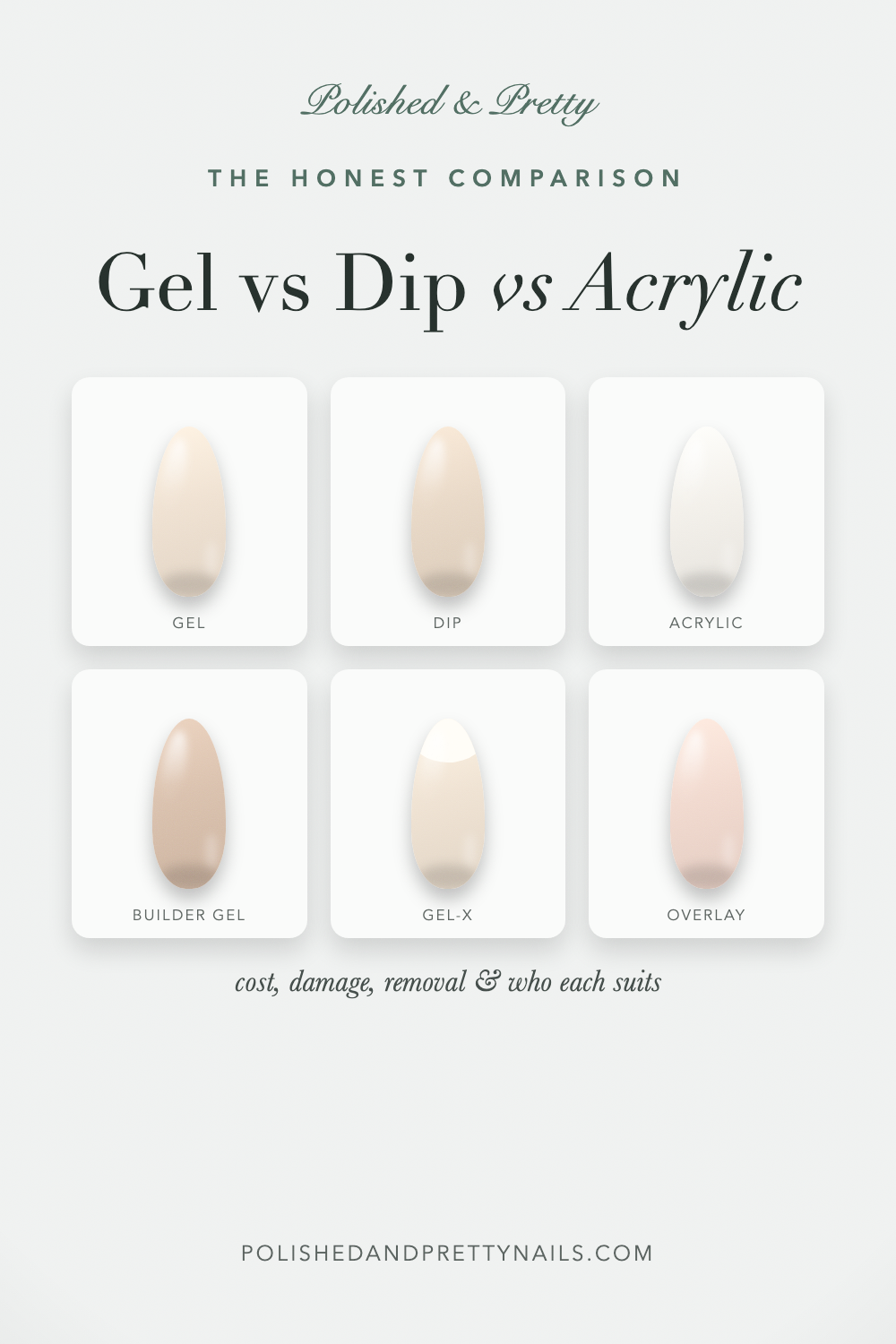
Gel vs dip vs acrylic is one of the most common nail questions, and the answer people want is which one is best. There isn’t one. They’re three different products solving three different problems, and picking wrong is why some people conclude that “fake nails ruin your nails” when what actually happened is they got acrylic when they needed gel.
Here’s the honest comparison across wear time, cost, damage, removal, and who each suits, plus where builder gel and Gel-X fit now that both are in most salons. There’s a straight recommendation at the end for the three most common situations. If you’d rather skip all three entirely, our press on nails guide covers the no-commitment route.
What each one actually is
Gel
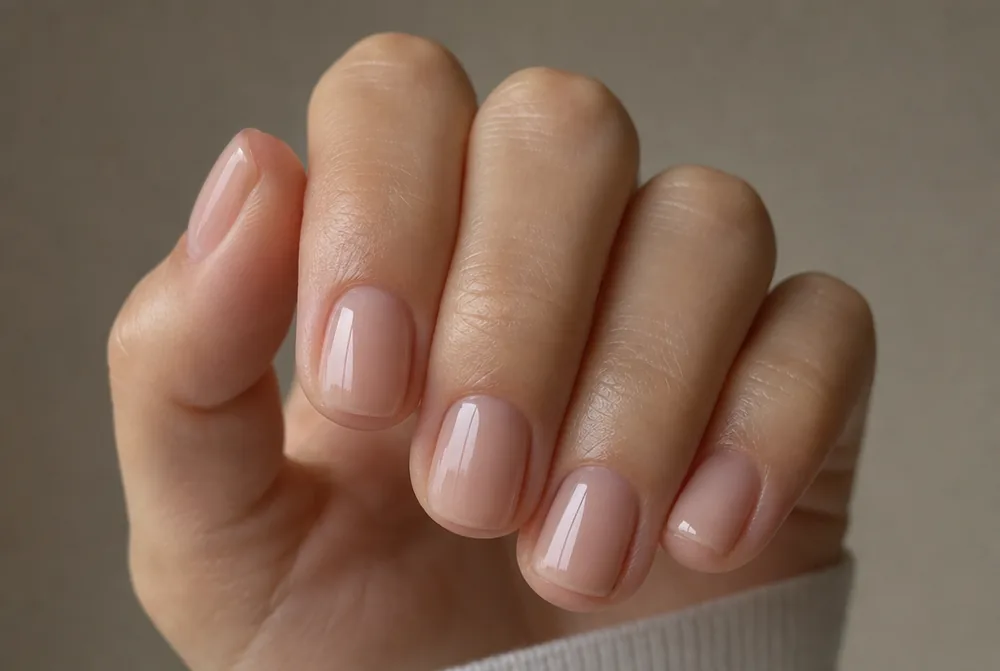
A liquid polish that cures hard under a UV or LED lamp, applied in thin coats directly onto your natural nail. It adds color and a little strength but no real structure and no length. This is what most people mean by “a gel manicure” and what most salons default to.
Dip powder
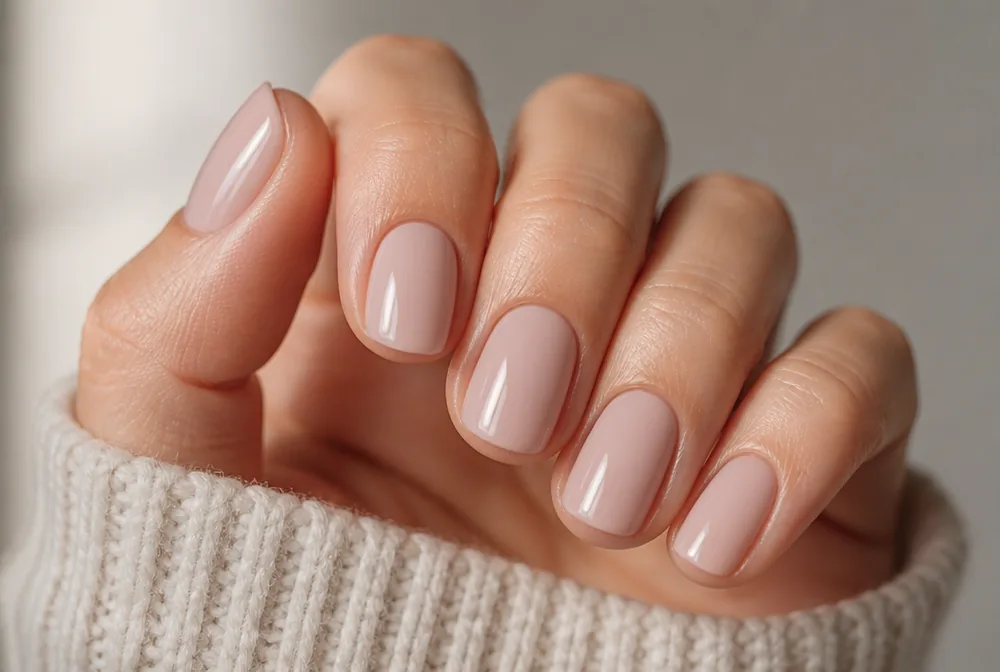
A resin applied to the nail, then dipped into colored acrylic powder, repeated in layers and sealed. It cures by air rather than under a lamp. It’s thicker than gel and adds genuine strength, which is why it’s the go-to for people with thin, peeling nails.
Acrylic
A liquid monomer mixed with a powder polymer, sculpted onto the nail or over a tip, which hardens in the air. It’s the strongest of the three and the only one really built for significant added length. It’s also the most technique-dependent.
Builder gel and Gel-X
Builder gel is a thicker gel cured under a lamp that can be sculpted like acrylic but removes like gel. Gel-X is a soft gel tip glued on with gel and cured. Both have taken over a lot of what acrylic used to do, and both are gentler.
How long each one lasts
Wear time is where people expect the biggest difference and it’s actually the smallest.
Gel lasts two to three weeks before grow-out at the cuticle becomes the reason you rebook, rather than chipping. Dark colors make that gap visible sooner, usually around day twelve.
Dip lasts three to four weeks and it’s the most chip-resistant of the three by a clear margin. The extra thickness is doing that work.
Acrylic lasts six to eight weeks with fills every two to three, and it doesn’t really “come off” so much as get maintained indefinitely. If you want nails you don’t think about for months, acrylic is the one built for that.
What each one costs
Prices vary a lot by region, but the relationship between them is fairly consistent across the country.
A gel manicure runs $45 to $65 in most of the country, plus $10 to $20 for chrome, cat eye, or an ombre. Removal is usually $10 to $15 if you’re not rebooking color.
Dip runs $50 to $70, slightly more than gel, and lasts slightly longer, so per week it’s close to a wash. Removal takes longer than gel and some salons charge more for it.
A full acrylic set with extensions runs $60 to $95, with fills at $45 to $65 every two to three weeks. Gel-X sits in the same range. Over a year, acrylic is the most expensive of the three because of the fill cadence.
Which one damages nails most
This is the part everyone actually wants to know, and the honest answer is that removal and prep cause nearly all of the damage, not the product.
Gel is the gentlest, provided the salon buffs lightly before application and soaks off rather than scraping. Over-buffing before a gel set is the single most common cause of thin nails, and it’s a technician habit rather than a property of gel.
The American Academy of Dermatology recommends choosing soak-off gel nails over acrylic, because gel is more flexible and your own nails are less likely to crack.
Dip sits in the middle. The removal soak is longer, which means more acetone exposure, and some salons file the surface more aggressively to help the resin grip. Dipping the finger directly into a shared powder pot is also a hygiene issue worth asking about; a good salon pours the powder over your nail instead.
To reduce your risk of infection, the American Academy of Dermatology says your technician should either pour the powder into a disposable container or sprinkle it straight onto your nails rather than having you dip into a shared jar.
Acrylic causes the most damage in practice, almost entirely because it needs the most filing at removal and because people pick or pry at lifted edges. Removed properly by a good tech, acrylic is not inherently destructive. Removed badly, it takes real layers off.
Removal, honestly
Removal is the deciding factor for more people than wear time is, and it’s the one salons undersell.
Gel comes off with a light file to break the top coat, then ten to fifteen minutes of acetone under foil. It’s the quickest and the least aggressive, and it’s genuinely doable at home.
Dip needs the surface filed down first and then twenty to thirty minutes of soaking. It’s slower and it’s the one people most often give up on halfway through and start scraping, which is where the damage happens.
Acrylic has to be filed down substantially before soaking and is genuinely a salon job. Do not attempt acrylic removal at home with acetone alone. Builder gel and Gel-X both remove like gel, which is a large part of why they’ve displaced acrylic in a lot of salons.
Which one suits your nails
The right pick depends on the state of your natural nails and what you want the product to do.
If your nails are healthy and you mainly want color that lasts, gel is the answer. It’s the least invasive, the cheapest, and the easiest to walk away from. Most people asking this question want gel.
If your nails are thin, peeling, or split constantly at the free edge, dip or builder gel is the better call. Both add a protective layer that lets the nail underneath grow without splitting. Builder gel is the gentler of the two.
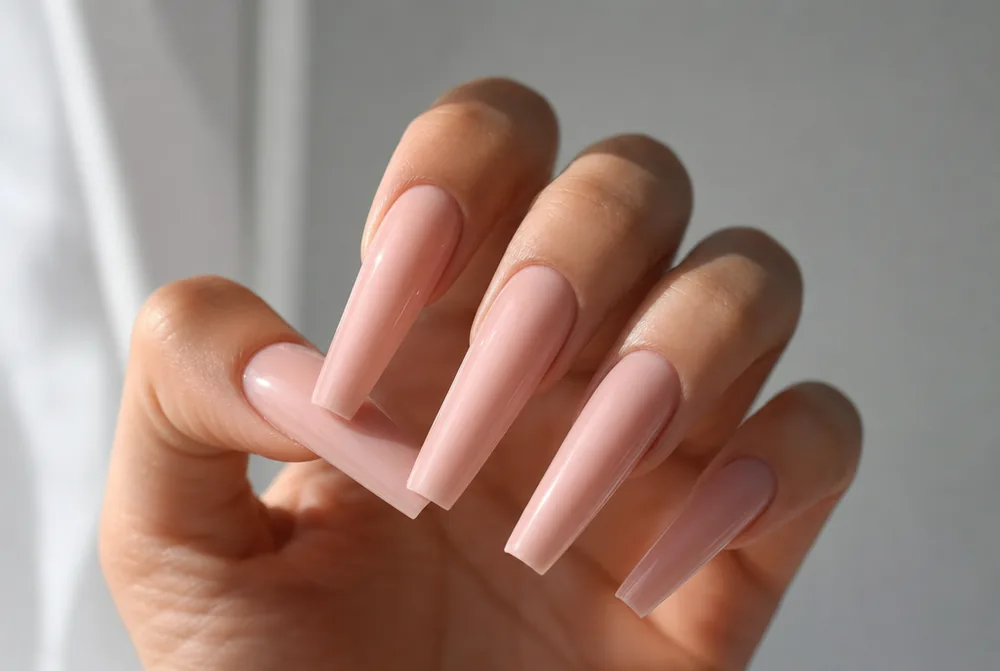
If you want real added length, especially a long coffin or stiletto, you need acrylic or Gel-X. Gel and dip cannot create length that isn’t there. My coffin nail designs guide covers what those shapes actually require.
Doing gel at home
Gel is the only one of the three we’d recommend attempting at home, and it’s genuinely worth it if you get your nails done monthly or more.
A starter kit with a lamp runs $40 to $70 and individual gel colors from DND or Beetles run about $8. That pays for itself in two skipped salon visits, and after that every manicure costs you time rather than money.
The two things people get wrong are coats that are too thick and not capping the free edge. Thin coats cure properly all the way through; thick ones stay soft underneath and lift within days. Running the brush along the tip of the nail seals the layer and it’s what stops chipping there.
Home gel also unlocks chrome, cat eye, and glazed finishes, none of which work over regular polish. That’s the real argument for a lamp, more than the money. If you do cure at home, the Skin Cancer Foundation recommends broad spectrum sunscreen on your hands 20 minutes before they go under the lamp.
Straight recommendations
Three situations cover most of the people asking, so here’s what we’d actually say to each.
You want a manicure that lasts two weeks and looks like your own nails: get gel, keep it short or medium, and use cuticle oil twice a day. This is the default and it’s right most of the time.
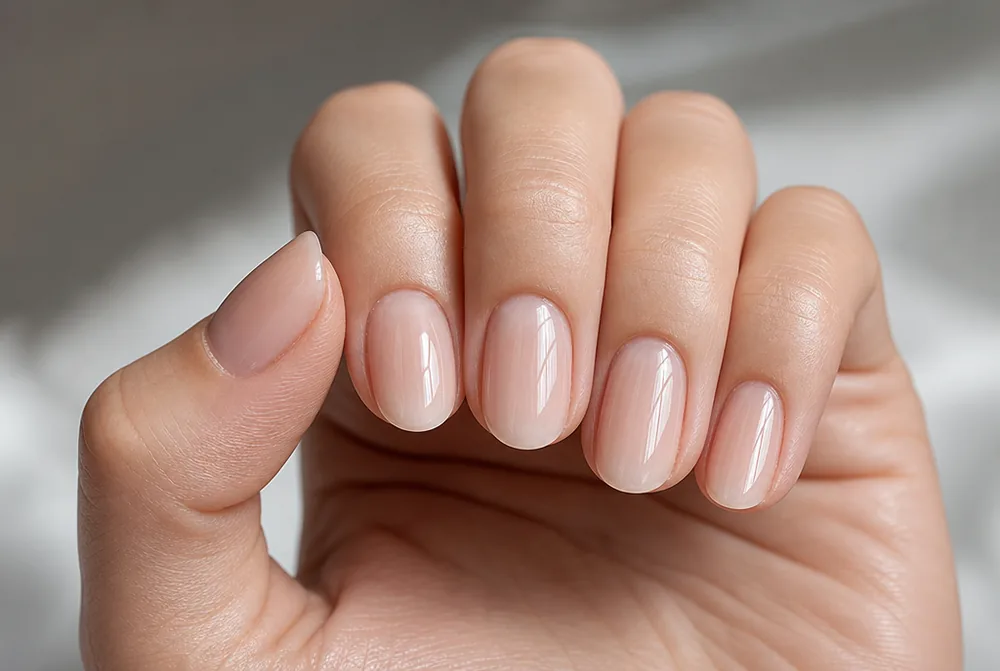
Your nails split and peel and never grow: get builder gel or dip as an overlay in a nude, and leave it on through two or three cycles while the nail underneath grows. Then reassess. My nude nail designs guide covers picking a shade that looks natural.
You want long dramatic nails: get Gel-X if your salon offers it and acrylic if they don’t. Both need fills every two to three weeks, so go in expecting an ongoing appointment rather than a one-off.
Signs your salon is doing it wrong
Most damage blamed on the product is really a technique problem, and there are a few things you can spot from the chair.
Heavy buffing before application is the biggest one. Prep should take the shine off the nail plate and nothing more, so if you can feel heat or your nails look visibly thinner and whiter afterward, that is too much. This single habit causes most of the thin, bendy nails people attribute to gel.
Scraping product off before it has soaked is the second. If a tech is pushing hard at the base of the nail with a metal tool and it hurts, the acetone has not done its job yet and the tool is taking nail with it. Ask them to re-soak.
With dip, watch whether they dip your finger straight into a communal pot. A good salon pours the powder over your nail into a tray instead, which is both more hygienic and, in many places, the licensed way to do it. It is a fair question to ask when you book.
Making any of the three last longer
The habits that extend wear time are the same regardless of which product you picked, and they matter more than the product does.
Cuticle oil twice a day is the highest-return thing you can do. A dry nail plate flexes more, and flexing is what separates product from nail at the edges. The difference between an oiled set and a neglected one is roughly five days of wear.
Gloves for washing up are the second. Hot water swells the nail plate and lifts product at the free edge faster than anything else in daily life, which is why sets often fail on the dominant hand first.
The third is not using your nails as tools. Every time you lever open a can or scrape a label with the tip, you are putting force exactly where the product bonds to your nail. My nail shapes guide covers picking a shape that holds up to how you actually use your hands.
FAQ
Which is better, gel or dip?
Gel is better if your nails are healthy and you mainly want long-lasting color, since it’s thinner, gentler, and quicker to remove. Dip is better if your nails are thin or peeling, because the extra thickness protects them while they grow. Dip also lasts about a week longer, but removal takes twice as long.
Which is least damaging to nails?
Gel, followed by builder gel, then dip, with acrylic last. The ranking is mostly about removal rather than the product itself, since acrylic requires the most filing to take off. All three are safe if the salon buffs lightly at prep and soaks off rather than scraping.
Can you put gel over acrylic?
Yes, gel polish over an acrylic set is standard practice and it’s how most acrylic nails get their color. What you can’t do is soak the gel off without affecting the acrylic underneath, so removal has to be done as one process. Tell the tech you have acrylic underneath before they start.
How long should you take a break between sets?
A week or two bare between cycles is worth doing if your nails feel thin or bendy, but it isn’t necessary as a routine if removal is done properly. What actually rehabilitates a nail is cuticle oil twice a day and keeping the length short while it recovers. Nails take about six months to fully replace themselves, so give any repair plan real time.
If you take one thing from this: most people asking the question want gel, and most people who think acrylic or gel ruined their nails had a removal problem rather than a product problem. For what to actually put on top, our short gel nails post has the designs that hold up longest.
Two more worth reading next: our removing gel at home guide and our brittle nails guide.
Builder gel does one thing the others do not, which is bury a decoration completely. My encapsulated nails guide covers what can safely be sealed inside.
Whichever system you pick, the question everyone asks next is how long it holds. My how long gel nails last post covers the real week-by-week timeline and why grow-out ends a set before wear does.