
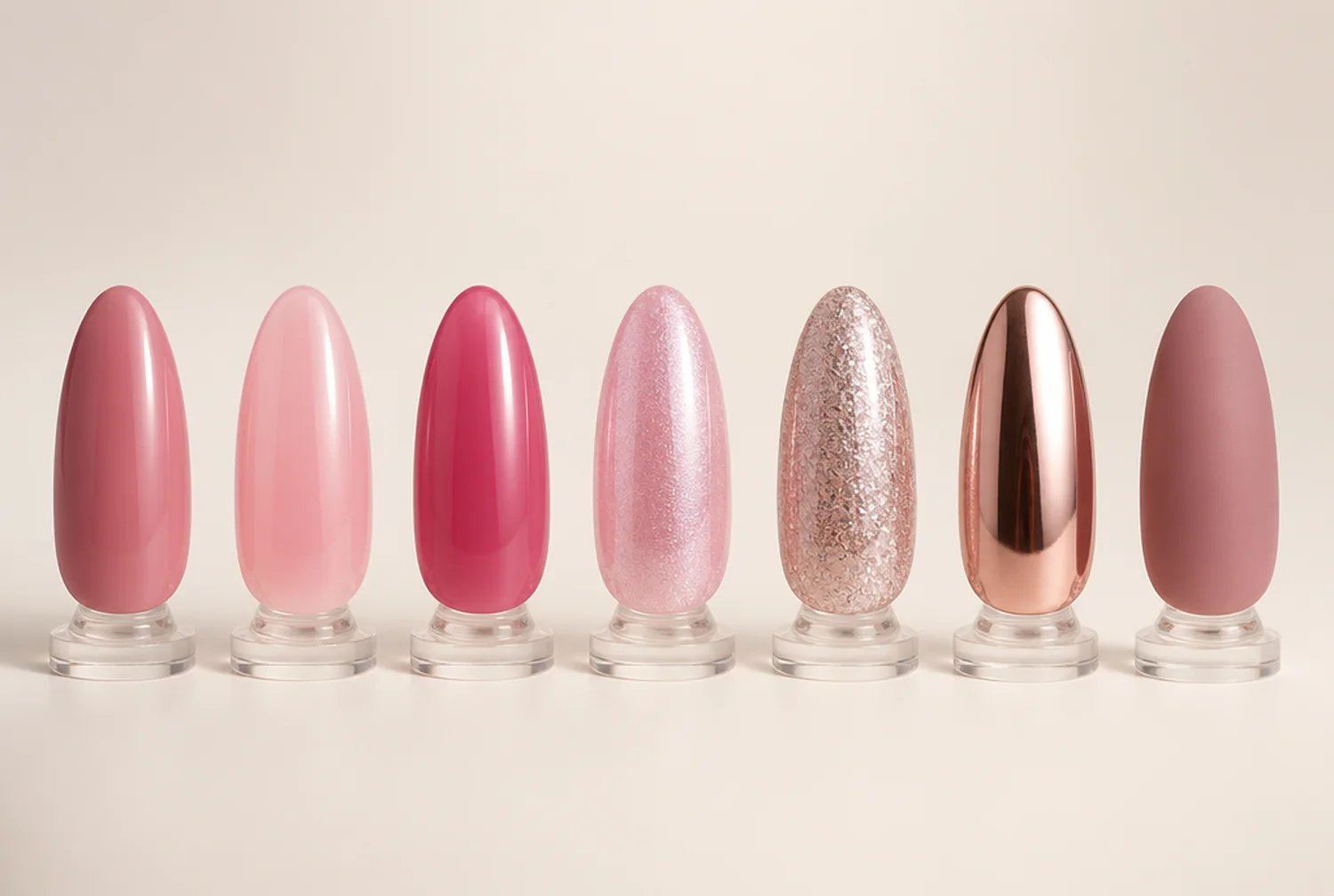
“A pink manicure with a little shine” could mean a sheer wash of color, fine shimmer, visible glitter or a glazed surface. The color name is only part of the description. Coverage tells you how much nail shows through; finish tells you how the surface looks and responds to light.
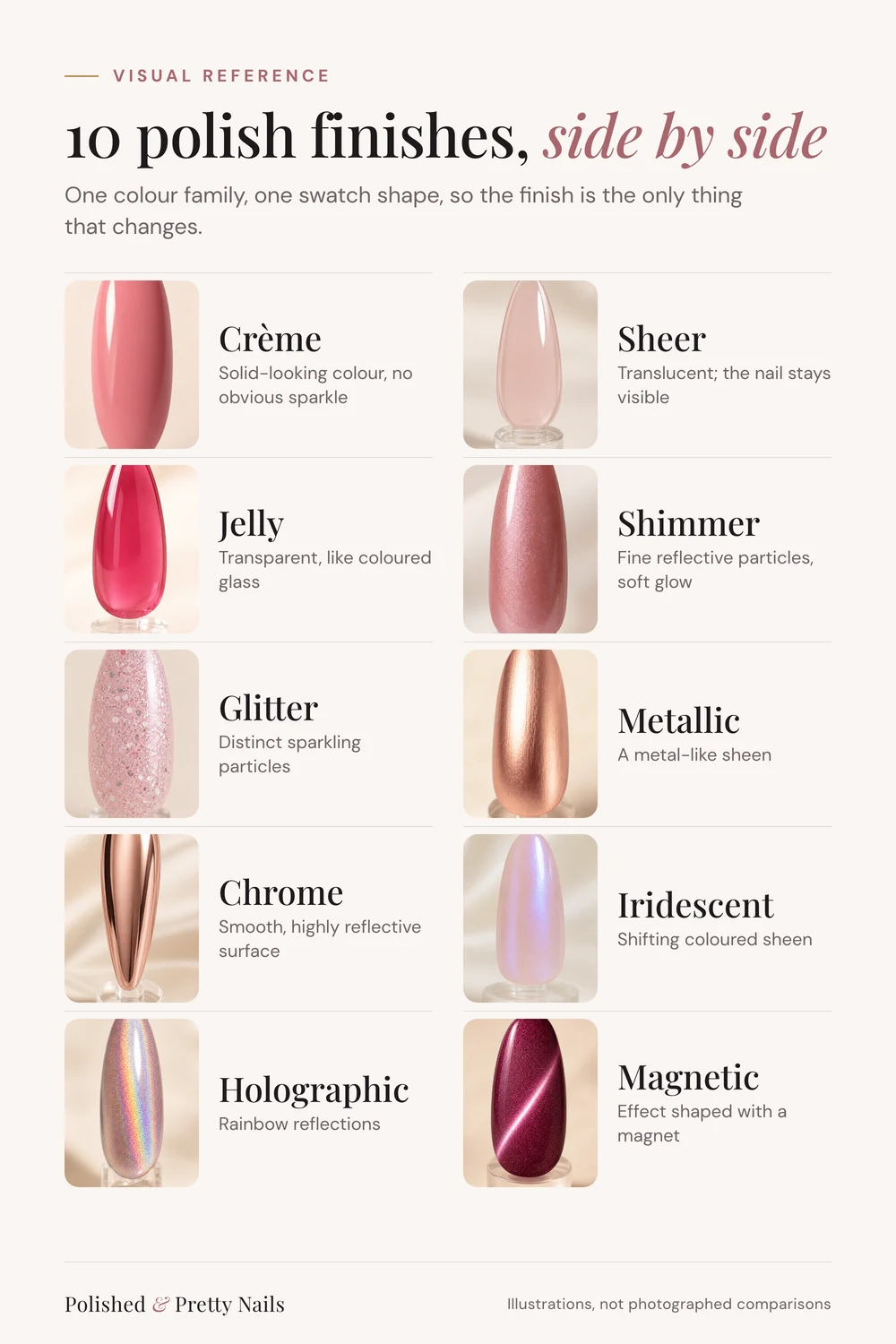
Use this reference chart to narrow down an inspiration photo, describe a salon request or label your own polish collection. Finish names overlap between brands, so treat them as useful descriptions rather than a universal technical standard.
First separate color, coverage and finish
Color: the main shade you notice—pink, red, brown, blue or another color. Coverage: whether the nail remains visible beneath it. Finish: the visual effect, such as fine sparkle or a mirror-like surface. Describing all three helps you get closer to the manicure you mean.
For example, “a sheer pink with a soft pearly sheen” is a different request from “an opaque pink with large silver glitter.” Neither is more correct. They simply describe different results. Add the length and shape separately when you talk to your nail artist.
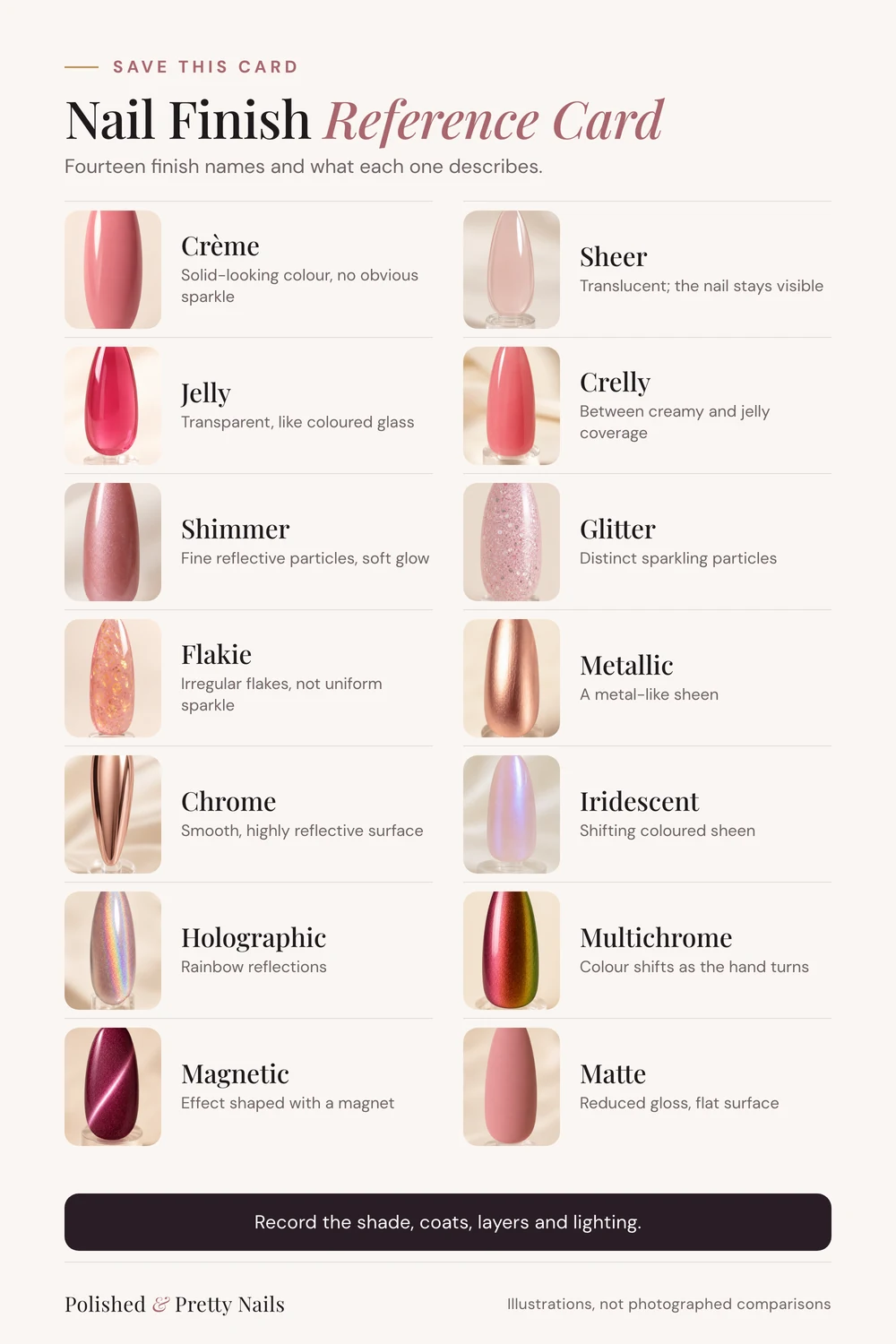
Nail polish finishes: the quick reference chart
| Term | What it describes | A useful question to ask |
|---|---|---|
| Crème | Solid-looking color without obvious sparkle. | How much coverage does this particular shade give? |
| Sheer | Translucent coverage that leaves the nail visible. | Will the natural tip still show? |
| Jelly | A transparent, colored-glass-like look. | Can I see a swatch at the intended coat count? |
| Crelly | A finish between creamy and jelly-like coverage. | How much of the nail shows through? |
| Shimmer | Fine reflective particles creating a soft glow. | Does the glow differ from the base color? |
| Glitter | Distinct sparkling particles. | Are the particles fine, chunky or mixed? |
| Flakie | Irregular flakes rather than uniform sparkle. | Is this a topper or a standalone shade? |
| Metallic | A metal-like sheen. | Is the effect brushed-looking or more reflective? |
| Chrome | A smooth, highly reflective or glazed effect. | Which base color and product create this version? |
| Iridescent | A shifting colored sheen, often translucent. | How does it look over a light or dark base? |
| Holographic | Rainbow reflections, scattered or in a band. | Can I see it in different lighting? |
| Multichrome | An angle-dependent shift between colors. | Which colors appear as the hand turns? |
| Magnetic | An effect shaped using magnet-responsive particles. | Do I want a defined cat-eye line or a velvet-style glow? |
| Matte | A surface with reduced gloss. | Can I compare it with the glossy version? |
For examples of how a polish brand organizes these categories, see Holo Taco’s finish directory. The questions in this chart are our suggested way to turn those labels into a useful comparison.
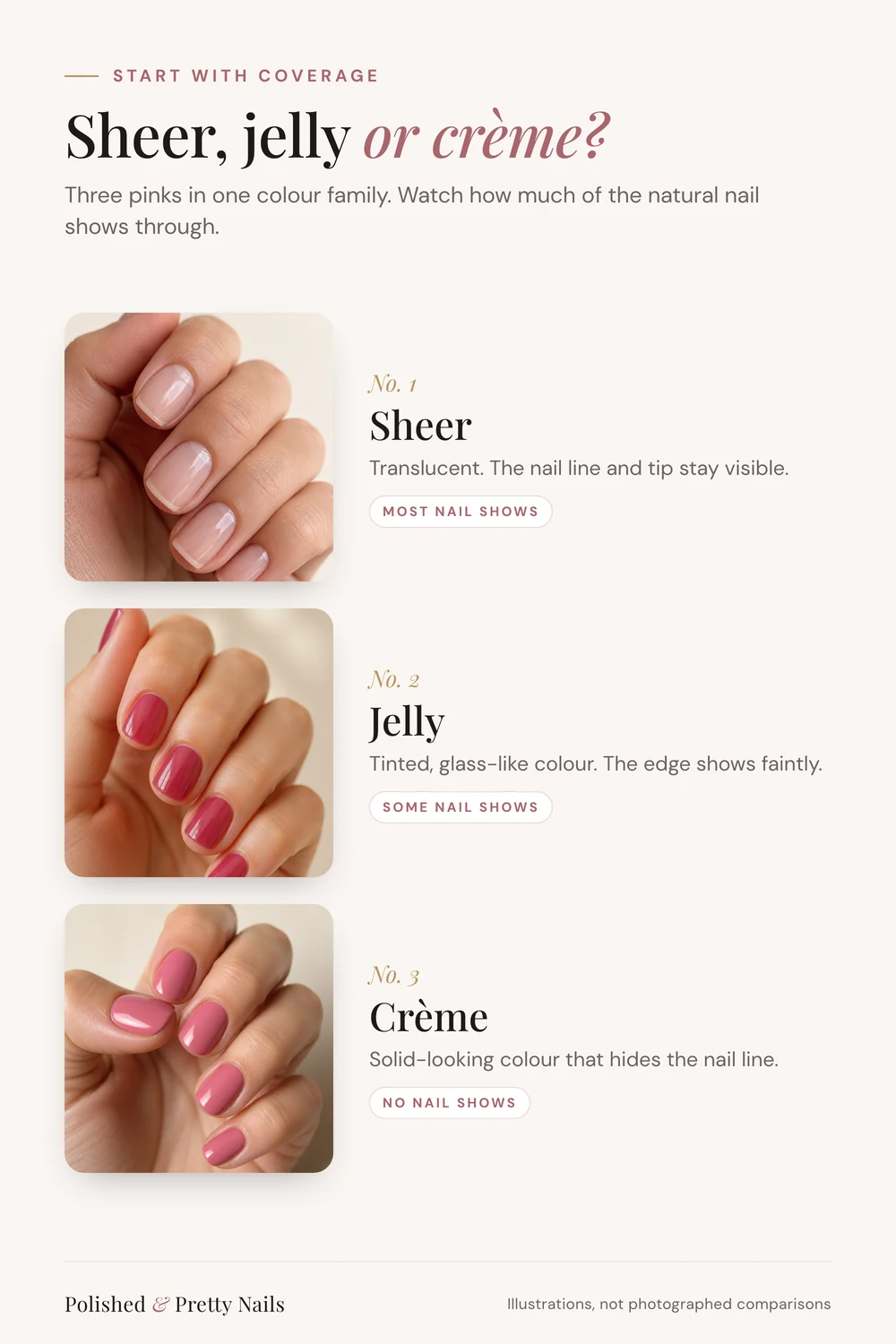
Sheer, jelly and crème: begin with coverage
If seeing your natural nail line would bother you, say so before choosing a shade. Do not rely on the bottle alone. Ask to see the color applied, and ask how many coats are shown. Conversely, if you want a translucent look, show a reference where the natural tip is visible.
The label does not guarantee a fixed number of coats for every color. Essie has a dedicated sheer category, while individual product descriptions give more specific information. Check the particular shade and product line rather than assuming every polish with the same color name behaves alike.
Shimmer, glitter and flakies: describe the size of the detail
When you inspect a reference, ask what you are responding to: an overall glow, individual points of sparkle or visible pieces. This is often more useful than deciding which fashionable label the image belongs to. A close-up can reveal detail that disappears when you look at the whole hand.
For a salon request, try “very fine sparkle that reads subtle from a distance” or “large visible pieces on two accent nails.” Show both a close crop and the full manicure if you have them. Ask whether the example is a color polish, a topper or a layered design, because that affects what needs to be recreated.
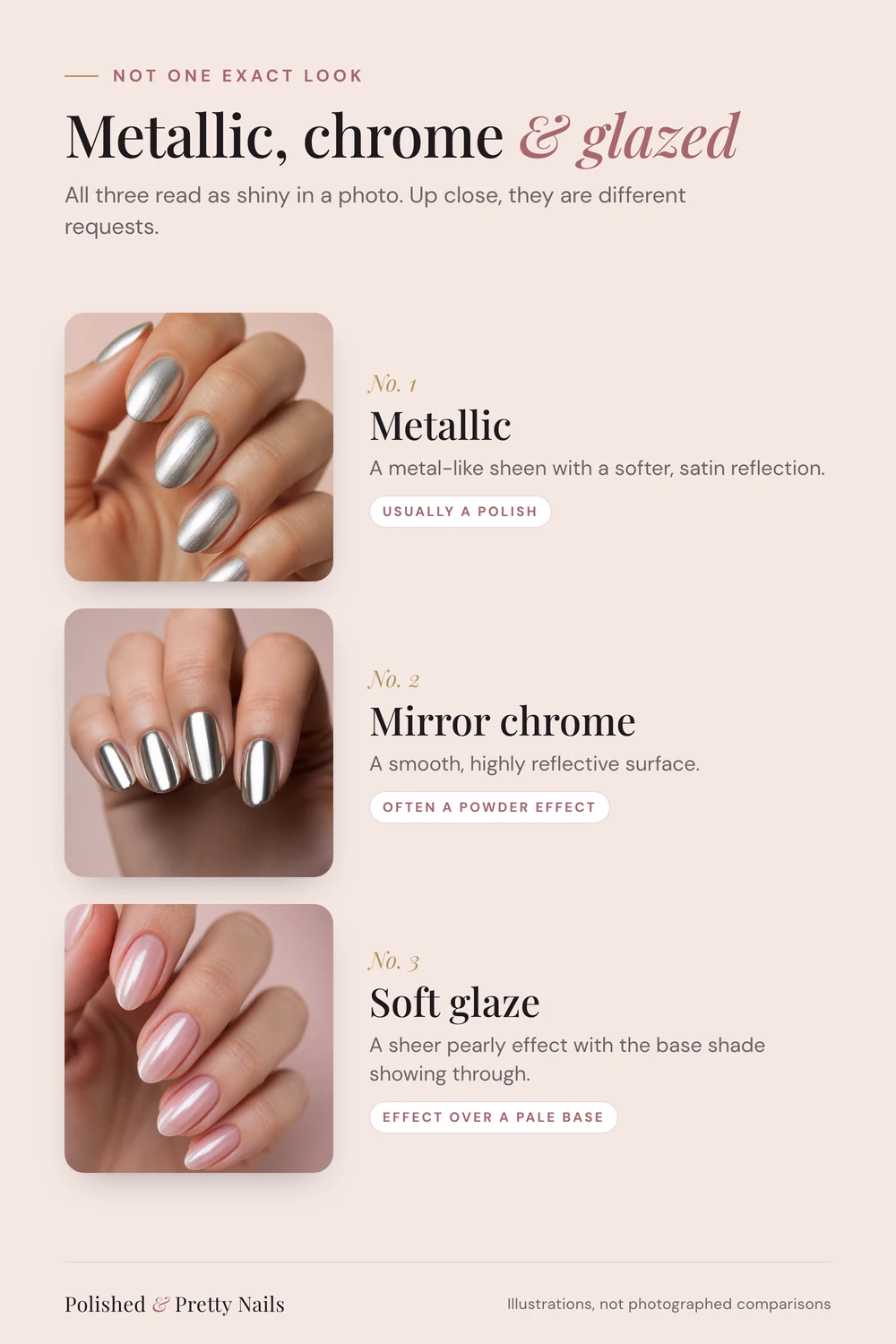
Chrome and metallic are not one exact look
A request for “chrome” still leaves several choices open. Specify whether you want a strong reflective surface or a softer glaze with the base shade showing through. OPI’s Tin Man Can Glaze, for example, is a silvery-white chrome powder. A powder effect and a bottle of metallic polish are different products, even if their photographs share a silver sheen.
Ask to see the complete combination: base shade, effect product and final finish. If you love a pale glazed reference, a swatch of the effect over black will not answer what it looks like over pink. Follow the relevant manufacturer’s application instructions, or have the effect applied by a nail professional familiar with that system.
Holographic, iridescent and multichrome: request more than one angle
A single image can hide the feature you are trying to choose. Ask for a short video or two photographs as the hand turns. Holo Taco explains that in a linear holographic topper, the tiny holographic pigments sit close enough together to form rainbows in the shape of a line. For a rainbow effect, look for the word holographic; for an angle-dependent color change, inspect the shifting colors rather than relying on the shade’s name.
Write down what matters to you in plain language: “I want visible rainbow sparkle” or “I want it to shift from one color to another.” A product can combine effects, so the finish labels on a bottle may describe several things at once. If you are choosing for an event, view the sample under lighting similar to the space where you will wear it, when possible.
Magnetic: cat-eye and velvet are different ways to show the effect
Magnetic polishes use particles that respond to a magnet. The resulting appearance depends on the product and how the effect is created. ILNP’s Moonlit description shows a defined beam and a velvet-style look, and identifies the polish as both magnetic and holographic. That is a useful example of overlapping categories.
For your booking, bring the exact version you want: a narrow diagonal line, a broader glow or another pattern. For home use, follow the instructions for your specific polish and magnet. The FDA advises reading nail product labels carefully and following any warnings, which applies to every finish on this chart. Do not copy lamp-curing steps from a gel tutorial onto an ordinary lacquer product; the finish name alone does not tell you the application system. If a product does need a lamp, the Skin Cancer Foundation recommends broad spectrum sunscreen on your hands 20 minutes before UV exposure.

Matte describes the surface, not the color
When you want less gloss, include that in the brief rather than changing only the shade. Ask to compare the intended color with a matte and glossy finish. Use the actual product combination where possible; a digital filter cannot reliably tell you what the finished manicure will look like. A cosmetic chemist explains how matte top coat removes shine for NAILS Magazine: a matting agent dries into a rough surface that no longer reflects light.
Matte and glossy sections can also be part of the same design. Describe the placement: “matte color with glossy tips” gives the artist a more useful instruction than simply “matte French.” Confirm whether the artist can produce that combination with the service you are booking.
Copy this finish description for your next appointment
“I would like [color] with [sheer / medium / opaque] coverage, so my natural nail line [does / does not] show. I want [finish], with [subtle / visible / statement] sparkle or reflection. The effect should cover [all nails / specified fingers / tips only]. The attached photo shows the finish I mean. Could I see a swatch and confirm which service would create it?”
Then add your shape, length and any existing product that needs removal. If you are combining reference photos, name the detail you want from each. Let your artist suggest a practical interpretation if the original product is unavailable.
How to make a polish swatch worth saving
A useful swatch includes enough information for you to repeat the result. Keep one simple record for each photographed look:
| Record | Why it is useful |
|---|---|
| Brand, line and shade | A color name alone may not identify the product. |
| Base color and other layers | The final effect may come from a combination. |
| Coat count | It helps explain the coverage shown. |
| Top coat or final finish | It records the glossy or matte result. |
| Lighting and angle | It helps you compare photos fairly. |
| Magnetic styling, if relevant | It identifies the version of the effect. |
| Photo date and creator credit | It keeps the image traceable and the maker credited. |
Use a plain background, keep the camera distance consistent and avoid filters that change color or smooth away detail. Take a whole-hand photograph as well as a close-up. For a shifting finish, add a second angle. These are simple editorial comparison guidelines, not a laboratory color standard.
Frequently asked questions
Does a finish tell me whether a polish is gel? No. Check the actual product and its instructions. Words such as shimmer or magnetic describe an appearance or effect, not one universal application system.
Can one polish belong to several categories? Yes. A product can combine transparent coverage, shimmer and another effect. Use the combination of terms that describes what you see.
Why does my polish look different from a photo? Check the layers, coat count, lighting and base color before assuming you have a different shade. Screens and image editing can also change how a color appears. A physical swatch is a better reference than a single product photograph.
What should I send a salon if I do not know the finish name? Send the image and describe the part you like: the rainbow sparkle, the glassy color, the moving line or the soft reflection. You do not need the perfect terminology to give a clear brief.