
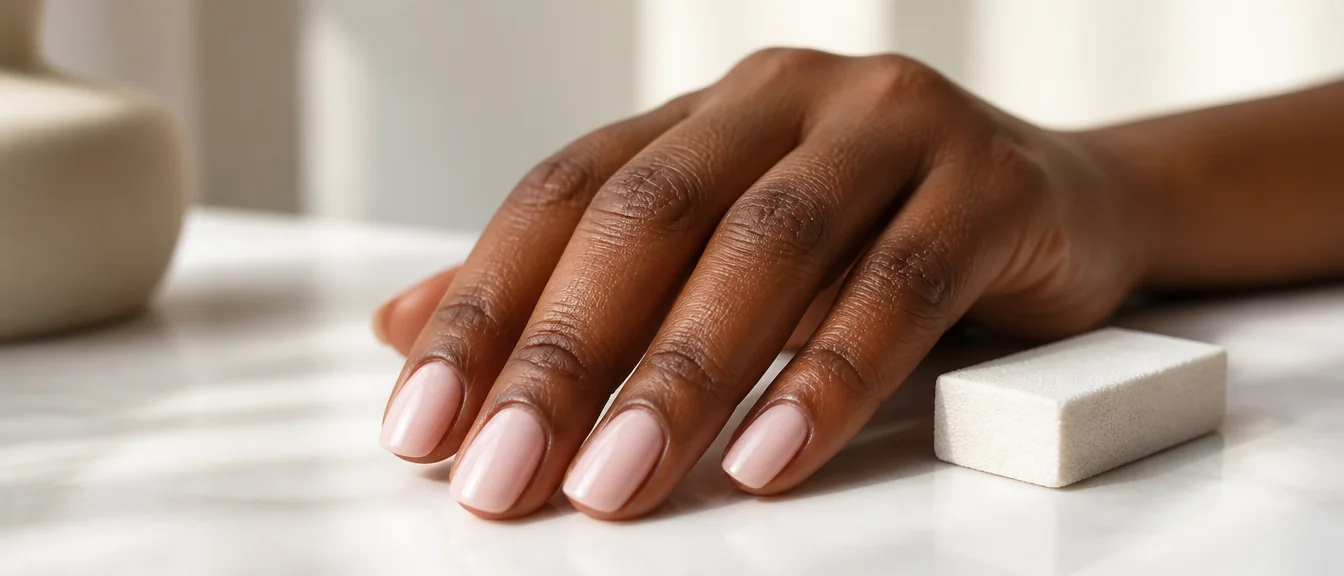
Gel nails peel off because the gel never properly bonded to your nail plate in the first place. Nine times out of ten that is a preparation problem rather than a bad product, and the giveaway is that the gel comes away in one flexible sheet rather than chipping into pieces.
Here are the six things that actually cause it, in the order they are most likely to be your problem, and what to change for each. If your gel is lifting at the edges instead of peeling off whole, that is a slightly different fault and our gel nails lifting post covers it.
- 1. Oil on the nail plate
- 2. The surface was never buffed
- 3. Gel touching your skin or cuticle
- 4. Coats applied too thick
- 5. The free edge was never capped
- 6. Your lamp is not curing properly
- How to tell which one is your problem
- If it peels off with layers of your nail attached
- What to ask a salon if it keeps happening
- FAQ
1. Oil on the nail plate

This is the single most common cause and it is almost always the answer when a whole set peels within a few days.
Your nail plate produces natural oil constantly. Gel bonds to keratin, not to oil, so any film left on the surface acts as a release layer. Hand cream applied that morning, cuticle oil from the day before, or simply the oil that resurfaces in the ten minutes between buffing and applying base coat is enough.
The fix is a proper dehydrate step immediately before base coat. Wipe every nail with 91% isopropyl alcohol or a dedicated nail dehydrator on a lint-free pad, and do not touch the nails afterwards. Not to check them, not to move hair out of your face. Then get base coat on within a minute or two.
If you have naturally oily nail plates, and some people genuinely do, wipe a second time halfway through doing the hand.
2. The surface was never buffed
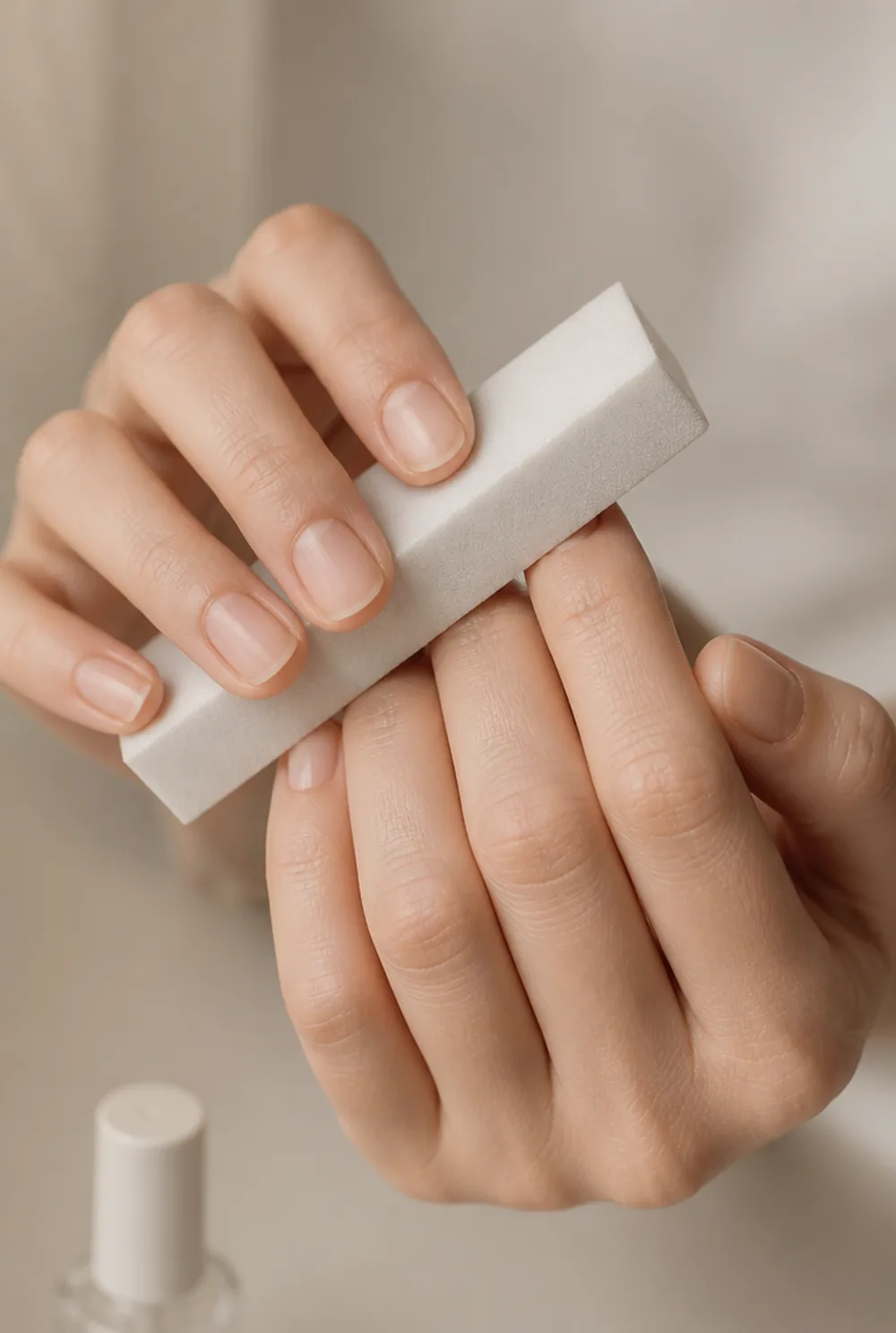
Gel needs texture to grip. A natural nail is shiny, and shiny means smooth, and smooth means nothing to hold on to.
A light pass with a 180 grit buffer over the whole nail until the shine is gone is all that is needed. You are not thinning the nail, you are dulling it. It should take about ten seconds per nail and the surface should look uniformly matte with no glossy patches left near the cuticle or the sidewalls.
Those missed glossy patches are worth checking for specifically. If your gel always peels starting from the same spot, look at whether that area is getting buffed at all.
Do not go further than removing the shine. Over-filing is what causes the thin, sore, bendy nails people blame on gel itself.
3. Gel touching your skin or cuticle
Any gel that touches the skin around the nail gives the whole coating a place to start peeling from.
Skin moves and sheds. Gel cannot bond to it, so the moment that skin flexes, the edge of the gel lifts away, and once air and water get underneath, the rest follows. This is why a set can look perfect for four days and then come off in one piece on the fifth.
Leave a visible hairline gap of bare nail all the way around, at the cuticle and down both sidewalls. It looks like a mistake and it is the correct technique. Push the cuticles back properly first so you have room to leave that gap. My cuticle pushing guide covers doing it without damage.
Clean up any overspill with a small brush dipped in alcohol before you cure. After curing it is too late.
4. Coats applied too thick
Thick gel does not cure properly, and gel that has not fully cured has no real strength.
UV and LED light can only penetrate so far. A thick layer cures hard on top while the gel underneath stays soft and rubbery, which means the layer touching your nail is the weakest part of the whole structure. It peels away as a unit because it was never properly solid.
Three thin coats will always outlast two thick ones. Each coat should be thin enough that you can still see the nail through it before curing. If gel is pooling anywhere or running toward the cuticle, there is too much on the brush.
Thick coats also shrink more as they cure, and that shrinkage pulls at the edges, which starts the lift.
5. The free edge was never capped
Capping means running the brush along the very tip of the nail so the gel wraps over the edge and seals it.
An uncapped free edge leaves a raw seam of gel facing forward into everything your hands do. Every time you type, open a can, or pull on a sock, that seam takes a knock, and it only takes one to start the peel.
Cap every layer, not just the top coat. Base, color, and top all get the same swipe along the tip. It adds about five seconds per nail and it is the difference between two weeks and five days.
6. Your lamp is not curing properly
This is the cause people reach for first and it is genuinely last on the list, but it does happen.
UV bulbs lose output long before they stop lighting up, so a lamp can look fine and still be undercuring. If yours has replaceable bulbs and is more than a year old with regular use, that is worth ruling out. LED lamps hold their output far longer and rarely fail this way.
The more common version of this problem is a mismatch. LED gel will not cure in a UV-only lamp, and some UV gels do not cure properly under LED. Check that your gel and lamp are compatible, and use a dual-wavelength lamp if you mix brands.
Hand position matters too. If your thumb sits at an angle in the lamp, part of the nail gets far less light than the rest. Cure thumbs separately and lay them flat.
How to tell which one is your problem
The way the gel comes off tells you a lot.
If it peels off as one whole flexible shell that keeps the shape of your nail, the bond failed at the base. That is oil, no buffing, or undercuring, in that order of likelihood.
If it lifts from the cuticle end first, you are getting gel on the skin or not leaving a gap.
If it chips or peels back from the tip, the free edge is not being capped, or your nails are long enough to flex.
If the peeled piece feels soft or bendy rather than hard, it never cured. Look at coat thickness and lamp first.
If it peels off with layers of your nail attached
This is a different and more serious problem, and it means the gel bonded fine and your nail plate gave way instead.
It happens when nails are already weak or have been over-filed, and it usually happens because someone picked the gel off rather than soaking it. Picking removes the top layers of nail along with the gel, which leaves a thinner, weaker plate for next time and a cycle that gets worse with every set.
The American Academy of Dermatology warns that picking or filing off gel nail polish can significantly damage your nails, so soaking it off is always the safer choice.
Stop wearing gel for a few weeks and let the damage grow out. Our brittle nails post covers the recovery, and our gel removal guide covers soaking it off properly so it does not happen again.
What to ask a salon if it keeps happening
If your gel peels within a week of a professional set, the prep is being rushed and it is reasonable to say so.
Ask whether they dehydrate the nail before base coat. A lot of walk-in salons skip it to save a minute per client and it is the step that matters most.
Ask them to cap the free edge, using that word. Technicians know exactly what it means.
Most salons will redo a set that has failed within a few days if you raise it promptly. Go back rather than living with it, and if it happens twice, the problem is the salon rather than your nails. My manicure longevity post covers what you can control at home.
FAQ
Why do my gel nails peel off after a day?
Peeling within 24 hours is almost always oil or moisture on the nail plate at the moment the base coat went on. Wipe every nail with 91% isopropyl alcohol immediately before base coat and do not touch them afterwards. The second most likely cause is that the surface was never buffed to remove the shine.
Is it bad to peel gel nails off?
Yes, and it is the most damaging thing you can do to a nail. Cured gel is bonded to the top layer of your nail plate, so peeling it off takes that layer with it. Repeat that every few weeks and nails get progressively thinner, weaker, and more prone to peeling on their own. Always soak gel off with acetone.
Does gel peel off more on some nails than others?
Thumbs and index fingers usually fail first, because they take the most contact and because thumbs often sit at a bad angle in the lamp and undercure. Cure thumbs separately, laid flat, and cap the free edge on every layer.
How long should gel nails last before peeling?
Two to three weeks is normal, and most sets need replacing because of grow-out rather than failure. Anything under a week points to a prep problem rather than a product one. My how long gel nails last post covers the full timeline.
If you only change one thing, make it the alcohol wipe immediately before base coat. My short gel nails post covers the rest of the at-home routine.