
The short answer
The “toxic trio” is toluene, formaldehyde and dibutyl phthalate (DBP), three nail polish ingredients flagged over health concerns.1,2 A “3-free” label means the brand says it left all three out. 5-free, 10-free and higher numbers add more exclusions, but each brand writes its own list, and no standard definition stands behind the numbers.1,3
The labels are not verified by anyone before they reach the shelf, and California lab tests have twice found “free” claims that did not hold up.2,3,4
Last checked October 202621 sources citedPrintable checklist included
This guide explains what each chemical does in the bottle and why it was flagged, decodes the 3-free to 21-free ladder, and lays out what the U.S., California and the EU actually require. It also separates two very different situations: a client getting a manicure every few weeks, and a nail technician breathing solvent vapors every shift. Every factual claim links to its source: government agencies, the law itself, peer-reviewed studies and, in one case, a brand’s own label definition.
We keep this page calm on purpose: nothing here is a reason to panic about a bottle of polish, and plenty of it is a reason to read labels more closely. If you work in a salon, our nail salon safety guide covers ventilation, gloves and masks in depth.
What is the toxic trio?
OSHA says toluene, formaldehyde and dibutyl phthalate are sometimes called the toxic trio in the nail industry,1 and California’s toxics agency describes the name as a term coined by non-government organizations.2 By 2006, U.S. companies had started labeling polish “3-Free” to show they had dropped all three.3 Each one does a real job in the formula, which is why removing it means replacing it with something else.
- Its job in the bottle
- A solvent that keeps polish smooth and spreadable; also used in some hardeners and removers.6
- Why it was flagged
- It can affect the nervous system. Low to moderate levels can cause headaches, dizziness, tiredness and nausea, and these usually fade once exposure stops.7 OSHA also lists skin dryness and harm to unborn children for salon workers.1
- Its job in the bottle
- A nail hardener: it bonds with the keratin in your nails to make them harder.6 May be listed as formalin or methylene glycol.6
- Why it was flagged
- IARC and the U.S. National Toxicology Program classify it as a human carcinogen, and breathing it in is the main way people are exposed.9,10 Frequent use of hardeners can make nails brittle, and it can cause irritation and allergic reactions.6
- Its job in the bottle
- A plasticizer, used at under 10% to keep polish flexible so it doesn’t crack.6
- Why it was flagged
- California lists it as a developmental toxin.2 The federal toxic substances agency notes no harmful effects have been found in people; very high oral doses affected reproduction and development in lab animals.12
One more name matters for label readers. Tosylamide/formaldehyde resin, often shortened to TSFR, is not a hardener; it forms the tough, glossy film that helps polish grip the nail.6 The FDA groups it with formaldehyde-related ingredients for anyone avoiding formaldehyde,6 and dermatologists name it the main allergen behind nail polish contact dermatitis.13 That is why it is usually the fourth or fifth item on a “free” list.3 Short definitions of all these terms live in our nail glossary.
If formaldehyde hardeners have left your nails snapping, our guide to brittle nails explains what actually helps.
3-free to 21-free: what each label usually leaves out
Here is the part most labels skip: the number only counts what the brand chose to list. In the first comprehensive study of these labels, researchers collected label definitions from nail polish brands and found labels running from 3-free to 13-free, with no standard for which chemicals each number excludes.3 5-free was the most common label, followed by 10-free.3 The chart shows the most common definition at each step, based on that survey.
Swipe the chart sideways →
| Label | Toluene | Formaldehyde | DBP | Camphor | TSFR resin | Xylene | Parabens | TPHP | Ethyl tosylamide | What to know |
|---|---|---|---|---|---|---|---|---|---|---|
| 3-freethe original | The toxic trio only. One brand in the survey swapped DBP for all phthalates.1,3 | |||||||||
| 5-freemost common label | 15 of 17 brands used this exact list. Every label at 5-free or above dropped camphor.3 | |||||||||
| 7-free3 definitions | Usually adds xylene and parabens; some brands drop TPHP instead of parabens.3 | |||||||||
| 9-freeno shared list | The two 9-free brands surveyed had different lists, adding items like acetone or an epoxy resin.3 | |||||||||
| 10-free6 definitions | All dropped the first seven here; the last three varied. TPHP was excluded in only four of the six versions.3 | |||||||||
| Up to 21‑free12-free and higher, brand-defined | Higher numbers mix chemicals with things that are not hazards at all. Some 10-free lists already counted gluten, soy or animal-derived ingredients,3 and one brand’s 21-free list counts “animal derivatives” as one of its 21.14 Read the brand’s actual list before comparing numbers. | |||||||||
The toxic trio only. One brand in the survey swapped DBP for all phthalates.1,3
15 of 17 brands used this exact list. Every label at 5-free or above dropped camphor.3
Usually adds xylene and parabens; some brands drop TPHP instead of parabens.3
The two 9-free brands surveyed had different lists, adding items like acetone or an epoxy resin.3
All dropped the first seven here; the last three varied. TPHP was excluded in only four of the six versions.3
Some 10-free lists already counted gluten, soy or animal-derived ingredients,3 and one brand’s 21-free list counts “animal derivatives” as one of its 21.14 Read the brand’s actual list before comparing numbers.
Toxic trioAlso excludedSome brands only
Most common definition at each step. Source: Young et al. 2018, Figure 1 and text.3
Two patterns jump out. The trio is in every tier, so a 10-free polish is also 3-free by its own definition. And the extra exclusions are a moving target: camphor and TSFR arrive at 5-free, while TPHP and ethyl tosylamide start appearing around 6-free and 8-free.3
Bigger number, safer polish?
Not necessarily. The same researchers found that the number of exclusions “does not always translate to the degree of reduced toxicity,” that brands define the same label differently, and that exclusions are usually not checked by any third party.3 Some definitions were not even printed on the product and had to be requested from customer service.3
Do “free” labels hold up? What California’s lab tests found
In May 2011, California’s Department of Toxic Substances Control (DTSC) bought 25 nail products from six distributors that supply salons. Twelve claimed to be free of at least one toxic trio chemical, and seven claimed to be free of all three.2 This is the study behind OSHA’s warning that some “free” products tested positive for the very chemicals they claimed to leave out, and its numbers are worth knowing exactly.1
Claimed “three-free”
5 of 7 claims could not be substantiated
Five contained high levels of DBP, toluene or both. One “three-free” product held 8.2% DBP.2
Claimed “toluene-free”
10 of 12 contained toluene
Toluene showed up more often, and at higher levels, in products making trio claims than in products making none.2
Formaldehyde is the gap in that study. The lab method was not sensitive enough to measure it in diluted samples, and the report says plainly that the results are not evidence the products were formaldehyde-free.2 DTSC’s main recommendation was simple: manufacturers should disclose their formulas.2
The 2023 follow-up: better, not fixed
DTSC’s Safer Consumer Products program ran a much larger study, testing 156 nail products bought online and in stores, and published it in October 2023.4 There is real progress in it. DTSC retested four products from 2012; none of the four contained toluene this time, and none contained DBP in either study.4 Retailers that had promised to have manufacturers restrict chemicals such as formaldehyde and toluene had, in general, kept that promise.4
The headline finding was still the same: labels and marketing claims continue to be inaccurate.4 Some examples from the report:
“Toluene-free” gels
Three products with toluene detected were marketed as non-toxic or toluene-free, including two UV gel polishes.4
“MMA-free” acrylic liquid
Two acrylic liquid monomers labeled MMA-free had high MMA concentrations.4
“Safe for kids”
Products marketed to children, or as safe for children and pregnant women, contained chemicals on California’s Candidate Chemicals list.4
Traces vs. recipes
Toluene and MMA turned up both at trace levels that look like contamination and at levels that suggest they were added on purpose.4
“Free” claims now show up on gels and acrylic liquids, not just polish. If you are choosing between them, our gel vs dip vs acrylic comparison covers wear and removal, and the MMA section of our salon safety guide explains why MMA liquid is restricted. Acrylic and gel monomers carry their own allergy issue: the FDA advises keeping methacrylate monomers off the skin to lower the chance of an allergic reaction,6 which is one reason the tacky layer on gel should never be smeared around the cuticle (more on that in why gel nails feel sticky after curing).
What a “free” label doesn’t tell you
A free-of claim tells you what a brand says it removed. It says nothing about what went in instead. When DBP left the formula, something still had to keep the film flexible, and California’s 2012 tests showed what that often was: triphenyl phosphate (TPHP, CAS 115-86-6) was the most common plasticizer in products without DBP.2,15
TPHP is the example researchers point to when they talk about regrettable substitution, where a flagged chemical is replaced by one later found to raise its own concerns.3 The 2018 label study describes TPHP as an endocrine-disrupting plasticizer that sometimes replaced DBP, and also identified another phthalate, DEHP, as a substitute in some polishes.3 The encouraging part: polishes labeled 5-free and higher had much lower TPHP levels than unlabeled or 3-free polishes.3
The study that measured it
In a 2016 study, TPHP turned up in eight of ten polishes, at up to 1.68% by weight, including two that did not list it. After volunteers painted their nails, a TPHP breakdown product in their urine rose nearly sevenfold within 10 to 14 hours. Levels were much lower when they painted fake nails while wearing gloves, which points to skin contact as the main route.16
That last detail is a practical one: polish on the nail plate is not the same as polish flooded onto the skin around it. Our guide to painting nails without getting polish on your skin is useful for more than neat edges.
Four other things a free label can’t tell you:
- Whether the claim was checked. Claims like 3-free or nontoxic do not need approval from the FDA or the Federal Trade Commission before they appear on a bottle.3
- Whether the ingredient list is complete. In California’s 2023 tests, TPHP and ethyl tosylamide were found more often in products that did not list them than in products that did.4
- What is in salon-only products. The ingredient-list rule covers retail cosmetics. Products used only in salons don’t need one unless they are also sold at retail.6
- Whether “non-toxic” means anything. DTSC found Candidate Chemicals in products marketed as non-toxic and safe for pregnancy.4
EU vs US: how the trio is regulated
You will often read that the EU “banned” the toxic trio and the U.S. did nothing. The real picture is more specific than that, and toluene is the surprise in both places.
Swipe the table sideways →
| Chemical | European UnionCosmetics Regulation 1223/2009 | United StatesFDA, federal | CaliforniaHealth & Safety Code 108980 |
|---|---|---|---|
| Toluene | Restricted Annex III: up to 25% in nail products, labeled “keep out of reach of children” and for adults only.5 | No specific rule The industry-sponsored Cosmetic Ingredient Review found it safe in nail products up to 50%; the FDA says its use is being phased out.6,17 | Not banned Not on the cosmetics ban list; DTSC proposed nail products with toluene as a Priority Product in 2019.4,8 |
| Formaldehyde | Prohibited Allowed in nail hardeners up to 5% until Regulation 2019/831 moved it to the prohibited list.11 | No specific rule Not on the FDA’s list of prohibited or restricted cosmetic ingredients.18 | Banned since Jan 1, 2025 Intentionally added formaldehyde, paraformaldehyde and methylene glycol.8 |
| DBP | Prohibited Listed in Annex II, the list of substances prohibited in cosmetics.5 | No specific rule The FDA said it saw no sound scientific basis for action against phthalates in cosmetics.17 | Banned since Jan 1, 2025 Intentionally added DBP; unavoidable traces are allowed.8 |
The U.S. position, precisely
Nail polish is regulated as a cosmetic under the Federal Food, Drug, and Cosmetic Act.6 Cosmetics and their ingredients don’t need FDA approval before sale, apart from most color additives,6 but by law they must be safe when used as directed. The FDA says many nail products contain potentially harmful ingredients and are allowed because they are safe as directed.6 So the accurate statement is that no FDA regulation specifically bans any of the three, not that the FDA has “approved” them, and certainly not that it has banned them.18
The Modernization of Cosmetics Regulation Act of 2022 (MoCRA) changed the system around the products rather than the ingredient list.19 Companies must now report serious adverse events to the FDA within 15 business days, list each product and its ingredients with the FDA, and keep records showing their products are adequately substantiated as safe.19 The FDA also gained the power to order a mandatory recall in serious cases.19
The EU position, precisely
The EU classified formaldehyde as a category 1B carcinogenic, mutagenic or reprotoxic (CMR) substance from 2016.11 Its scientific committee had judged hardeners with about 2.2% free formaldehyde safe for nails, but because no one had shown there were no suitable alternatives, the EU removed formaldehyde from the restricted list in 2019 and added it to the prohibited list.11 Toluene remains permitted in nail products up to 25%.5
How the rules changed
- 2004The EU bans DBP in cosmetics.3
- 2006U.S. brands begin voluntary “3-Free” labels.3
- 2010An FDA survey finds DBP in only a few nail polishes.6
- 2012California’s DTSC reports that 5 of 7 “three-free” claims could not be substantiated.2
- 2016The EU’s CMR 1B classification of formaldehyde takes effect.11
- 2018A label study finds 3-free to 13-free labels and six definitions of 10-free.3
- 2019The EU prohibits formaldehyde in cosmetics; DTSC proposes nail products with toluene as a Priority Product.4,11
- 2022MoCRA brings adverse event reporting, product listing and recall power to U.S. cosmetics.19
- 2023DTSC tests 156 products and finds claims still inaccurate.4
- 2025California bans intentionally added DBP and formaldehyde in cosmetics.8
Who is really exposed: salon workers vs. clients
Most toxic trio coverage blurs two very different people together. The client and the technician are in the same room, but their exposure is not in the same league.
Nail technicians
All shift, every day
Many products, many hours
- Exposure comes from breathing vapors and dusts, skin and eye contact, and hand-to-mouth transfer.1
- OSHA says exposures “add up” when many products are open at once, day after day, with poor ventilation.1
- A California study put air monitors on 80 workers in 20 salons; toluene and total VOC levels were above guidelines meant to prevent headaches and breathing problems.20
- In a Colorado study, 70% of surveyed workers reported at least one work-related health issue, and one salon’s formaldehyde level was over the NIOSH limit.21
Clients
One appointment at a time
Brief, occasional
- The nail plate is a barrier: the FDA notes some ingredients are harmful if swallowed but not when used on the nails.6
- Polish on the surrounding skin is different; TPHP studies show skin is the main way it gets in.16
- The FDA’s advice for home use: good ventilation, and keep products away from flames and heat.6
- Removal counts too: toluene has been used in some polish removers, so ventilate during soak-offs as well.6,7
- If you have a reaction, stop using the product and report it to the FDA.6
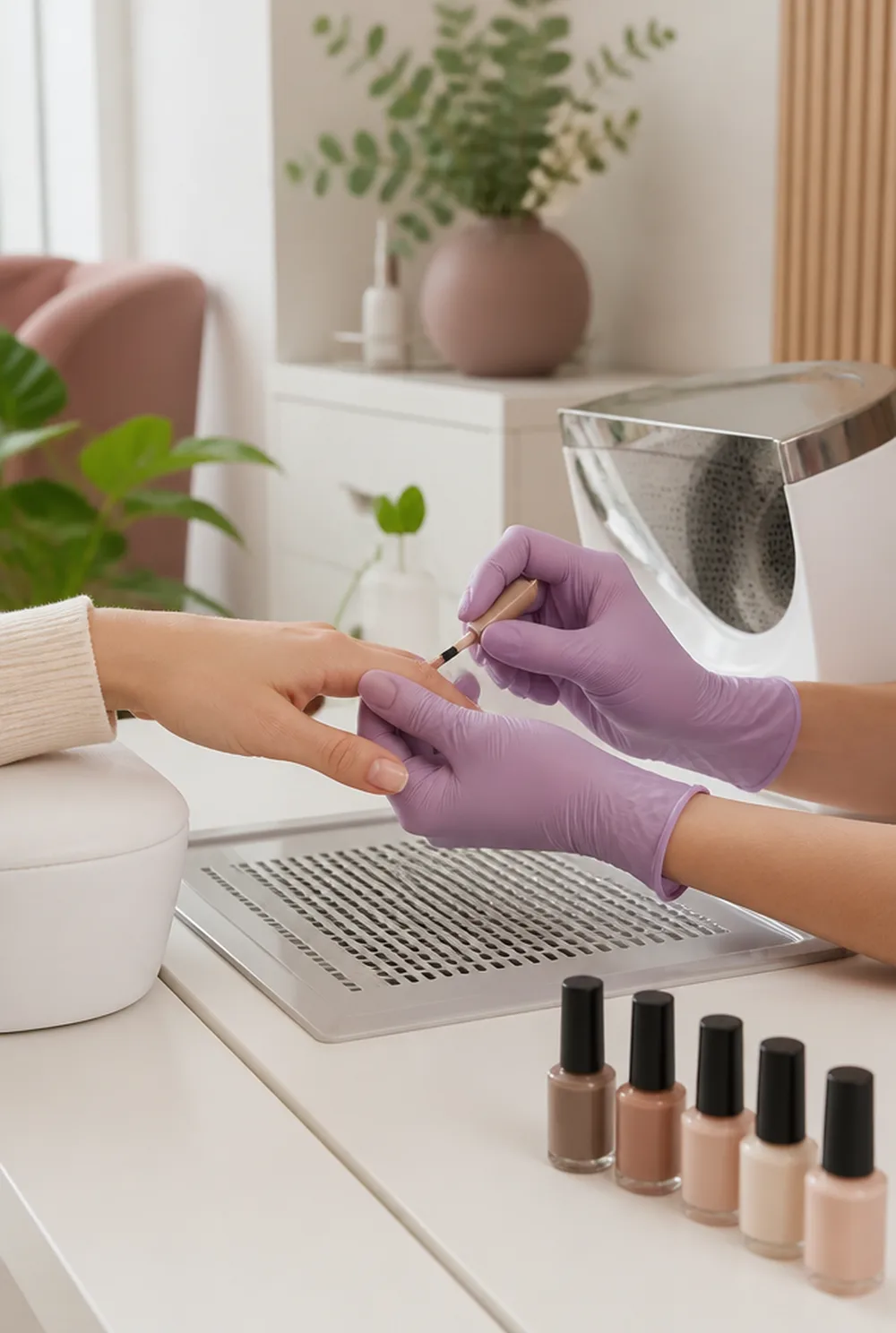
For nail technicians
What lowers your exposure
OSHA calls ventilation the best way to lower chemical levels in a salon; NIOSH lab tests suggest exhaust ventilation can cut a worker’s exposure by at least half.1
Nitrile gloves protect against many salon chemicals; latex or vinyl are the right call for acetone.1
Read the label and safety data sheet even for products labeled “free,” because an SDS may not tell you everything you need to protect yourself.1
The full playbook is in our nail salon safety guide.
In 2012, DTSC put California’s nail salon workforce at about 121,000,2 and the 2016 TPHP study flagged polish as a possible source of chronic exposure for frequent users and people exposed at work.16 If you are training to become a technician, the license requirements for your state include the safety and sanitation hours you’ll need. At home, our guide to removing gel nails at home walks through the soak-off.
Pregnant? OSHA lists harm to unborn children among toluene’s effects for salon workers,1 while the federal toxic substances agency ties developmental effects to high exposures, such as those seen with solvent abuse.7 That gap between a workday of vapors and an occasional manicure is exactly the worker vs. client difference above; talk it through with your own doctor or midwife.
How to read a nail polish label: a printable checklist
Use this at the drugstore, the beauty supply counter or the salon. It fits on one page: the print button prints the card alone, or download the PDF to share with a class or post at the front desk.
Printable label check
Reading a nail polish label in 10 steps
Polished & Pretty Nails
polishedandprettynails.com/toxic-trio-nail-polish/
Checked October 2026
- Find the ingredient list.Retail polish must have one. For salon-only products, ask for the safety data sheet.1,6
- Scan for the trio by name.Toluene, formaldehyde, dibutyl phthalate (DBP). CAS numbers: 108-88-3, 50-00-0, 84-74-2.5
- Know formaldehyde’s other names.Formalin, methylene glycol, and the resin tosylamide/formaldehyde resin (TSFR).6
- Look up what the number means.Find the brand’s own list of what its 5-free or 10-free excludes. Definitions differ.3
- Check for the usual substitute.If you are avoiding plasticizers, look for triphenyl phosphate (TPHP).2,3
- Read the warnings.Labels must carry a warning when one is needed to prevent a hazard.6
- Treat “non-toxic” as marketing.Claims like 3-free and nontoxic need no approval before sale.3
- Hardener habits.Frequent formaldehyde hardener use can leave nails brittle.6
- Open a window.Use polish and remover with good ventilation, away from flames.6,7
- Report reactions.Stop using a product that causes a rash or other reaction, and report it to the FDA.6
Frequently asked questions
What are the toxic trio chemicals in nail polish? Toluene, formaldehyde and dibutyl phthalate (DBP). Toluene is a solvent, formaldehyde hardens nails, and DBP is a plasticizer that keeps polish from cracking.1,6
What does 10-free nail polish mean? It means the brand says the polish leaves out 10 ingredients, but brands define the list differently. A 2018 survey found six different 10-free definitions; all dropped toluene, formaldehyde, DBP, camphor, TSFR, parabens and xylene, and the last three varied.3
Is 3-free nail polish safe? A 3-free label is not a safety rating. It only means the brand says it left out toluene, formaldehyde and DBP, and California's 2012 tests found five of seven three-free claims could not be substantiated.1,2
Are the toxic trio chemicals banned in the US? Not federally. No FDA regulation specifically prohibits them. California has banned intentionally added DBP and formaldehyde in cosmetics since January 1, 2025, while toluene is not on that list.8,18
Is formaldehyde resin the same as formaldehyde? No. Tosylamide/formaldehyde resin (TSFR) forms the tough, glossy film in polish rather than hardening the nail, but the FDA lists it among formaldehyde-related ingredients, and it is the main allergen behind nail polish contact dermatitis.6,13
Why do some labels exclude TPHP? Triphenyl phosphate became a common replacement for DBP. Researchers describe it as an endocrine-disrupting plasticizer, and a 2016 study found it is absorbed after painting nails, mainly through the skin.2,3,16
Sources
Every claim above links to one of these sources: government agencies, laws, peer-reviewed studies and one brand label definition used as an example. We checked each one on October 5, 2026. If a link has moved or a rule has changed, email hello@polishedandprettynails.com and we’ll update this page.
- OSHA, Nail Salons: Chemical Hazards
- California DTSC, Summary of Data and Findings from Testing of a Limited Number of Nail Products (April 2012)
- Young et al., Environ Sci Technol 2018: Phthalate and Organophosphate Plasticizers in Nail Polish: Evaluation of Labels and Ingredients
- California DTSC Safer Consumer Products, Laboratory Study of Chemicals in Nail Products (October 2023)
- EU Cosmetics Regulation (EC) No 1223/2009, consolidated text of 1 May 2026
- FDA, Nail Care Products
- ATSDR, Toluene ToxFAQs (PDF)
- California Health and Safety Code section 108980 (Cosmetic Safety)
- ATSDR, Formaldehyde ToxFAQs (PDF)
- National Cancer Institute, Formaldehyde and Cancer Risk
- Commission Regulation (EU) 2019/831 (formaldehyde moved to Annex II)
- ATSDR, Di-n-butyl Phthalate ToxFAQs (PDF)
- Lazzarini et al., An Bras Dermatol 2017: allergy to hypoallergenic nail polish
- Example brand definition of a 21-Free label (butter LONDON product page)
- PubChem, Triphenyl phosphate (CID 8289)
- Mendelsohn et al., Environ Int 2016: Nail polish as a source of exposure to triphenyl phosphate
- FDA, Phthalates in Cosmetics
- FDA, Prohibited and Restricted Ingredients in Cosmetics
- FDA, Modernization of Cosmetics Regulation Act of 2022 (MoCRA)
- Quach et al., Am J Public Health 2011: workplace exposures in California nail salons
- Lamplugh et al., Environ Pollut 2019: VOC exposure in Colorado nail salons
Looking for an older toxic trio handout? Several widely linked resources have moved or gone offline, including the older web versions of the ATSDR ToxFAQs. The ATSDR fact sheets for toluene, formaldehyde and DBP are still available as PDFs (sources above), and this page brings the label, lab-test and regulatory picture up to date for 2026.7,9,12
This guide is general information, not medical or legal advice. For a health concern, talk to a doctor; for the rules that apply to your salon, check with your state board and OSHA.