

Gel nails last two to three weeks. What ends a set is almost never the gel failing, it is grow-out, and by day 16 or so there is a visible band of bare nail at the cuticle that no amount of good application prevents.
Here is the honest week-by-week timeline, what shortens it, why toes last twice as long as fingers, and how to get to the full three weeks rather than the ten days a lot of people actually see. If yours is failing early, our gel peeling post covers why.
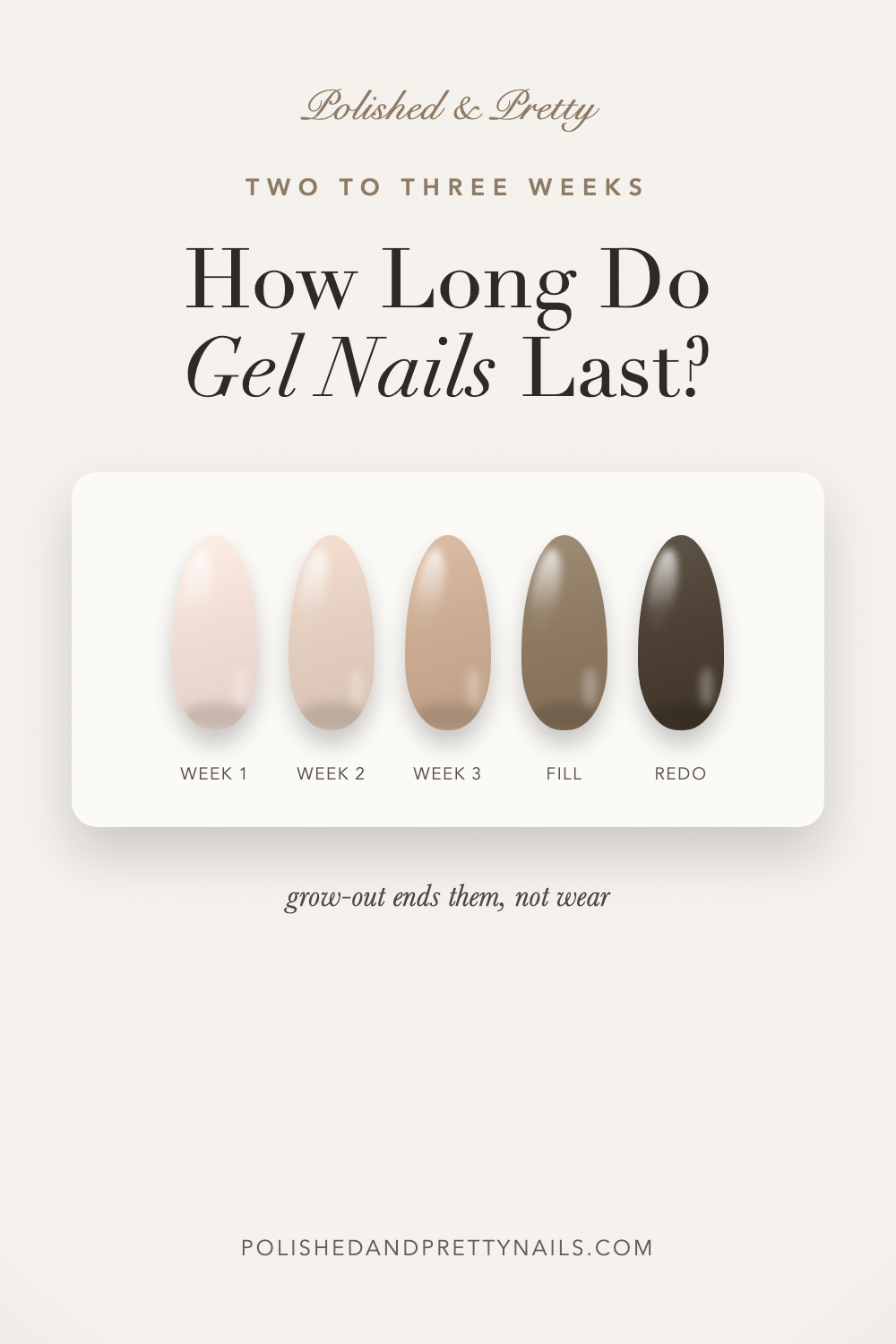
The week-by-week timeline

A well-applied set on natural nails follows a fairly predictable path.
Week one looks exactly as it did leaving the salon. The gloss is intact, the color is even, and there is no visible grow-out because nails only advance about 0.1mm a day. Nothing should go wrong in this period, and anything that does is an application fault rather than wear.
Week two is where grow-out becomes noticeable, roughly 1mm of bare nail at the cuticle. On a nude or milky shade this is nearly invisible. On a dark red or a black it is obvious from across a room, which is the single biggest factor in how long a set looks good rather than how long it survives.
Week three is the practical end. Grow-out is around 2mm, the free edge has thinned from wear, and the whole nail is more likely to catch on things because the gel now extends past where it is properly supported.
Past three weeks the risk shifts from cosmetic to structural. A long grow-out means more leverage on the bond, and that is when nails start lifting and trapping moisture.
Why color changes how long it lasts
This is the easiest way to buy yourself an extra week and almost nobody thinks about it at the point of choosing.
Grow-out is a strip of bare nail against a strip of color. The more those two contrast, the earlier you see it. A sheer pink, a milky white, or a warm nude sits close enough to your natural nail bed that the line is genuinely hard to spot at two weeks.
Black, navy, deep red, and bright neons show the line from about day nine. The set is not failing any faster, it just looks like it is.
If you want three weeks out of one appointment, book a nude. My nude nail designs post covers finding the shade that matches your hands.
Designs that hide grow-out

Some designs are built so that grow-out barely registers, and they are worth knowing if you stretch your appointments.
Anything that puts interest at the tip and leaves the base pale works. A French, a chrome tip, or a glitter fade all draw the eye to the free edge, and the cuticle end is already close to your natural color.
Ombre is the best of all, because there is no hard line anywhere on the nail for the eye to compare grow-out against. My ombre nails post covers it.
The worst is a solid dark color with a crisp cuticle line, which is exactly the design that looks sharpest on day one.
What shortens a set
Some of this is habit and some of it is genuinely out of your hands.
Water is the main one. The nail plate absorbs water and expands slightly, the gel does not, and repeated cycles of that stress the bond. Washing up without gloves, long baths, and swimming all take days off a set.
Using nails as tools is the second. Opening cans, scraping labels, and prying lids puts force directly on the free edge, which is where lifting starts.
Length matters more than people expect. A long nail is a lever, and every knock at the tip multiplies into force at the bond. Short sets routinely last a week longer than long ones on the same hands. My short gel nails post covers that.
Fast nail growth shortens the cosmetic life rather than the structural one. Nails grow faster in summer, during pregnancy, and in your twenties.
Why gel lasts longer on toes
A gel pedicure routinely lasts five or six weeks, which is roughly double.
Toenails grow at about a third to a half the rate of fingernails, so grow-out takes far longer to become visible. That alone accounts for most of the difference.
A study in the Journal of the European Academy of Dermatology and Venereology measured fingernails growing about 3.5mm a month and toenails about 1.6mm a month, less than half as fast.
Toes also do almost nothing. They are not typing, washing up, opening packaging, or getting knocked against doorframes, and they spend most of the day inside a shoe rather than in water.
This is why chrome and other delicate finishes hold up so much better on a pedicure. My toe nail designs post covers what to put on them.
Gel on extensions versus natural nails
The numbers change if there is product underneath the color.
Gel polish on natural nails is two to three weeks and then it comes off. Gel extensions, builder gel overlays, and acrylic are three to four weeks and then they get infilled rather than removed, because the structure underneath is still sound.
An infill is cheaper than a full set and takes less time, which is why extension wearers often end up spending less per month than people getting fresh gel polish every fortnight.
The trade-off is that infills eventually need a full rebalance, usually every third or fourth visit. My gel vs dip vs acrylic post compares the systems.
How to get the full three weeks
Assuming the set was applied properly, the rest is small habits.
Wear rubber gloves for washing up and cleaning. This is the single highest-impact thing on the list and most people will not do it, which is fine, but it is worth knowing that is the trade.
Oil your cuticles daily. Flexible, healthy skin around the nail tugs less at the gel edge, and oil does not damage cured gel despite the fact that it prevents bonding during application.
Keep them short, and if a nail does start lifting, deal with it rather than leaving it. My gel lifting post covers patching one properly.
What that works out to per week
Thinking in cost per week rather than cost per appointment changes which option looks expensive.
A gel manicure at roughly $40 to $60 lasting three weeks is about $15 to $20 a week. The same set stretched to only ten days because you picked a black and washed up without gloves is closer to $30 a week for an identical service.
An at-home kit changes the math again. A lamp, base, top, and a few colors runs $60 to $100 once, after which each set costs pennies. It pays for itself in two salon visits, and the trade is that your own application will not match a good technician for the first several attempts.
Press-ons sit in between at a few dollars a set for a week of wear, with no lamp and no removal. My press-on nails post covers where they genuinely compete.
When to take a break
Gel is much kinder to nails when it is applied and removed correctly, though dermatologists say it can still leave them brittle, and it damages them badly when it is not.
The American Academy of Dermatology notes that gel manicures can cause nail brittleness, peeling and cracking, and suggests going one to two weeks without polish between sets so nails have time to repair.
Back-to-back sets go better when the prep is a light buff rather than aggressive filing and removal is a proper acetone soak rather than picking or scraping, and a week or two off between sets now and then is worth it. Take that break sooner if your nails turn thin, peel or feel sore.
Take a break if your nails feel thin or bendy, if the surface is pitted or rough after removal, or if you have picked a set off. Two or three months bare lets the damage grow out. My brittle nails post covers the recovery.
FAQ
How long do gel nails last on natural nails?
Two to three weeks. Grow-out rather than wear is what ends the set, since nails advance about 0.1mm a day and a visible band appears at the cuticle by around week two. A well-applied set should not chip or lift before then.
How long do gel nails last on toes?
Five to six weeks, roughly double a manicure. Toenails grow at a third to a half the rate of fingernails, so grow-out takes much longer to show, and toes take far less physical contact and spend less time in water.
Can gel nails last a month?
Structurally sometimes, cosmetically rarely, and it is not a good idea. By four weeks grow-out is around 3mm, which puts significant leverage on the bond and makes lifting likely. Lifted gel traps moisture against the nail, which causes staining and bacterial growth.
Why do my gel nails only last a week?
That is a preparation problem rather than normal wear. The usual causes are oil left on the nail plate before base coat, a surface that was never buffed, gel touching the skin, or the free edge not being capped. Any set failing inside a week is a fault worth raising with your salon.
Book a nude rather than a black if you want the full three weeks out of one appointment. My manicure longevity post covers the rest.