Stiletto nails are the most dramatic shape there is and the one I’m most careful about recommending. They look extraordinary in photographs and they break more than anything else, cost more to maintain, and change how you use your hands for the first week. None of that is a reason not to get them. It’s a reason to know what you’re signing up for.
Here are 22 stiletto nail designs at long and short lengths, plus how the shape is filed, why it breaks where it does, what it actually costs, and who it suits. If you want the shape one step softer, my almond nail designs guide covers the version most people are happier with.
22 stiletto nail designs
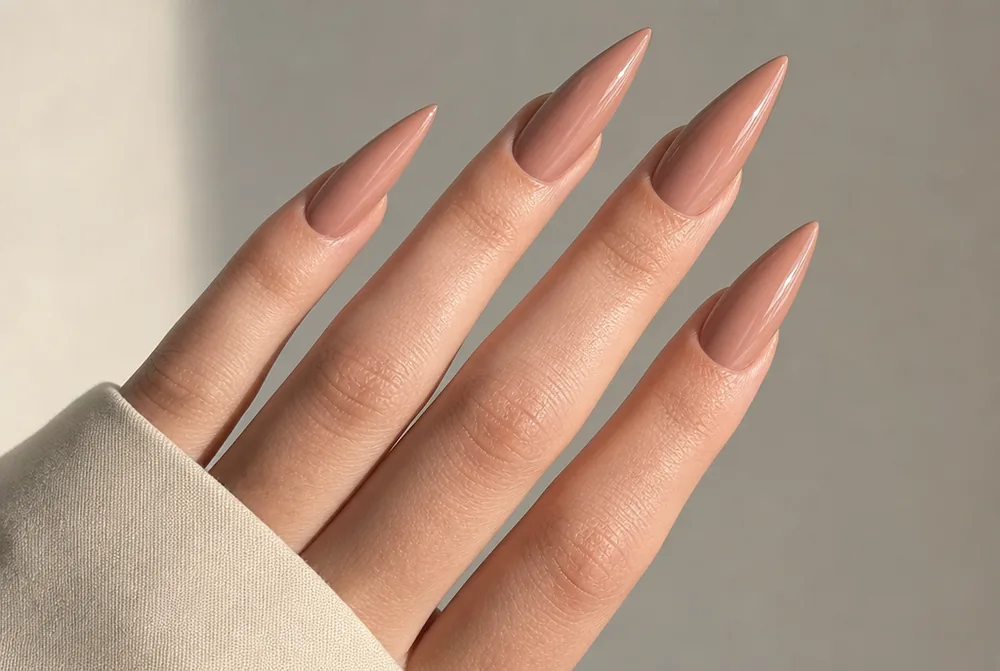
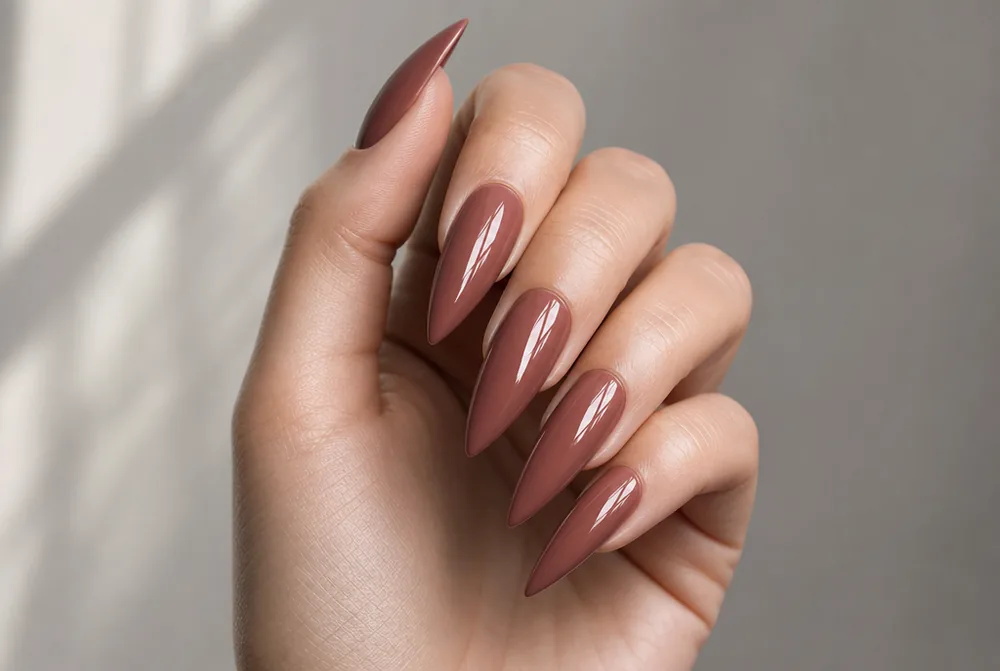
1. Long Nude Stiletto
Long stiletto in a nude matched to your skin, which is the most-photographed version of the shape. The matched colour is what stops it reading as a claw. My nude nail designs guide covers matching.
2. Short Stiletto
The point kept short, so you get the taper without the fragility. It’s genuinely underrated and it’s how I’d suggest anyone try the shape first. Far less likely to snap.
3. Black Stiletto
Glossy black on a long point, which is the most iconic and the most costume-adjacent thing here. It works when the length is moderate and the finish is high shine. More in my black nail ideas post.
4. Red Stiletto
A deep cool red on a long point. Red plus stiletto is the combination people picture, and a cool cherry reads sharper than a bright fire engine here. More in my red nail designs guide.
5. Stiletto French Tip
A French on a stiletto follows the point rather than sitting flat, which gives you a V rather than a curve. Keep the tip thin or the point disappears into white. Bring a photo.
6. Chrome Stiletto
Full mirror chrome on a point, which is the most high-impact manicure in this entire site. The taper concentrates the reflection toward the tip. Needs gel. More in my silver nail designs guide.
7. Stiletto Ombre
A fade running the full length of the point, which is where ombre has the most room to be gradual. Grow-out is invisible, which matters on a shape you keep for months. Technique in my ombre nails guide.
8. Milky Stiletto
Milky white on a point, which softens the whole shape considerably. It’s the least aggressive long stiletto there is. More on the shade in my milky white nails guide.
9. Stiletto Cat Eye
Magnetic gel pulled into a band running the length of the point, which is the longest travel the effect can get. Technique in my cat eye nails post.
10. Stiletto with Gold Foil
Torn gold leaf on two pointed nails over a deep base. The long surface gives the foil room to look scattered rather than crowded. More placements in my gold nail designs post.
11. Burgundy Stiletto
Deep wine on a point, which is dressier and less severe than black. It’s my pick if you want dramatic without going full gothic. More in my burgundy nails guide.
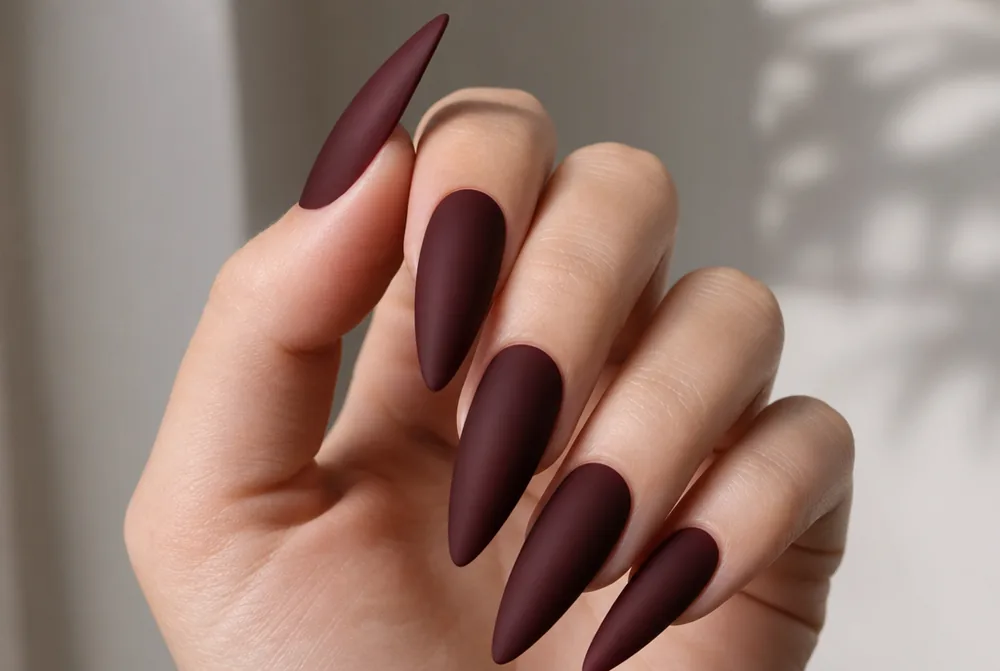
12. Matte Stiletto
Any deep colour under a matte top coat, which turns a glossy claw into something closer to sculpture. Matte also softens the point visually. More on the finish in my matte nails guide.
13. Stiletto with Rhinestone Cuff
Crystals set at the cuticle rather than the tip, which keeps them away from the part of the nail most likely to knock into things. Gel-sealed on all sides.
14. Negative Space Stiletto
Colour on part of the nail with the rest left clear, which visually breaks up the length. It’s the smartest way to make a long point look less heavy. Diagonal splits work best.
15. Stiletto Marble
Marble veining down the length of a point. Because the nail tapers, the veining compresses toward the tip, so ask for it clustered at the wider end. Technique in my marble nails guide.
16. Stiletto Glitter Ombre
Glitter packed at the point fading down, which the long taper makes especially smooth. Fine glitter, not chunky, or the point catches on everything. More in my glitter nail designs guide.
17. Emerald Stiletto
Saturated emerald on a point, which looks like carved stone. Jewel tones suit this shape better than pastels do. More in my emerald green nails guide.
18. Two-Tone Stiletto
Each point split diagonally into two colours. The diagonal follows the taper, so it looks like it belongs to the shape rather than fighting it. Striping tape gives the clean line.
19. Stiletto with Chrome Tips
Chrome on the point alone, so the tip looks dipped in metal. It draws the eye to the sharpest part of the shape, which is the whole idea. Needs gel.
20. Soft Point Almond-Stiletto
A stiletto with the very tip softened, sitting between almond and full point. It’s noticeably stronger than a true stiletto and looks nearly identical. Ask for a soft stiletto.
21. Stiletto Leopard Accent
Neutral leopard on two pointed accent nails. The taper compresses the pattern, so ask for fewer, larger spots than you would on a coffin nail. More in my leopard print nails guide.
22. Press-On Stiletto
Stiletto is the shape press-ons make most sense for, since you get the drama for a weekend without extensions and fills. It’s the low-risk way to find out whether you like the shape. More in my press on nails guide.
What stiletto actually is
The shape gets confused with almond and coffin constantly, and the difference is entirely in the last few millimetres.
Stiletto tapers along both sides to an actual sharp point. There’s no flat tip and no rounding. That point is the defining feature and it’s also the whole structural problem.
Almond tapers to a soft rounded point, which looks similar at arm’s length and behaves completely differently. Coffin tapers the same way but the tip is filed flat, which gives it far more strength.
If a tech is filing your sides in hard and the tip is going sharp rather than rounded, that’s stiletto. Say “soft point, not sharp” if you wanted almond, and say it before they finish rather than after.
Why stiletto breaks and what helps
Stiletto is the weakest shape in nails by a clear margin, and it fails in a predictable place for a predictable reason.
The point has almost no material supporting it, and every knock lands directly on it. Force that a square nail would spread across a flat tip concentrates into a single spot on a stiletto. That’s the whole story.
A proper apex is the main defence. A good tech builds a slightly thicker zone in the middle of the nail that acts like a bridge, and a set without one cracks across the middle rather than at the tip. If your stilettos keep snapping in the same place, that’s why.
Softening the very tip is the other. A soft point is nearly as dramatic and considerably stronger, and dropping a few millimetres of length helps more than anything else, since long shapes get weaker exponentially rather than proportionally.
What stiletto costs to keep
This is the part that catches people out, because it’s an ongoing appointment rather than a one-off.
Stiletto needs extensions on almost everyone, since very few people can grow enough natural length for the taper to work. Expect $60 to $95 for a full set with acrylic or Gel-X in most of the country.
Fills run $45 to $65 every two to three weeks, which is more frequent than a gel manicure because the length exaggerates grow-out at the cuticle. Over a year that’s a meaningful commitment.
Add repairs. A broken stiletto usually means a same-week salon visit rather than waiting for the next fill, and most salons charge per nail for a repair. My gel vs dip vs acrylic comparison covers which system holds a point best.
Living with a point
The first week is an adjustment and then it stops being one, which is genuinely true and worth saying.
Use the pads of your fingers for everything: opening cans, picking up coins, pulling zips, typing. Every time you lever something with the tip you’re putting force exactly where the shape is weakest, and that’s how most breaks happen.
Typing takes a few days. The fix is a slightly steeper finger angle rather than trying to type flat, and most people adapt quickly. Anything with small buttons stays awkward longer.
Gloves for washing up matter more here than at any other length, because hot water gets under a long free edge and lifts extensions from the tip back. That lifting causes most mid-cycle failures.
Who stiletto suits
Being honest about this saves people money, and stiletto is the least universal shape on the site.
Long fingers with narrow nail beds carry it best, because the taper has somewhere to go without the nail looking spindly. If that’s your hand, stiletto will look better on you than almost anything else.
Short fingers are the hard case. A long sharp point on a short finger throws the proportion off and reads as length borrowed rather than length owned. Short stiletto works fine; long doesn’t.
And it suits a life more than a hand, honestly. If you cook constantly, work with your hands, or have small children, this is the shape most likely to make you unhappy. My nail shapes guide covers picking one that fits how you actually live.
Colours and designs that suit a point
Stiletto changes what a colour does, because the taper concentrates everything toward the tip and the eye follows it there.
Deep saturated colours and metallics suit the shape best. Black, emerald, burgundy, and chrome all read as sculptural on a point, since the length gives the depth somewhere to go. Jewel tones in particular look carved rather than painted.
Pastels are the hard case. A soft lilac or mint on a long sharp point reads costume more than almost any other combination, because the sweetness of the colour argues with the severity of the shape. If you want pale on a stiletto, go milky or nude rather than pastel.
For designs, anything that breaks up the length helps: negative space, a diagonal split, an ombre, a chrome tip. Dense all-over patterns compress badly toward the point and end up looking crowded at the end of the nail.
Filing a point down safely
Most people who get stiletto once end up shortening it at some stage, and doing that badly is how a set gets ruined mid-cycle.
Never clip an extension with nail clippers. The shock travels through the product and lifts it from the natural nail underneath, which you will not see until the whole nail pops off a week later. File it down instead, even though it takes longer.
File all ten to the same length before reshaping any of them, working from the sides in toward a new point. Shortening a taper means the point has to be rebuilt, not just blunted, or you end up with a flat-ended stub.
If a nail breaks below the free edge, that is a salon visit rather than a filing job. Filing over a crack in the product traps the damage and the nail fails again within days.
FAQ
What is the difference between stiletto and almond nails?
Stiletto tapers to an actual sharp point, while almond tapers to a soft rounded one. They look similar at arm’s length and behave completely differently, since the rounded tip on an almond gives it far more strength. Say “soft point, not sharp” at the salon if you want almond.
Do stiletto nails have to be long?
No, and short stiletto is genuinely underrated. You get the taper and the point without most of the fragility, and it works on short fingers where a long point looks out of proportion. It’s how I’d suggest trying the shape before committing to extensions.
How much do stiletto nails cost?
Expect $60 to $95 for a full set with extensions in most of the country, plus fills at $45 to $65 every two to three weeks. Stiletto needs extensions for nearly everyone, since few people can grow enough natural length. Repairs are extra and more frequent than with other shapes.
Why do my stiletto nails keep breaking?
Usually because the set was built without a proper apex, which is a slightly thicker zone in the middle of the nail that acts as a bridge. Without it the nail cracks across the middle rather than at the tip. Ask for a built apex, soften the very tip slightly, and drop a few millimetres of length.
If you’re curious about the shape, buy a set of stiletto press-ons and wear them for a weekend before you book extensions. And if you love the taper but not the point, my coffin nail designs guide covers the sturdier version.