
Quick answer
Keep kids’ nails short, clean and trimmed straight across.Babies may need fingernail trims twice a week at first, and dermatologists suggest an adult does the trimming until a child is about 9 or 10.1,2 Scrub under nails at every handwash, leave cuticles alone, and see a doctor for swelling with pus, a dark streak or a crumbling nail.2,3,4
Kids’ nails don’t ask for much: a trim, a good scrub and a grown-up who notices when something looks off. This guide covers all three for parents, caregivers, teachers and school nurses. Every health claim links to its source, and the green For kids boxes are written to be read aloud.
It also takes the place of a resource many classrooms used. The American Academy of Dermatology once ran a kids’ section on nails covering nail care, hangnails, infections, ingrown toenails, injuries, manicures and pedicures, nail biting, rough nails and warts.7 Those pages are no longer online. Everything they covered is below, checked against current guidance, plus a free printable and a ready-to-teach lesson.
How nails work: a kid-friendly nail diagram
A nail looks simple, but it has several parts, and knowing their names makes the rest of this guide easier to follow. Fingernails are made of layers of a protein called keratin, and they grow from an area at the base of the nail, under the cuticle.8
From above
From the side
- 1Free edge. The white tip that grows past the fingertip. It’s the part you trim.
- 2Nail plate. The nail itself, the hard part you can see and paint.9
- 3Side nail folds. The skin along each side of the nail.9
- 4Lunula. The pale half-moon at the base and the only part of the matrix you can see. Some people can’t see theirs, and that’s normal.9
- 5Cuticle. The thin, clear or white skin at the base of the nail.9 It protects the nail root, so leave it alone.2
- 6Proximal nail fold. The skin at the base of the nail, just behind the cuticle.9
- 7Matrix. The nail’s root, tucked under the skin. It makes new nail cells all the time and never rests.9
- 8Nail bed. The skin under the nail plate.9
Because the nail is built in the matrix, a knock or illness there can show up later. Minor damage to the matrix can temporarily change how a nail looks, with a bruise, ridges or dents.9 Dermatologists describe nails as a reflection of overall health, which is why a lasting change is worth a look.11 For more nail vocabulary, our nail glossary explains 140-plus terms.
How fast do kids’ nails grow?
In a study that measured 22 healthy young adults, fingernails grew an average of 3.47 millimeters a month and toenails 1.62, so fingers grew about twice as fast.6 That’s a bit more than an eighth of an inch a month. The same study found nail growth rates have increased compared with estimates from decades ago, so treat any single number as a ballpark.6
You may have heard
“Nails on your writing hand grow faster.”
What the measurements show
When researchers compared both hands, they found no significant difference between right and left nails.6
What this means day to day: a bruise, white spot or dent rides out with the nail. A white spot can take six to nine months to leave a fingernail and 12 to 18 months to leave a toenail,12 and after a fungal infection a big toenail can take a year or longer to look clear again.13 Babies are the exception you’ll notice most: their tiny fingernails grow so quickly that they may need trimming twice a week.1
How to trim kids’ nails safely, by age
Short nails stay cleaner and break less often.2 Dermatologists recommend that an adult trims a child’s nails until the child is about 9 or 10, when many kids can take over if they feel comfortable.2 Here’s how the job changes along the way.
0 to 12 months
Babies
- Tools
- Baby nail clippers, small round-ended safety scissors or a soft emery board. Baby tools are safer than adult clippers.1,14
- How often
- Fingernails up to twice a week in the early weeks; toenails once or twice a month.1
- Best time
- After a bath if your baby lies quietly, or while they’re asleep.1,14
- Watch for
- Never bite a baby’s nails short: it risks herpetic whitlow, a herpes-virus finger infection.1 Soft baby toenails can look ingrown; that only matters if the skin beside the nail turns red, inflamed or hard.1
1 to 5 years
Toddlers and preschoolers
- Tools
- Small clippers or round-ended scissors, plus an emery board to smooth edges.1,14
- How
- Trim after the bath, when nails are softer. Fingers almost straight across with slightly rounded corners; toes straight across.2
- How often
- As needed. Toenails grow more slowly, so they need trimming less often.11
- Make it easier
- Short sessions help: one hand now, the other after a story, with a favorite show or song as the timer.
6 to 9 years
School-age kids
- Who trims
- Still an adult’s job for most children this age.2
- Teach
- Let them file while you clip, and explain why cuticles stay put: they protect the nail root.2
- Habits
- Dry hands well, since nails that stay wet can get infected, and rub in lotion after washing.2
- Watch for
- Biting, hangnails and tight shoes; cramped toes can lead to painful ingrown toenails.2
About 9 and up
Tweens and teens
- Who trims
- Many kids can trim their own nails at about this age.2
- How
- Clippers or nail scissors for fingers, a toenail clipper for toes, and file in one direction only.2,11
- Hygiene
- Their own clippers, never shared, disinfected monthly with 70 to 90 percent isopropyl alcohol.11,15
- Salon visits
- No cuticle cutting, and no shaving legs for 24 hours before a pedicure.16

Step by step: trimming a child’s nails
- Soften first. Trim after a bath or shower, when nails are softer and easier to cut.2
- Pick the right tool. Baby clippers or round-ended scissors for babies; nail clippers or scissors for fingers and a toenail clipper for toes as kids grow.11,14
- Steady the finger. Hold one finger at a time and press the fingertip pad down, away from the nail, so you can see where the nail ends.
- Cut the right shape. Fingernails almost straight across with slightly rounded corners; toenails straight across.2
- Smooth the edges. File in one direction; sawing back and forth can weaken nails.2
- Finish gently. Leave the cuticles alone and rub in a little lotion to keep nails flexible.2
| Tool | Best for | Good to know |
|---|---|---|
| Baby nail clippers | Newborns to toddlers | Safer than adult clippers for tiny nails.14 |
| Round-ended safety scissors | Babies and toddlers | Go slowly; nicking the fingertip causes pain and bleeding.1 |
| Soft emery board | Newborns, and smoothing at any age | File in one direction.1,2 |
| Nail clippers or nail scissors | School-age kids and up | Clean before use and disinfect monthly.3,11 |
| Toenail clippers | Toes, once nails harden | Cut straight across.2,11 |
| Your teeth | Never | Biting a baby’s nails short risks herpetic whitlow.1 |
Handwashing and nails: the germ hideout
Dirt and germs can live under fingernails and help spread infections such as pinworms, and more dirt and bacteria collect under long nails than short ones.3 The CDC’s fix is simple: keep nails short and scrub the underside with soap and water, or a nail brush, every time you wash.3
- WetClean running water, warm or cold. Turn off the tap and add soap.5
- LatherBacks of hands, between fingers and under the nails.5
- ScrubAt least 20 seconds. Hum Happy Birthday twice.5
- RinseUnder clean, running water.5
- DryWith a clean towel or an air dryer.5

When kids should wash
A simple way to teach the nail part: after lathering, kids scratch their fingertips gently across the soapy palm of the other hand, then switch. It turns “wash under your nails” into a move they can actually do.
Those are the CDC’s figures for what handwashing education achieves in communities, which is a strong case for teaching it in class.17
Nail biting: why kids do it and how to help
Nail biting is common, and it usually starts young. In a survey of 281 patients aged 3 to 21 at a pediatric clinic, 37% said they had bitten their nails for more than a month, and the median age it started was 5.18 About half of children aged 10 to 18 bite their nails at some point.19
Children may also bite more when they’re having problems at school or with friends, and many bite without realizing they’re doing it.19 It’s worth easing off because repeated biting can make the skin sore, damage the tissue that makes nails grow, and carry germs between the mouth and fingers.20
- Talk about it together. Kids are more likely to stop when they understand what sets it off, and when they help choose the method.19
- Keep nails short. Less nail means less to bite.20
- Try a bitter-tasting polish. Read and follow the label first.20,21
- Give the hands a job. A fidget toy or stress ball works as a swap.20
- Go one set at a time. Stop biting the thumbnails first, then add more nails.20
- Fix hangnails right away. Clip them so there’s nothing to pick at.2,20
Skip scolding. Since much of the biting happens without the child noticing, a calm private signal works better than an embarrassing reminder in front of others.
When to talk to the doctor
If biting continues after repeated tries to stop, if it comes with hair pulling or skin picking, or if a finger gets infected.19,20 In the clinic survey, 18% of children who bit their nails had a psychiatric diagnosis, compared with 6% of those who didn’t.18 That doesn’t mean biting is a sign of one, but if it comes with a lot of worry or changes in mood, mention it.
Hangnails and ingrown toenails
These are the two small problems kids bring to grown-ups most, and both usually clear with simple care at home.
Fingers
Hangnails
A torn strip of skin beside the nail. Despite the name, it’s skin that tears, not nail.22
Do
- Wash hands with soap and water, then clip the loose skin with clean clippers or nail scissors.2,3
- Rub lotion into dry nail folds and cuticles; very dry skin cracks.4
Don’t
See a doctor if
- The skin turns red, warm and swollen or fills with pus.4
Toes
Ingrown toenails
The nail grows into the skin, usually on the big toe.23
Do
- Soak the foot in warm, salty water to soften the skin.23
- Wear wide, comfortable shoes or sandals.23
- Prevent it: cut straight across, not too short, and buy shoes with room for toes.2,23
Don’t
See a doctor if
- Home care isn’t helping, or the toe is painful and swollen with pus.23
For babies, soft toenails often look ingrown without being a problem; it only matters if the skin beside the nail turns red, inflamed or hard.1 Older kids and teens who want tidy cuticles can read how to push back cuticles gently; dermatologists say never to cut them, and to push them back only gently after a bath or shower if at all.16
Nail changes: when to see a doctor
Children’s nails are usually healthy, and seeing a change doesn’t always mean disease.2,25 Use this to sort what can wait from what needs a visit. It can’t diagnose anything; your pediatrician or a board-certified dermatologist can.
Usually harmless
Home care first
- A hangnail: wash, then clip.2
- A mild ingrown toenail: warm salty soaks and roomy shoes.23
- A minor nail injury: a cool, damp cloth and the hand or foot raised above the heart.26
- Mild redness at the nail fold: warm-water soaks for about 15 minutes a few times a day; if it isn’t better in a day or two, call.4
Call the doctor
- Red, warm, swollen skin around a nail, or pus.4
- A dark streak under or along the nail.2,8
- A nail that crumbles, thickens, or pulls away from the skin.2,8,15
- After an injury: can’t bend the finger or toe, blood under more than half the nail, a black or purple nail, or a lot of pain. Get urgent care if needed.26
- Bleeding around the nail or a nail that stops growing.8
Myth
“White spots mean your child needs more calcium.”
What Cleveland Clinic says
Injury is the most common cause. Some believe low iron, calcium or zinc plays a role; others say there isn’t enough research to draw conclusions.12
A few other changes are worth knowing by name:
Nail infection around the nail (paronychia). Pain, swelling and tenderness, skin that’s red and warm, and sometimes pus under the skin.4 Biting or picking at cuticles creates tiny cracks and cuts that let bacteria in.4 Caught early, it’s often treated with soaks and antibiotics.25
Fungal nail infection. Uncommon in children: a survey of 2,500 North American kids seen by dermatologists found a rate of 0.44%.27 In 65% of the children who had it, a sibling, parent or grandparent had nail fungus or athlete’s foot too.27 The nail often thickens and turns white or yellow.15 It almost never clears on its own, and pharmacy nail paints may not be suitable for under-18s, so this one goes to the doctor.13,15 Dirty nails alone can’t cause it; it spreads through shared towels and clippers and barefoot floors.2,13
Warts. Caused by a virus, they can appear on fingers and around and under the nails.28,29 Most people get one at some point, and they usually go away on their own, though it can take months or years.28 Kids with finger warts shouldn’t bite their nails or suck those fingers.28
Rough or pitted nails. Severe eczema can affect the matrix and temporarily change nail growth, so mention nail changes at eczema checkups.9 Peeling or splitting in older kids is covered in our brittle nails guide.
Nail polish and manicures for kids
Polish is a fun treat for most kids. The AAD’s old kids’ pages even noted that polish can help keep nails moist, while suggesting a month off polish each year.30 A few habits keep it simple and safe:
Poison Help, 24/7
1-800-222-1222Reaches your local poison center from anywhere in the U.S., free and confidential.31 If a child swallowed acetone remover, the Illinois Poison Center advises a few sips of water and watching for nausea, vomiting, clumsiness or drowsiness, and calling if they had more than a sip or show symptoms.32 Call 911 if anyone is unconscious or struggling to breathe.32
Going to a salon with an older child? If it doesn’t look clean, move on, and don’t let anyone cut cuticles.16 Our nail salon safety guide covers what a careful salon looks like.
For the fun part, try easy ideas like polka dot nails, simple designs for beginners, extra short nail ideas, toe nail designs and back to school nails. Little painters can learn how to paint nails without getting polish on skin.
Fun nail facts for kids
Read these aloud, put them on a bulletin board, or use them as warm-up questions before the lesson below.
For parents: a five-minute weekly nail check
Bath time is the easiest moment. Run through this once a week, and teach older kids to do it themselves; checking nails young builds a healthy habit.2
- Trim as needed. Baby fingernails may need it twice a week; toenails less often.1
- Scrub under the nails with soap and water or a nail brush.3
- Look for hangnails and clip them before they get picked.2
- Check the toes for redness where the nail meets skin, and check that shoes leave room to wiggle.2
- Clean the clippers before use, and disinfect them monthly.3,11
- Fresh socks daily, and flip-flops at pools and locker rooms.2
- Note anything new, like a dark streak, a crumbling nail or swelling, and mention it to the doctor.2,4
For teachers: a 20-minute nail health lesson
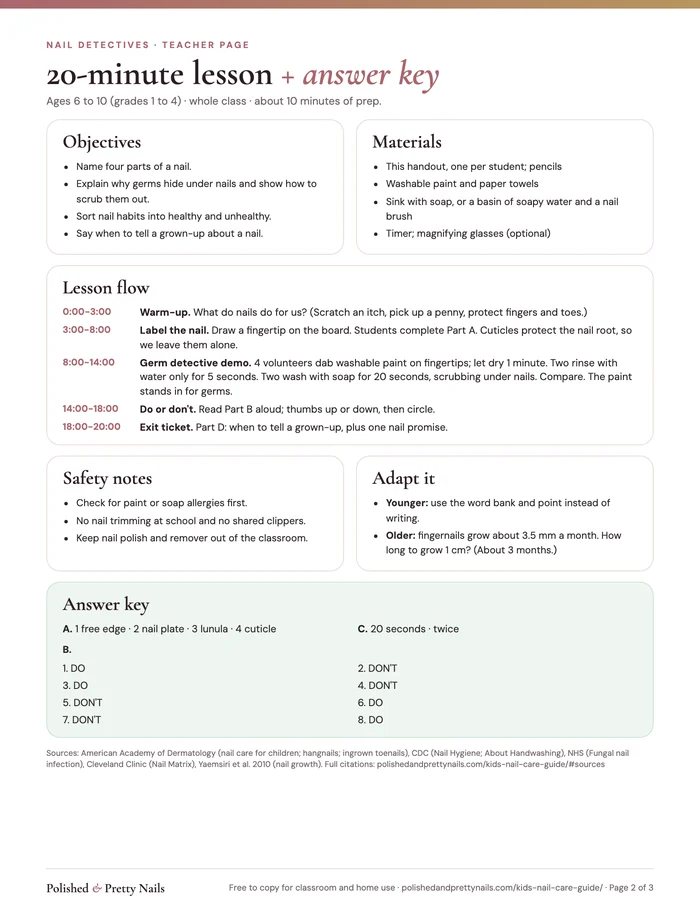
This lesson pairs with the free handout below and needs no special supplies. The AAD’s own hair-and-nails module now requires a request form for full access;34 this one is free to print, copy and adapt for your class, no signup.
Lesson plan · Free to use
Nail Detectives
Objectives
Students will be able to:
- Name four parts of a nail.
- Explain why germs hide under nails, and show how to scrub them out.
- Sort nail habits into healthy and unhealthy.
- Say when to tell a grown-up about a nail.
Materials
- The printable handout, one per student
- Pencils
- Washable paint and paper towels
- A sink with soap, or a basin of soapy water and a nail brush
- A timer; magnifying glasses are a bonus
Lesson flow
- 0:00 to 3:00Warm-up: what do nails do?Ask the class. Steer toward the answers the AAD used to give kids: scratching an itch, picking up a penny, and protecting fingers and toes.7
- 3:00 to 8:00Label the nailDraw a big fingertip on the board. Students complete Part A of the handout: free edge, nail plate, lunula and cuticle. Point out that the cuticle protects the nail root, so we leave it alone.2
- 8:00 to 14:00Germ detective demoFour volunteers dab washable paint on their fingertips and let it dry for a minute. Two rinse with water only for five seconds; two follow the CDC steps with soap for 20 seconds, scrubbing under their nails.5 The class compares nails. The paint stands in for germs that hide under nails.3
- 14:00 to 18:00Do or don’t?Read the Part B statements aloud; students answer with thumbs up or down, then circle their answers.
- 18:00 to 20:00Exit ticketEach student finishes Part D: when to tell a grown-up, and one nail promise for the week.
Safety notes
Adapt it
- Younger students: use the word bank and point instead of writing.
- Older students: add growth math. If a fingernail grows about 3.5 mm a month, how long does it take to grow 1 centimeter? (About 3 months.)6
Printable classroom handout
Three US Letter pages: a student worksheet, a teacher page with the lesson and answer key, and a family take-home sheet with trimming tips by age and when to call the doctor. Print in color or black and white.


Frequently asked questions
How often should you cut a baby's nails? In the early weeks, a baby's fingernails may need trimming twice a week because they are small and grow quickly. Toenails grow more slowly and may only need trimming once or twice a month.1
At what age can kids cut their own nails? Around 9 or 10. Dermatologists recommend that an adult trims a child's nails until about that age, after which many children can trim their own if they feel comfortable doing so.2
Is it OK to bite a baby's nails to trim them? No. The American Academy of Pediatrics advises against it because of the risk of herpetic whitlow, a finger infection caused by the herpes simplex virus. Use baby nail clippers, round-ended safety scissors or a soft emery board instead.1,14
Why does my child bite their nails? Usually stress, excitement, boredom or habit, and it can be learned from family members. It often starts around age 5. Talk to your doctor if it continues after repeated tries to stop or a finger becomes infected.18,19,20
Are white spots on nails a sign of calcium deficiency? Usually not. The most common cause is a minor injury to the nail, and the spots grow out over several months. Some people believe low minerals such as calcium play a role, but others say there is not enough research to draw conclusions.12
Is nail polish safe for kids? Occasional polish is fine for most kids with a few precautions: use it in a well-ventilated room, follow the label, and keep nail polish remover out of reach, because even small amounts can be dangerous if a child swallows it.21,31
When should a child see a doctor about a nail? See a doctor if the skin around a nail is red, warm, swollen or has pus, if there is a dark streak, or if a nail crumbles or pulls away from the skin. After an injury, get care if your child can't bend the finger or toe, the nail turns black or purple, or blood covers more than half the nail.2,4,8,26
Sources
Every claim above links to one of these official, medical or peer-reviewed sources. We checked each one on October 5, 2026. Archived AAD pages are linked through the Internet Archive. If a link has moved or advice has changed, email hello@polishedandprettynails.com and we’ll update this page.
- American Academy of Pediatrics (HealthyChildren.org), Nail Care: Fingers and Toes
- American Academy of Dermatology, Teaching your child healthy nail care
- CDC, Healthy Habits: Nail Hygiene
- Cleveland Clinic, Paronychia (Nail Infection)
- CDC, About Handwashing
- Yaemsiri et al., J Eur Acad Dermatol Venereol 2010 (nail growth rates)
- American Academy of Dermatology, For Kids: About nails (archived)
- Mayo Clinic, Fingernails: Do's and don'ts for healthy nails
- Cleveland Clinic, Nail Matrix
- American Academy of Dermatology, For Kids: How nails grow (archived)
- American Academy of Dermatology, How to trim your nails
- Cleveland Clinic, White Spots on Nails (Leukonychia)
- American Academy of Dermatology, Nail fungus: FAQs
- NHS, Washing and bathing your baby
- NHS, Fungal nail infection
- American Academy of Dermatology, Manicure and pedicure safety
- CDC, Handwashing Facts
- Winebrake et al., Am J Clin Dermatol 2018 (pediatric nail biting survey)
- HealthLinkBC, Nail-Biting
- American Academy of Dermatology, How to stop biting your nails
- FDA, Nail Care Products
- American Academy of Dermatology, For Kids: Hangnails (archived)
- NHS, Ingrown toenail
- American Academy of Dermatology, 11 dermatologists' tips for healthy nails
- American Academy of Dermatology, 12 nail changes a dermatologist should examine
- American Academy of Dermatology, Tips to care for an injured nail
- Gupta et al., J Am Acad Dermatol 1997 (onychomycosis in children)
- NHS, Warts and verrucas
- American Academy of Dermatology, For Kids: Warts (archived)
- American Academy of Dermatology, For Kids: Common questions (archived)
- MedlinePlus (NLM), Acetone poisoning
- Illinois Poison Center, My Child Ate Acetone
- American Academy of Dermatology, For Kids: Manicures and pedicures (archived)
- American Academy of Dermatology, Good Skin Knowledge Module 4: Healthy hair and nails
This guide is general health information for parents and educators, not medical advice, and it can’t diagnose a nail problem. For anything painful, spreading or changing, talk to your child’s pediatrician or a board-certified dermatologist.