
The short answer
MMA (methyl methacrylate) is a cheap, hard-setting acrylic liquid that some salons still use even though 40 states and DC prohibit it in their rules.1,2 § No federal regulation specifically bans it, but the FDA pulled 100% MMA nail products off the market in the 1970s.2
The warning signs are a strong, unusual odor, acrylic that is very hard to file or won’t soak off, and a price that looks too good.1,3
This guide to MMA acrylic nails covers what MMA is and how it differs from EMA, the liquid most salons use; what the FDA actually did about it and which states have written rules against it; what it can do to nails and to the people breathing it; and what to say at the front desk. Every claim links to an official or peer-reviewed source, and there’s a printable card for your wallet at the end.
MMA vs EMA, in plain words
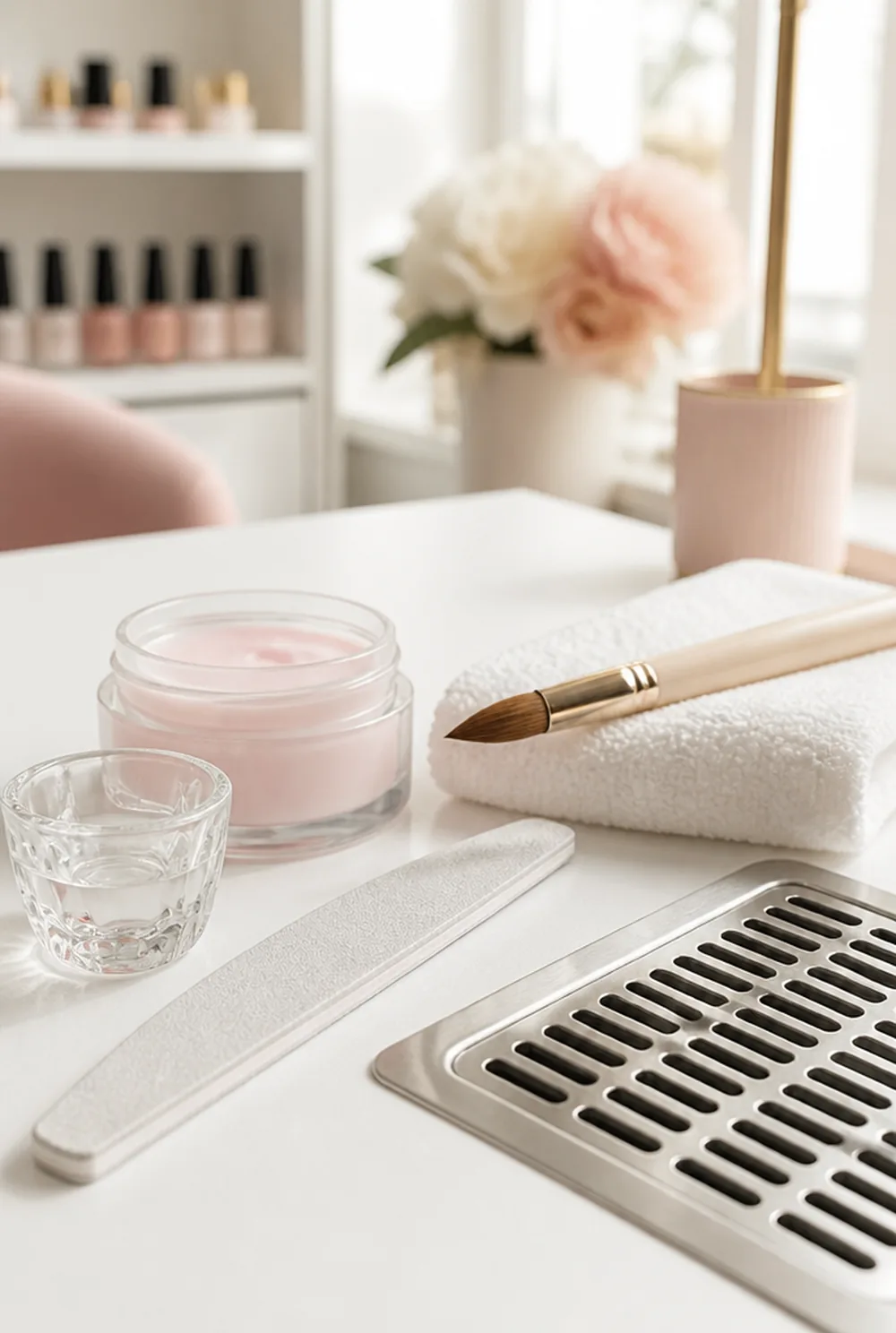
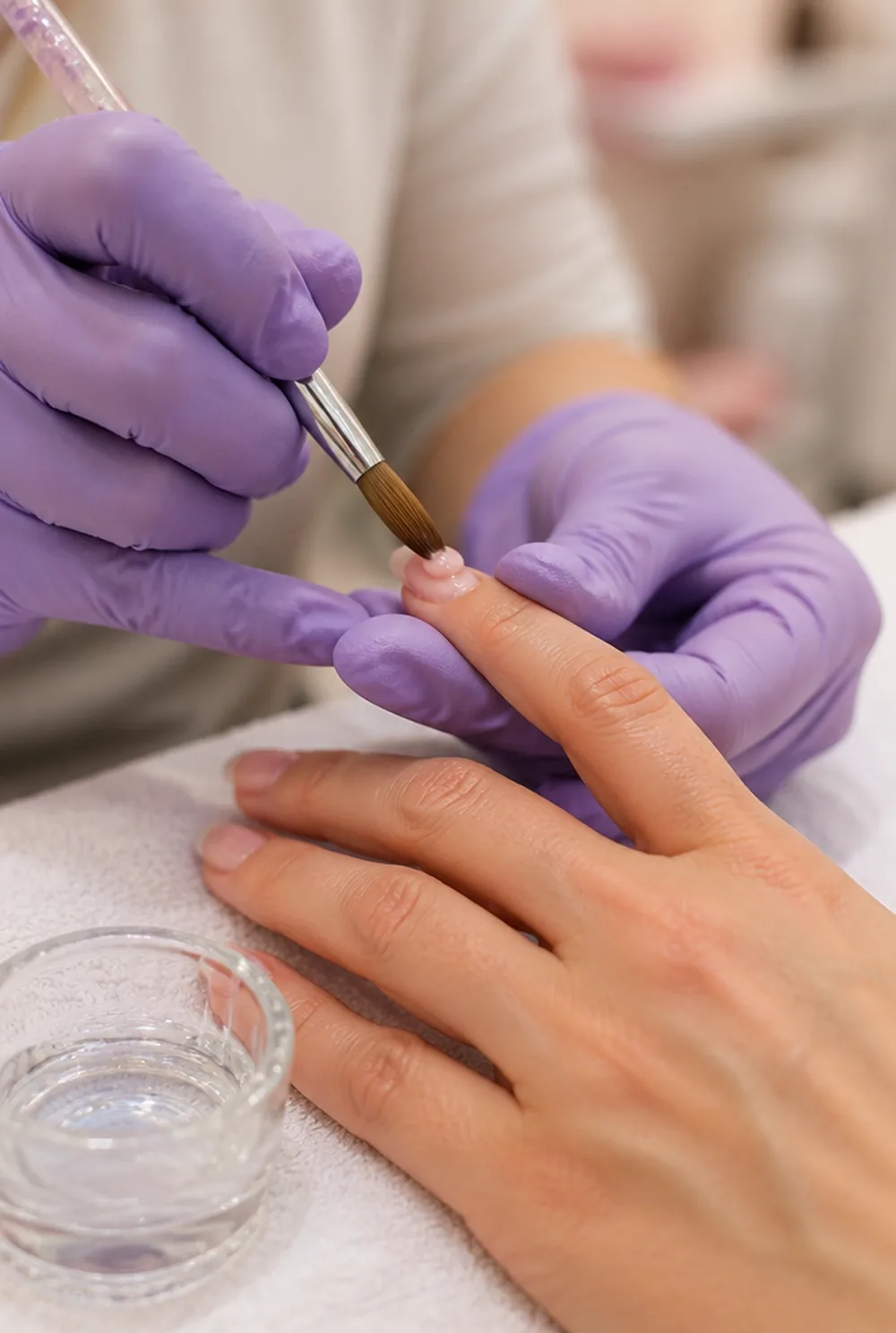
An acrylic nail starts as two parts: a liquid and a powder. The liquid is a monomer, a small molecule that links up into solid plastic when it meets the powder, which is already a polymer.2,5 Your tech dips a brush in the liquid, picks up a bead of powder, and shapes it on the nail while it hardens. A little unreacted monomer stays in the finished nail.2
- The liquid. Monomer: EMA in most salons; MMA is the problem.
- The powder. Polymer, often PMMA, already a plastic.
- The bead. They react on the brush and start to harden.
- The nail. Hard plastic, with traces of monomer left in it.
The MMA question is about the liquid. Most acrylic liquids use EMA.1
Which monomer is in that liquid is the whole story. Most acrylic liquids today use ethyl methacrylate (EMA).1 Methyl methacrylate (MMA) is its close chemical cousin, and liquid MMA was a common nail ingredient for many years.5 Outside the salon, MMA is an ordinary industrial chemical: it goes into plastics like Plexiglas and into bone and dental cements.1,6
So why would a salon still use it? Arizona’s cosmetology board puts it plainly: MMA sets faster, grips harder and costs less, at roughly a third of the price of other acrylic products.1 That grip comes with a catch. MMA doesn’t bond well to a natural nail unless the nail is roughed up with coarse abrasives, and that heavy filing can damage the nail plate and bed.5 Terms like monomer, polymer and fill are defined in our nail glossary.
| EMA (ethyl methacrylate) | MMA (methyl methacrylate) | |
|---|---|---|
| Where it’s used | Most acrylic nail liquids sold to salons.1 | Plastics, dental and bone cements; still turns up occasionally in nail liquids.1,2,6 |
| Safety review | Found safe as used in 2002, with directions to avoid skin contact.2 | FDA removed 100% MMA nail products through court actions in the 1970s.2 |
| 1970s injury reports | EMA polymers were not associated with them.2 | Nail damage and deformity, plus contact dermatitis.2 |
| Allergy | Can sensitize skin, so it shouldn’t touch skin.2 | Allergic reactions, usually after repeated exposure.5 |
| For the nail tech | OSHA lists asthma, irritation and trouble concentrating.7 | OSHA lists asthma, irritation, trouble concentrating and loss of smell.7 |
| Prep and removal | Normal prep and soak-off. | Needs heavy filing to stick; very hard to remove with normal solvents.1,5 |
| State rules | Not prohibited in any rule we read; Missouri’s rule says ethyl methacrylate products are acceptable.8 | Prohibited by name in 40 states and DC. § |
The powder isn’t the problem
Many acrylic powders contain polymethyl methacrylate (PMMA), so you may spot “methyl methacrylate” inside a longer word on a powder label.2 That’s a finished polymer, not MMA liquid: EPA says powder MMA polymers are considered safer because they don’t penetrate the skin.5
Is MMA banned? What the FDA actually did
You’ll often read
“MMA is banned by the FDA.”
What the FDA says
No regulation specifically prohibits MMA monomer in cosmetic products. In the 1970s, after injury complaints, the FDA removed 100% MMA nail products from the market through court proceedings: an injunction against one firm, several seizures and voluntary recalls.2
The “FDA ban” line is everywhere, including older official material. California’s 1989 health department booklet on artificial nails, reprinted in 2000, described a 1974 FDA ban.9 The FDA’s current page doesn’t use that word. The distinction matters because it tells you who to call: the FDA oversees products, while states license salons and nail technicians and write the salon rules.2
Two more details explain why MMA can still reach a nail table. Cosmetics, including nail products, don’t need FDA approval before they’re sold,2 and products used only in salons don’t have to list their ingredients.2 The FDA says MMA monomer is still used occasionally in some artificial nail products,2 and the EPA’s salon guide tells owners not to buy or use any nail product containing liquid MMA monomer.5
- Early 1970sThe FDA receives injury complaints tied to MMA nails: nail damage and deformity, and contact dermatitis.2
- 1970sCourt actions, seizures and recalls remove 100% MMA nail products from the market.2
- 1989California’s HESIS booklet warns nail techs about MMA (and calls it an FDA ban).9
- 2002An expert panel finds EMA safe as used, with directions to avoid skin contact.2
- 2011 to 2019Air studies in California, Utah and Michigan salons still detect MMA.4,10,11
- TodayNo federal rule names MMA; 40 states and DC prohibit it in their rules.2 §
State rules: where MMA is prohibited
Because the FDA left it to the states, the real prohibitions are in state cosmetology rules and statutes.2 Older guides, including the EPA’s, say “at least 30 states” restrict MMA;5 we went state by state instead. On October 5, 2026 we read the rules for all 50 states and DC, and 40 states and DC name MMA as prohibited. The table quotes each rule and links to it.
All 51 jurisdictions checked
40 states and DC name MMA in their rules
- Rule names MMA
- Bans 100% MMA only
- Unclear or guidance only
- No MMA rule found
Tap a state to jump to its rule. Checked October 5, 2026.
| State | Rule | What the rule says |
|---|---|---|
| Rule names MMA (40 states and DC) | ||
| Alabama | Ala. Admin. Code r. 250-X-3-.02(5) via LII | “No licensee shall use methyl methacrylate or any other product considered poisonous or unsafe” |
| Arizona | Ariz. Admin. Code R4-10-112(M)(1) via LII | “including liquid methyl methacrylate monomer and methylene chloride, are on the establishment premises” |
| Arkansas | Ark. Code R. 007.47.24-001, Part 200 (z)(5) via Justia† | “Cosmetologist and manicurist shall not use Liquid Methyl Methacrylate (MMA) Monomer.” |
| California | Cal. Code Regs. tit. 16, § 989(b) | “Have on the premises methyl methacrylate monomer and/or methylene chloride.” |
| Colorado | 4 CCR 731-1, Rule 1.8(A)(2)(b) via LII | “Methylmalonic acid or Methacrylate Liquid Monomers, (MMA)” |
| Delaware | 24 Del. Admin. Code 5100-16.3 via LII | “The use of methyl methacrylate (MMA) is prohibited. No licensee, school or shop shall use or permit the use of MMA.” |
| District of Columbia | 17 DCMR § 3718.18(c)(1) | “A person may not use or possess methyl methacrylate liquid monomer (MMA) in a salon of any type in the District of Columbia.” |
| Florida | Fla. Stat. § 477.0265(1)(g) | “In the practice of cosmetology, use or possess a cosmetic product containing a liquid nail monomer containing any trace of methyl methacrylate (MMA).” |
| Idaho | IDAPA 24.28.01.200.06.a | “Use of Methyl Methacrylate acid (MMA).” |
| Illinois | 68 Ill. Adm. Code 1175.115(b)(16) | “The use of nail products or the distribution of nail products containing monomer Methyl Methacrylate (MMA) is prohibited.” |
| Indiana | Ind. Code § 25-8-11-7(a) | “A person licensed under this article may not use acrylic liquid monomer formulated with methyl methacrylate (MMA).” |
| Iowa | Iowa Admin. Code r. 481-943.17(1) | “Prohibited products include, but are not limited to, any product containing liquid methyl methacrylate monomer and methylene chloride.” |
| Kansas | K.A.R. 28-24-14(a)(7) | “possessing methyl methacrylate monomer (MMA); and” |
| Kentucky | Ky. Rev. Stat. § 317A.130(1)(e) | “Use on any patron a liquid nail enhancement product containing monomeric methyl methacrylate, also known as dental acrylic monomer” |
| Louisiana | La. Admin. Code tit. 46, pt. XXXI, § 701(R)(3) via LII | “nail enhancement products containing methyl methacrylate (MMA) monomer” |
| Maine | 02-041 C.M.R. ch. 26, § 26.151 via Justia† | “Nail or any other service product containing methyl methacrylate liquid monomers, also known as MMA.” |
| Maryland | Md. Code, Bus. Occ. & Prof. § 5-608.1(a) | “A person may not use or possess methyl methacrylate liquid monomer (MMA) in a beauty salon in this State.” |
| Michigan | Mich. Admin. Code R 338.2179g(1)(a) via LII | “Use or possess methyl methacrylate monomers.” |
| Minnesota | Minn. R. 2105.0377(A); also Minn. Stat. § 155A.355, subd. 3 | “Prohibited substances in salons are methyl methacrylate (MMA) liquid monomers, formalin tablets, formalin liquids, and other fumigants.” |
| Mississippi | 30 Miss. Code R. 2101-8.15(H) via LII | “No product containing the ingredient methyl methacrylate (MMA) can be used in any manicuring or pedicuring procedure.” |
| Missouri | 20 CSR 2085-11.020(J) | “No cosmetology licensee shall provide any cosmetology services that involve the use of any liquid product containing methyl methacrylate (MMA).” |
| Montana | Admin. R. Mont. 24.121.1517(2)(d) via LII | “methyl methacrylate monomers for artificial nails” |
| Nevada | Nev. Admin. Code § 644A.805(1)(b) | “Methyl methacrylate liquid monomers, also known as MMA, and fumigants, formalin tablets or formalin liquids; or” |
| New Hampshire | N.H. Code Admin. R. Bar 302.07(g)(1) via LII | “Apply methyl methacrylate (MMA) monomer on a person, or have MMA available for use in the facility;” |
| New Jersey | N.J.A.C. 13:28-3.4(a) via LII | “A licensee, licensed shop, or school of cosmetology and hairstyling shall not utilize any product that contains methyl methacrylate monomer.” |
| New Mexico | 16.34.7.9(D)(3) NMAC | “for the purpose of performing services under the Act, no licensee shall buy, sell, or use, or apply to any person liquid monomeric methyl methacrylate (MMA);” |
| New York | N.Y. Gen. Bus. Law § 404-a(1) | “sell, use or apply to any person monomeric methyl methacrylate” |
| North Carolina | 21 NCAC 14H .0401(e)(1) | “Methyl Methacrylate Liquid Monomer, a.k.a. MMA;” |
| North Dakota | N.D. Admin. Code 32-02-01-11(14) | “Any products or supplies banned by the United States drug enforcement administration or other federal, state, or local governing agency, including methyl-methacylate, are prohibited.” |
| Ohio | Ohio Rev. Code § 4713.14(M)(3) | “Use or possess a liquid nail monomer containing any trace of methyl methacrylate (MMA).” |
| Oklahoma | Okla. Admin. Code 175:10-7-14(f) | “The use of methyl methacrylate (MMA) is prohibited.” |
| Rhode Island | 216-RICR-40-05-4.7.6(B)(17) via LII | “The possession and/or use of any cosmetic nail preparation containing methyl methacrylate (MMA) shall be prohibited.” |
| South Carolina | S.C. Code Ann. Regs. 35-20(P)(1) | “Methyl Methacrylate Liquid Monomers (MMA).” |
| South Dakota | S.D. Admin. R. 20:42:04:08.01(1) | “monomer nail products containing methyl methacrylate monomers (MMA)” |
| Tennessee | Tenn. Comp. R. & Regs. 0440-02-.17(1) via LII | “including, but not limited to, liquid methylmethacrylate” |
| Texas | 16 Tex. Admin. Code § 83.112(a)(1) via LII | “Methyl Methacrylate Liquid Monomers, (MMA).” |
| Utah | Utah Admin. Code R392-702-11(1)(a) via LII | “Methyl Methacrylate Liquid Monomers (MMA);” |
| Vermont | Vt. Admin. Rules for Barbers and Cosmetologists, Rule 13-5(f) | “including liquid methyl methacrylate monomer and methylene chloride” |
| West Virginia | W. Va. Code R. § 3-5-4.1 | “Prohibited substances in salons and schools are methyl methacrylate (MMA) liquid monomers, formalin tablets, formalin liquids, and other fumigants and must not be present in a salon or school.” |
| Wisconsin | Wis. Admin. Code Cos § 2.03(9) | “Licensees may not use methyl methacrylate monomer, commonly referred to as MMA in liquid form, and may not use any cosmetic or nail product formulated with MMA as one of its ingredients.” |
| Wyoming | Wyo. Admin. Code 033.0001.10 § 17(a) via Justia† | “Methylemethacrylate Monomer (MMA)” |
| Bans 100% MMA products only | ||
| Washington | WAC 308-20-110(15) | “Use of 100% liquid methyl methacrylate monomer and methylene chloride products are prohibited.” |
| Unclear or guidance only | ||
| Hawaii | Board minutes, June 29, 2021 | “unanimously carried that the Board informally opined that methyl methacrylate should not be used in artificial nail” |
| Nebraska | 172 Neb. Admin. Code ch. 34, § 019(B) via Justia† | “Products containing methacrylate monomers.” |
| No MMA rule found (7) | ||
| Alaska, Connecticut, Georgia, Massachusetts, Oregon, Pennsylvania and Virginia. | ||
† Read in a browser on October 5, 2026; the copy we used blocks automated checks. “via LII” or “via Justia” means we read the rule in that free legal library’s reproduction of the official code.
We found no MMA-specific rule in Alaska, Connecticut, Georgia, Massachusetts, Oregon, Pennsylvania or Virginia. That doesn’t make MMA welcome there: we searched the cosmetology rules, not every statute, and boards can act under general safety and workmanship rules. Hawaii is a good example. It has no MMA rule, but its board said in 2021 that MMA should not be used in artificial nails.12
Where a rule exists, it has teeth. Florida makes a violation a second-degree misdemeanor; New York sets a civil penalty of up to $1,000 for a first violation; and Maryland lets inspectors chemically test or sample products they suspect, with fines up to $1,000.13,14,15
What MMA can do to nails, skin and lungs
Most of what’s known comes from injury reports, case studies and regulators’ warnings rather than large trials, so we’ve stuck closely to what those sources say. EPA considers MMA not likely to cause cancer in humans,6 and we’re not going to suggest otherwise. The documented problems are nail damage, allergy and breathing irritation.
In the chair
For clients
- Nail damageThe heavy filing MMA needs can damage the nail plate and bed.5 California’s board warns the acrylic can grip so hard that the nail bed may be torn away under extreme pressure.3
- AllergyAllergic reactions usually come after repeated exposure and tend to get worse with more of it.5 Redness, swelling and pain around the nail are typical signs of methacrylate allergy.2
- Lasting harmArizona’s board links MMA nail liquid to permanent loss of the nail plate and, in some cases, of feeling in the fingertips.1
- InfectionBreaks in the natural nail open the door to dangerous nail infections.3
At the table
For nail techs
- BreathingOSHA links MMA to asthma; irritated eyes, skin, nose and mouth; difficulty concentrating; and loss of smell.7
- Short-term exposureEPA lists chest tightness, shortness of breath, coughing and wheezing in people exposed to MMA vapor.6
- Long-term exposureRespiratory and nasal symptoms and reduced lung function have been reported in workers exposed over time.6 In animals, very high vapor levels damaged the respiratory system and liver.5
- SkinAllergy to acrylates is rising among both nail techs and clients.16
The worst outcomes are rare but real. A 1980 case report describes a client who became allergic to MMA in an artificial-nail mix; her nail plates were gradually destroyed and still hadn’t grown back six years later.17 That’s one case, not a rate, but it’s the kind of report that put MMA on regulators’ radar. If your nails are thin or splitting after any set, our guide to brittle nails covers what actually helps.
What researchers keep finding
If you work with any acrylic liquid, ventilation is the lever that moves exposure most. In a NIOSH study, a downdraft table vented outdoors cut technicians’ EMA exposure from 8.7 ppm to 0.6 ppm.20 That study began after six cosmetologists working with artificial nails were diagnosed with occupational asthma.20 Our nail salon safety guide covers ventilation, gloves and masks in detail.
Signs your salon may be using MMA
None of these proves MMA on its own. The surest check is the bottle, since MMA should appear on the product label,1 but salon-only products don’t have to list ingredients2 and lab testing has found labels that miss chemicals.18 Treat these as reasons to ask questions, drawn from what state boards and federal agencies say:
A sharp, unusual smell
California’s board describes MMA’s odor as very strong and fruity, South Dakota’s as powerful and unusually sweet, and Arizona’s says it doesn’t smell like other acrylic liquids.1,3,21
Source: California, South Dakota and Arizona boards
Your nail gets ground down first
MMA doesn’t stick to a natural nail without heavy filing with coarse abrasives.5 A lot of aggressive filing before the acrylic goes on is worth a question.
Source: EPA
Rock-hard and hard to file
MMA product sets much harder, feels less flexible and is very difficult to file.1,21
Source: Arizona and South Dakota boards
It won’t soak off
MMA acrylics are extremely hard or virtually impossible to remove with normal solvents, and won’t soak off in acrylic removers.1,21 If a previous set wouldn’t budge in remover, mention it.
Source: Arizona and South Dakota boards
A price that seems too low
MMA product costs roughly a third as much as other acrylic products, which is why it’s still used.1 Low prices alone prove nothing; plenty of honest salons are inexpensive.
Source: Arizona board
What to ask your salon
Asking is normal, and in Arizona the cosmetology board says consumers have the right to ask, and be told, whether a product contains MMA.1 Keep it friendly; a salon using a reputable EMA liquid is usually happy to show you the bottle. These are the questions worth having ready:
“Which acrylic liquid do you use? Could I see the bottle?”
MMA is listed on the label when it’s in the product.1
“Is your liquid EMA or MMA?”
EMA is the monomer used in most acrylic nail liquids.1
“How do you prep my natural nail?”
MMA needs heavy filing with coarse abrasives to stick.5
“How will these come off when I’m done?”
MMA nails are extremely hard or virtually impossible to remove with normal solvents.1
“Do you keep safety data sheets for your products?”
Manufacturers must supply SDSs, and employers keep them near the product for workers.7
“Is your establishment license posted?”
California tells clients to check for a current license at reception.22
If a quote looks suspiciously low, our nail salon price checklist shows what a fair price includes, so you can compare salons on more than the total.
What to do if you suspect MMA
- Stop the service. You’re allowed to pause or end an appointment. Ask to see the liquid before any more goes on.
- Write down the details. Salon name and address, the date, your technician, and a photo of the bottle or the price list if you can get one. Keep your receipt.
- If your nails or skin react, see a doctor. The FDA’s first step for any cosmetic reaction is to stop using the product and contact your healthcare provider.23 Redness, swelling or pain around the nail can be a methacrylate allergy.2
- File a complaint with your state board. States, not the FDA, license salons and nail techs, so salon complaints go to your state board.2 Arizona’s board, for one, asks people who suspect MMA to file a complaint.1 Every board’s website is linked in our nail tech license requirements by state guide.
- Report the product to the FDA. The FDA asks people to report reactions to nail products, online through MedWatch or by phone.2,23
- Nail techs: you can also call OSHA. Workers can ask OSHA to inspect, OSHA keeps identities confidential on request, and employers can’t punish you for filing.24 Don’t wait: OSHA can’t cite incidents more than six months old.25
Report a product
1-888-723-3366FDA (1-888-SAFEFOOD), then option 4 for cosmetics.23Report a workplace
1-800-321-6742OSHA (1-800-321-OSHA). TTY 1-877-889-5627.24Printable client card
Print it, fold it along the dashed line, and keep it in your wallet or tape it inside a cabinet at your station. The button prints only the card.
Side 1 · Watch for
5 signs it may be MMA
- A strong, sharp or fruity smell unlike other acrylics
- Heavy, coarse filing of your natural nail
- Sets rock-hard and is very difficult to file
- Won’t soak off with normal remover
- Unlabeled bottles, bulk jugs, or a price far below others
MMA = methyl methacrylate, a cheap acrylic liquid most states prohibit in salons. Most salons use EMA.
None of these signs proves MMA by itself. The label is the best check.
Side 2 · Ask before you sit down
4 questions
- “Which acrylic liquid do you use? Can I see the bottle?”
- “Is it EMA or MMA?”
- “How do you prep my natural nail?”
- “How will these come off?”
Something off? Leave, then report it to your state cosmetology board. Find yours at polishedandprettynails.com/nail-technician-license-requirements-by-state
Skin or nail reaction: see a doctor, then tell the FDA at 1-888-723-3366, option 4. Full guide and sources: polishedandprettynails.com/mma-acrylic-nails
Sources for every line on the card are in the sections above. If you’d rather skip liquid-and-powder acrylic altogether, Arizona’s board lists the alternatives: EMA acrylics, light-cure gels, wraps and natural nail manicures.1 Our gel vs dip vs acrylic comparison breaks down cost, wear and damage, and how long gel nails last sets expectations for wear. If you switch to gel, here’s how to remove gel nails at home without wrecking them. Or try press-on nails, which skip the liquid and powder entirely.
Frequently asked questions
Is MMA banned in the United States?
Not by a federal regulation. The FDA says no regulation specifically prohibits MMA monomer in cosmetics, although it used court actions in the 1970s to remove 100% MMA nail products from the market. The prohibitions are state rules, and we found 40 states and DC whose current rules name MMA.2
How can you tell if acrylic nails have MMA?
You can't be certain without the product label, but state boards point to the same warning signs: a strong, unusual odor (California calls it very fruity), acrylic that sets very hard and is difficult to file, nails that won't come off with normal solvents, and a price that seems too low.1,3
Why do some nail salons still use MMA?
Cost and grip. Arizona's cosmetology board says MMA is cheaper, sets faster and adheres more strongly, and that MMA product costs roughly a third of the price of other acrylic products.1
Is the powder in acrylic nails MMA?
No. The powder is a polymer, often polymethyl methacrylate, which is already a plastic. The rules and warnings target the liquid monomer; EPA says powder MMA polymers are considered safer because they don't penetrate the skin.2,5
Is EMA safe for acrylic nails?
EMA is the standard liquid in most salons, and an expert panel found it safe as used in 2002, with directions to avoid skin contact because it can cause allergies. It still needs good ventilation and careful application.1,2
Can MMA nails cause permanent damage?
It can happen. Arizona's board says MMA nail liquid has been linked to permanent loss of the nail plate and, in some cases, permanent loss of feeling in the fingertips, and a 1980 case report describes nails that never grew back after an MMA allergy.1,17
What should I do if my nails hurt after an acrylic set?
Stop and get it looked at. The FDA's advice for any cosmetic reaction is to stop using the product and contact a healthcare provider, then report it to the FDA. Redness, swelling and pain around the nail can be an allergic reaction to methacrylates.2,23
Sources
Every claim above links to one of these official or peer-reviewed sources. We checked each one on October 5, 2026. If a link has moved or a rule has changed, email hello@polishedandprettynails.com and we’ll update this page.
- Arizona Barbering and Cosmetology Board, Methyl Methacrylate: What to Know (2023)
- FDA, Nail Care Products
- California Board of Barbering and Cosmetology, Industry Bulletin: MMA (2014)
- Zhong et al., Int Arch Occup Environ Health 2019 (Michigan salon air)
- EPA, Protecting the Health of Nail Salon Workers (guide, PDF)
- EPA, Methyl Methacrylate hazard summary
- OSHA, Nail Salons: Chemical Hazards
- Missouri Code of State Regulations, 20 CSR 2085-11
- California Department of Public Health (HESIS), Artificial Fingernail Products (1989, reprinted 2000)
- Quach et al., Am J Public Health 2011 (California salon air)
- Alaves et al., Int J Environ Health Res 2013 (Utah salon air)
- Hawaii Board of Barbering and Cosmetology, minutes of June 29, 2021
- Florida Statutes § 477.0265
- New York General Business Law § 404-a
- Maryland Code, Business Occupations and Professions § 5-608.1
- Acta Dermatovenerol Croat 2022 ((meth)acrylate allergy review)
- Fisher, J Dermatol Surg Oncol 1980 (case report)
- California DTSC, Sci Total Environ 2026 (178 nail products tested)
- Gregoriou et al., Dermatitis 2020 (acrylate allergy)
- NIOSH, Appl Occup Environ Hyg 1997 (ventilated table study)
- South Dakota Cosmetology Commission, nails consumer guide
- dcregs.dc.gov
- FDA, How to Report a Cosmetic Product Related Complaint
- OSHA 3542, Stay Healthy and Safe While Giving Manicures and Pedicures
- OSHA, File a Complaint
State rule citations, with a link to each rule, are in the state table above.
This guide is general information, not medical or legal advice. For a reaction or an injury, see a doctor; for the rules that apply to a particular salon, check with your state board.