

Teaching is harder on nails than most people expect. Constant handwashing, whiteboard pens, laminators, sticky tape, guillotines, and picking up a hundred small objects a day all take a toll, and long nails simply do not survive it.
Here is what actually works in a classroom, the finishes that last a term rather than a week, and how to have something you like without spending every Sunday redoing it. Most schools have no formal nail policy, so this is practicality rather than compliance.
What classrooms do to nails
It is worth naming the specific hazards, because they are not the ones people expect.
Handwashing is the biggest and it is relentless, particularly in primary settings. Every wash cycle swells and contracts the nail plate, which works the keratin layers apart and causes splitting and peeling over a term.
Then there is the physical side. Peeling stickers, prying apart laminated sheets, opening glue sticks, unjamming staplers, and pulling display backing off walls all put direct force on the free edge. Long nails break; short nails do not.
Board pens and paint stain polish and skin, and hand sanitizer dissolves regular lacquer. Between them they will chip a normal manicure within days.
Keep them short

This is the whole answer to durability and it is not a compromise.
A nail level with or just past the fingertip has almost no leverage on it, so the forces that snap a long nail are absorbed by the fingertip instead. Two to three millimeters is plenty and still allows a proper shape.
Short nails are also genuinely easier for the job. Typing, writing on a board, tying shoelaces, doing up coats, and handling small equipment are all easier without length getting in the way.
If you teach early years or work with children who need physical support, short is effectively required regardless. My extra short nail ideas post covers making it look deliberate.
Round or soft oval
Shape matters more for durability than most people realize.
Round is the most robust shape there is, because there are no corners to catch and the curve follows the fingertip so the nail is supported along its whole edge. It is the shape to pick if your nails break easily.
A soft oval is the next best and looks slightly more considered, provided you have a couple of millimeters to work with.
Square is the one to avoid. Corners catch on everything in a classroom, from display staples to the edge of a laptop, and a square nail on natural nails will lose a corner within a fortnight. My round nails post covers the shape.
Gel is worth it here
If there is one job where gel earns its cost, this is close to it.
Regular polish will not survive. Hand sanitizer dissolves lacquer, and between that, washing, and board pens, a manicure done on Sunday is chipped by Wednesday. Redoing it weekly is a real time cost.
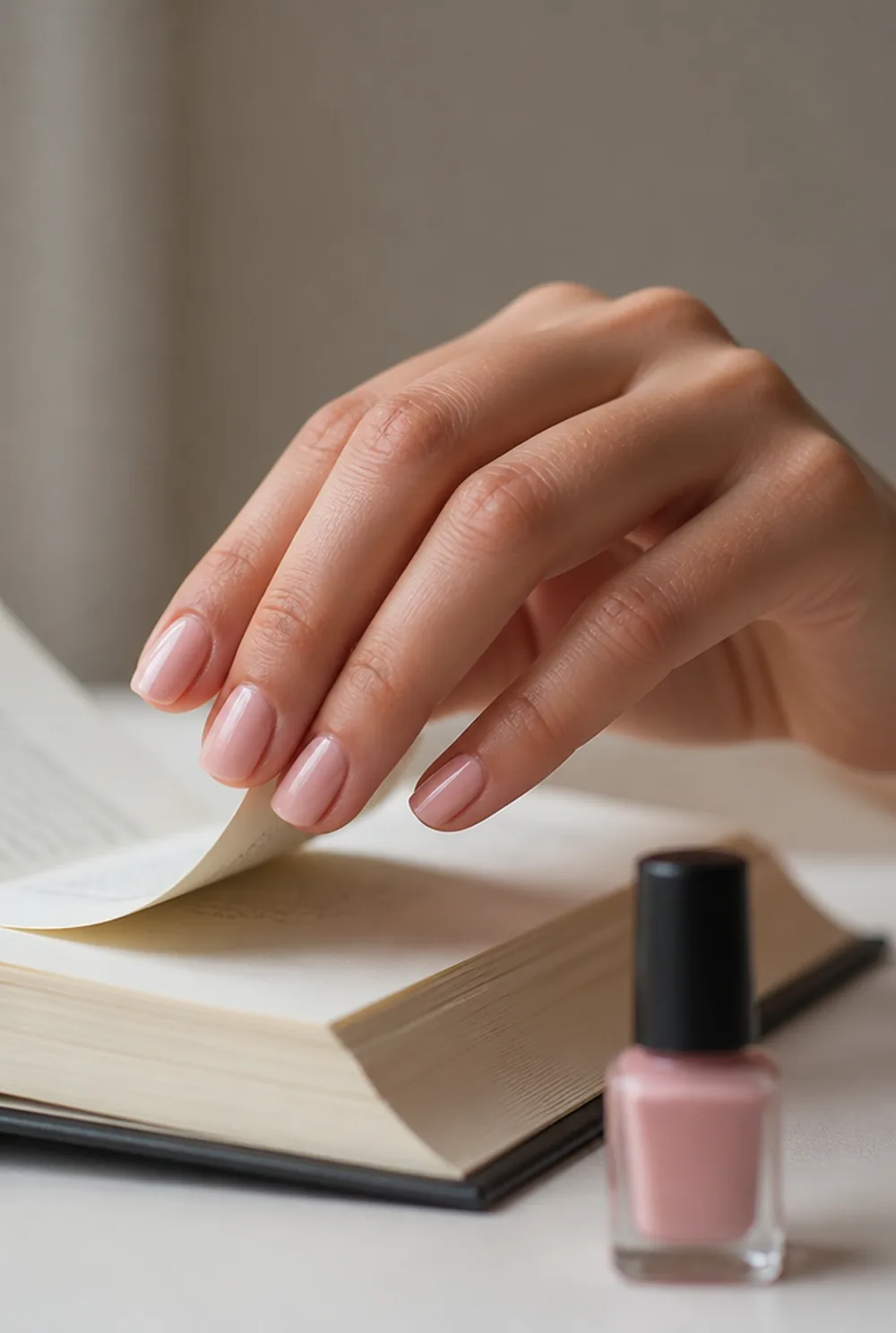
Gel polish on short natural nails is unaffected by sanitizer and lasts two to three weeks, which fits neatly into a half-term rhythm. A clear gel overlay does the same job without any color, and it also stops the splitting caused by constant washing.
Keep it short, cap the free edge, and it will hold. If you wear gel back to back, keep in mind that dermatologists advise moderation with gel manicures and a check with a dermatologist if your nails change. My short gel nails post covers the routine.
Colors that hide the damage
Given something will eventually chip, choose a color where it does not matter.
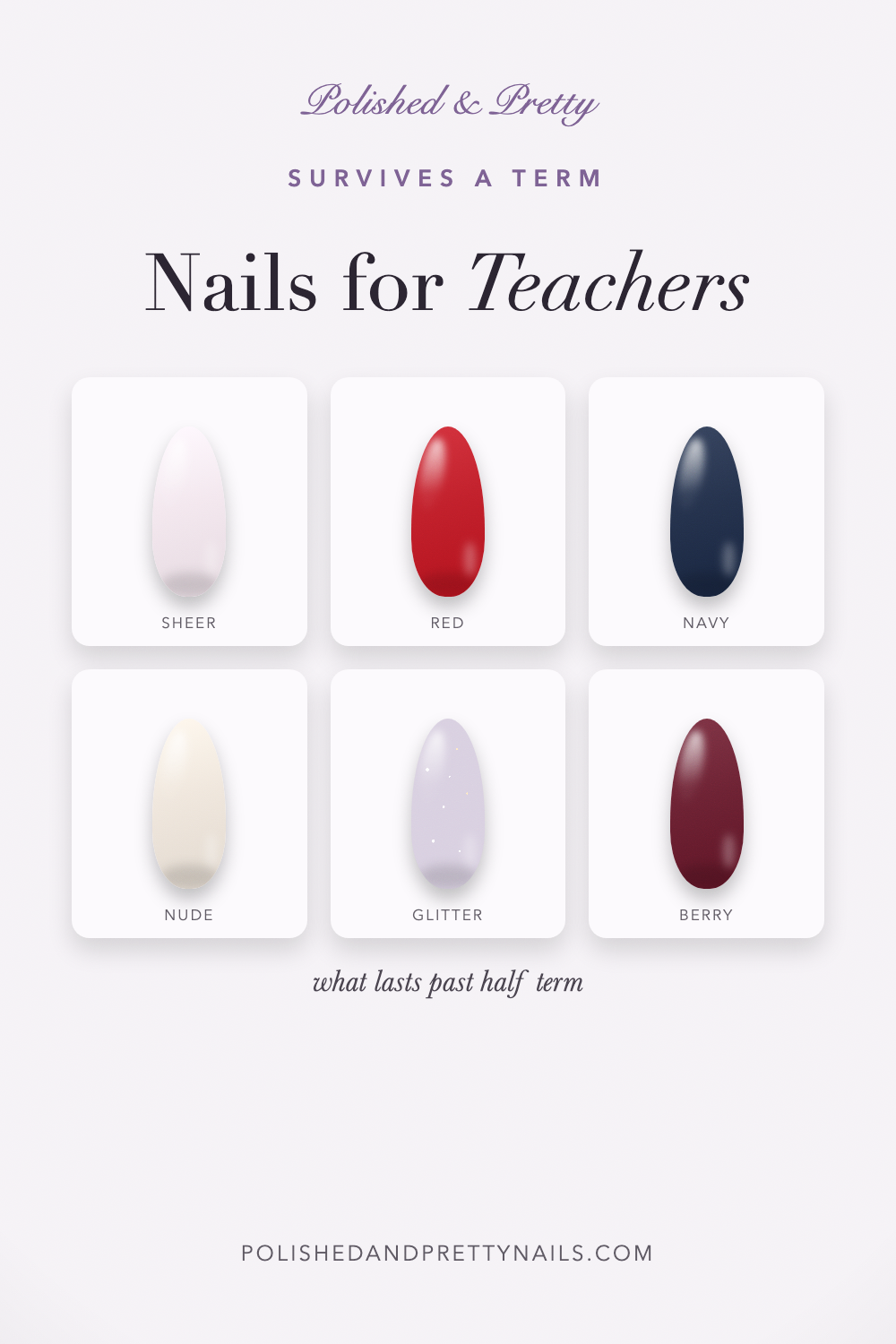
Pale shades hide chips almost entirely. A chip in a sheer pink, a nude, or a milky white is nearly invisible from more than a foot away, which means a manicure stays presentable for its full life rather than looking neglected halfway through.
Dark shades do the opposite. A chip in navy or burgundy is obvious immediately, and grow-out shows from about day nine.
Glitter is the sleeper choice, since the texture hides chips completely, though removal is more work. My nude nail designs post covers matching a shade to your hands.
Is bright color unprofessional?
Almost never, and this worries people more than it should.
Very few schools have any policy on nail color at all, and those that do usually only ask for neat and unchipped rather than restricting shades. Bright color on short, tidy, well-kept nails reads as put-together, not unprofessional.
What does read badly is chipped polish, uneven lengths, and ragged cuticles, none of which are about color. A neat bright red beats a chipped nude every time.
Children also love a bright color, which is worth something. Seasonal shades are an easy conversation starter with a class. My classy red nail designs post covers the timeless end.
What to skip
A few things are more trouble than they are worth in a classroom.
Long extensions of any kind. Beyond the breakage, they make a surprising number of daily tasks harder, and in early years settings they are a genuine issue when handling children.
Rhinestones, charms, and anything raised. They catch on clothing and displays, they fall off within days, and one landing on a classroom floor is not something you want to explain.
Sharp shapes such as stiletto and long almond. Anything pointed is a poor idea around children and breaks quickly anyway.
Fitting it around the timetable
The practical constraint for most teachers is not what to wear, it is when there is time to do it.
Gel at two to three weeks lines up almost exactly with a half-term rhythm, which is why it suits the job so well. Booking on the first weekend of a half-term and again at the start of the next means you are never doing nails during a working week, and the set is always at its best rather than growing out through the busiest fortnight.
If you do your own, an at-home gel kit pays for itself in about two salon visits and a full set takes forty minutes in front of the television on a Sunday. The bigger saving is not needing an appointment at all.
Whatever you use, do them on a Saturday rather than a Sunday evening. Polish needs one to two hours to harden properly, and a rushed manicure before bed on Sunday will have sheet marks by Monday. My nail polish drying post covers speeding that up.
Something different for the holidays
The compromise most teachers land on is practical nails in term time and something else in the breaks.
Press-ons are ideal for this. A set costs a few dollars, goes on in fifteen minutes, lasts about a week, and comes off cleanly with no damage, so you can have length over a half-term break and be back to short natural nails for the Monday you go back.
Use adhesive tabs rather than glue if you want them off quickly. My making press-ons last post covers both.
Hand care through a term
The nails are usually not the real problem by half-term. The skin is.
Constant washing and sanitizer strip oils, and the result is dry cracked cuticles, hangnails, and sore skin around the nail. That does more to make hands look unkempt than any chip.
Keep hand cream on your desk and cuticle oil in your bag, and use both at the end of the day rather than the start so they absorb. This is the single highest-value habit for anyone in a classroom.
If nails are already splitting, our brittle nails post covers recovery.
FAQ
Can teachers have long nails?
Most schools have no formal policy, so it is usually a practical question rather than a rule. Long nails break quickly on classroom tasks and make handling equipment and supporting young children harder, which is why most teachers settle on short nails regardless.
What nails are best for teachers?
Short round or soft oval nails with gel polish in a pale shade. Gel survives hand sanitizer where regular polish does not, short round shapes do not catch or break, and pale colors hide chips so the manicure stays presentable for its full two to three weeks.
Is bright nail polish unprofessional for teachers?
Generally not. Very few schools restrict color, and neat bright nails read as well-groomed. What looks unprofessional is chipped polish, uneven lengths, and ragged cuticles, none of which relate to the shade.
Why does my polish chip so fast at school?
Hand sanitizer dissolves regular lacquer, and repeated handwashing swells and contracts the nail plate, which loosens polish from underneath. Gel polish is unaffected by both and is the practical answer if you do not want to repaint weekly.
Short, round, gel, and pale is the combination that survives a term. My classy short nail designs post covers the looks.