
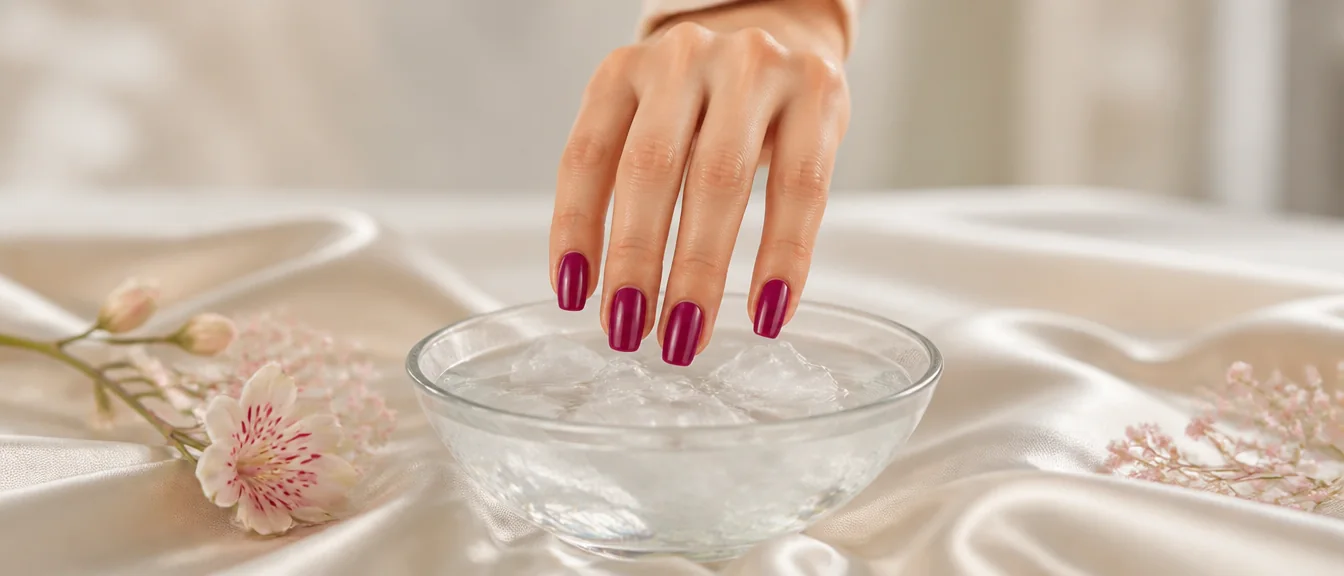
The fastest genuine way to dry nail polish is to apply thin coats and then plunge your hands into ice water for two minutes. Everything else that works does the same two things: reduces how much solvent has to escape, or cools the film so it firms evenly rather than skinning over on top.
Here is what actually speeds it up, what makes it worse despite being widely recommended, and how long polish genuinely needs before it is safe. Several popular tricks are the direct cause of the bubbling covered in our nail polish bubbles post.
Why polish takes so long
Polish does not dry the way paint or glue does. Nothing is curing or reacting. It is pigment and resin suspended in solvent, and drying is simply that solvent evaporating and leaving the solids behind.
That matters because it means the only variable is how much solvent there is and how easily it can get out. More coats means more solvent. Thicker coats mean the solvent at the bottom has further to travel. Anything that seals the surface early traps it.
It also means polish goes through two stages people confuse. Touch dry happens in a few minutes, when the surface has lost enough solvent to feel firm. Fully hard takes far longer, sometimes hours, because solvent is still leaving the layers underneath. Sheet marks at bedtime come from polish that was touch dry but nowhere near hard.
Thin coats, and why this is the biggest one

Nothing else on this list comes close to the difference thin coats make.
Two thin coats contain less total solvent than one thick coat, and each layer is shallow enough for that solvent to reach the surface quickly. A single heavy coat can take three or four times as long to harden all the way through, even though it looks dry on top within minutes.
Wipe one side of the brush against the neck of the bottle and lay the polish down from the loaded side. If polish is pooling anywhere or creeping toward the cuticle, there is too much on the nail.
Waiting two to three minutes between coats also speeds up the total, which sounds wrong and is not. A second coat applied over a wet first coat re-dissolves it, and you end up with one thick wet layer instead of two thin ones.
Cold water
This is the one home trick that genuinely works, and it works for a reason worth understanding.
Fill a bowl with cold water and a few ice cubes. Wait two minutes after your last coat so the surface is touch dry, then submerge your fingers for two to three minutes. The polish firms up noticeably and the finish stays glossy.
Cold does not evaporate solvent faster. What it does is cool the whole film at once so the resin sets throughout rather than skinning over on top while the base stays soft. You get a hard, even film rather than a firm shell over wet polish.
The nails are not fully cured afterwards and solvent is still leaving, but they are far more resistant to dents and smudges, which is what actually matters in the twenty minutes after a manicure.
Drying drops and sprays

These work, they are inexpensive, and most people misunderstand what they do.
Drying drops are mostly oil with a solvent carrier. They do not make polish dry faster in any chemical sense. What they do is form a slick protective film over the surface so that the still-soft polish underneath is far harder to dent or smudge, and they pull the surface together so it sets smoothly.
That is genuinely useful and it is not the same as dry. Your nails will resist a knock at four minutes instead of fifteen, but the polish beneath is still soft for another hour.
Apply one drop per nail about a minute after top coat, let it sit, then rinse with cool water. A bottle costs around $8 and lasts a year.
Quick-dry top coats
A quick-dry top coat is the most practical single upgrade if you paint your nails often.
They contain more volatile solvent and a resin system designed to set fast, so the top layer hardens within a couple of minutes. Seche Vite is the best known and there are cheaper equivalents that perform nearly as well.
The catch is that all that solvent attacks whatever is underneath. Applied over color that is still wet, a quick-dry top coat drags pigment, causes streaking, and can shrink the polish back from the tip. Give color a full five minutes first, and float the top coat on rather than brushing it.
These formulas also thicken faster than most, so keep the cap clean and expect to thin the bottle. My thick nail polish post covers that.
What does not work
Several widely repeated tricks make things actively worse.
Blowing on nails is the main one. Warm, moist breath dries the surface faster than the layer beneath, which is the exact condition that produces bubbles. It also deposits moisture on the film, which can cause cloudiness.
Hairdryers on a warm setting are worse for the same reason, with more force behind them. A hairdryer on cold air is fine and mildly helpful, but it is doing the same job as cold water less effectively.
Radiators, heaters, and sunny windowsills all soften the resin while accelerating the surface, which gives you a wrinkled or dented finish. Cooking spray and olive oil are internet folklore; they leave a greasy film that does nothing for the polish underneath.
There is a safety reason too, because the US Food and Drug Administration warns that some nail products can easily catch fire if they are exposed to a flame or another heat source.
UV lamps do nothing for regular polish
This one catches people who own a gel lamp and assume it will help.
Gel cures through a photochemical reaction that UV or LED light triggers. Regular polish contains no photoinitiators and nothing for that light to react with, so a lamp does nothing except warm the nail slightly, which is mildly counterproductive.
If you want a manicure that is genuinely hard in sixty seconds, that is what gel is for. My short gel nails post covers the at-home version.
How long polish really needs
Realistic numbers, assuming two thin coats and a top coat.
Touch dry is two to five minutes, or one to two with a quick-dry top coat. Safe for careful use, meaning you can pick things up and use a phone, is about fifteen to twenty minutes, or ten with drying drops or the cold water trick.
Fully hard is one to two hours for most polishes and longer for dark, heavily pigmented shades or anything applied thickly. This is why nails painted at bedtime almost always end up with sheet marks, and why painting them in the evening but a couple of hours before bed is the better plan.
Do not do anything involving hot water for at least an hour. Heat softens the film and washing up an hour after a manicure is one of the most common ways to ruin one. My manicure longevity post covers the rest.
The fastest realistic routine
Put together, a manicure that is genuinely safe to use in about twelve minutes.
Thin base coat, two minutes. First thin color coat, three minutes. Second thin color coat, five minutes. Quick-dry top coat, floated on. Two minutes, then two to three minutes in ice water. Pat dry rather than rubbing.
Skipping the waits between coats is what makes people slower rather than faster, because the layers merge into one thick wet film that takes far longer to harden than the sum of its parts.
FAQ
Does cold water really dry nail polish faster?
Yes. Wait two minutes after your last coat, then submerge your fingers in ice water for two to three minutes. Cold sets the resin evenly throughout the film rather than letting it skin over on top, so the polish resists dents far sooner. Solvent is still evaporating, so the nails are not fully hard.
Can you use a hairdryer to dry nail polish?
Only on the cold setting, and cold water works better. Warm air dries the surface much faster than the layer beneath, which traps solvent and causes bubbles, and it softens the resin so the finish dents and wrinkles.
How long does nail polish take to fully dry?
Touch dry in two to five minutes, safe for careful use at fifteen to twenty, and fully hard in one to two hours. Dark shades and thick coats take longer. Sheet marks happen because polish that felt dry at bedtime was still soft underneath.
Does a UV lamp dry regular nail polish?
No. Regular polish dries by solvent evaporation and contains no photoinitiators, so there is nothing for UV or LED light to react with. The lamp only warms the nail slightly, which makes the finish marginally worse rather than better.
Thin coats and ice water is the whole answer for most people. My streaky nail polish post covers getting the coats right.