
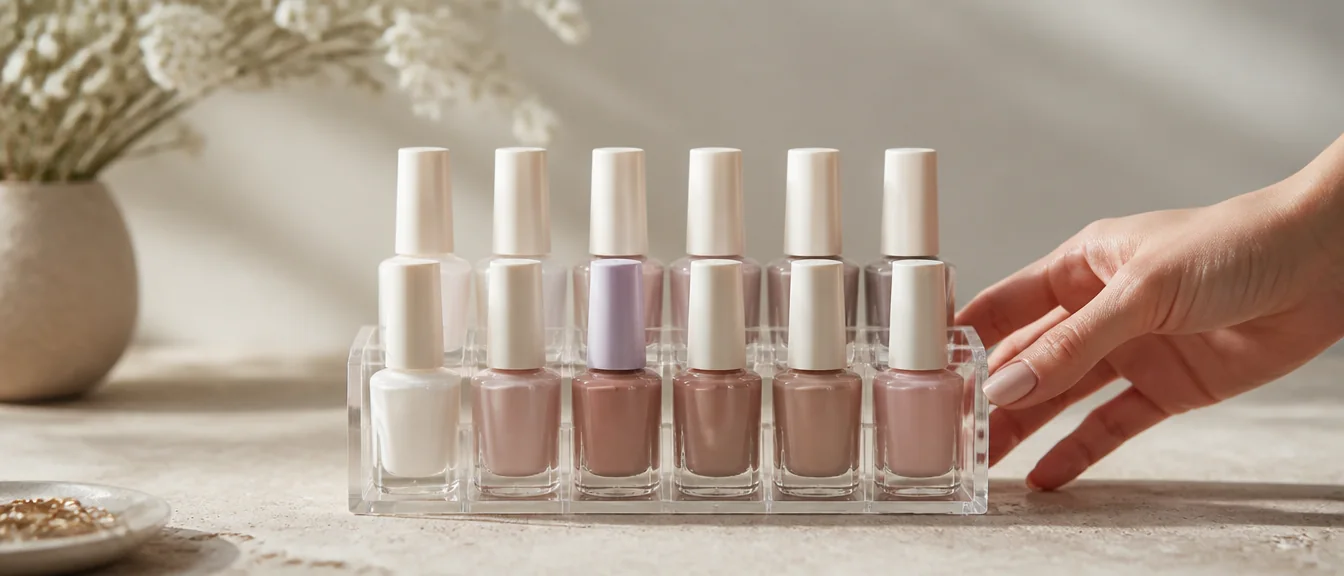
Store nail polish upright, somewhere cool, dark, and stable. That is genuinely the whole answer, and the two things that kill a collection fastest are the bathroom, where heat and humidity swing constantly, and any shelf that gets daylight.
Here is why each of those matters, why the fridge is a myth worth ignoring, and the small habits that let a bottle last five years instead of one. If yours have already thickened, our thick nail polish post covers bringing them back.

Cool, and why heat is the main enemy
Heat does two things to polish and both of them shorten its life.
It speeds up solvent evaporation, so the bottle thickens faster even when closed, because no cap seals perfectly. It also accelerates the chemical breakdown of the resin system, which is what eventually makes a polish stop drying hard.
Somewhere between 10 and 21 degrees Celsius is ideal, which in practice means a normal room rather than anywhere special. What matters more than the exact temperature is that it stays steady. Repeated warming and cooling cycles are harder on a bottle than a consistently slightly warm room.
That rules out windowsills, radiators, cars, and anywhere above a heat source.
The US Food and Drug Administration also advises keeping cosmetics out of the heat, such as a hot car, because temperature changes and sunlight can alter their color and texture.
Dark, because light changes the color
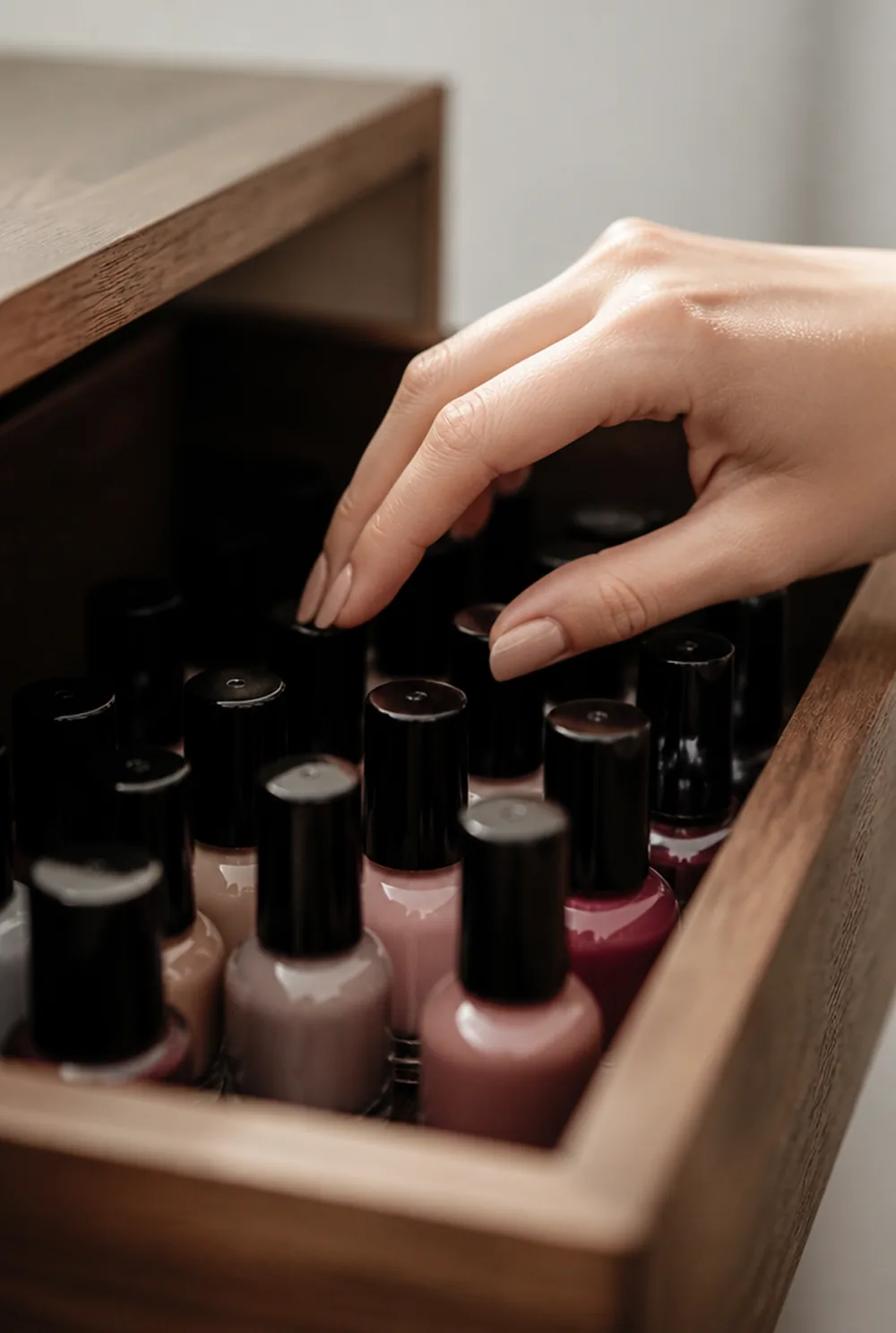
Light damage is the reason old whites turn yellow and old blues go dull.
UV degrades both the pigments and the resin. Whites and pale nudes yellow, reds can darken or brown, and blues and purples fade. The change is permanent, and it shows on the nail as well as in the bottle.
This is the strongest argument against the wall-mounted display racks that look so good on Pinterest. A rack in daylight is the fastest way to ruin an expensive collection, and the bottles worst affected are the pale shades you probably wear most.
A closed drawer or a box solves it completely. If you want your collection visible, choose a spot with no direct daylight and keep the whites out of the front row.
Why the bathroom is the worst place
This is where most people keep polish and it is the single worst room in the house for it.
A bathroom swings from cold to hot and humid several times a day. That temperature cycling drives solvent out past the cap threads far faster than a stable room does, and the humidity can get into a bottle that is not sealing well. NAILS Magazine advises keeping polish in a cool, dry area, out of direct sunlight, which a steamy bathroom is not.
Moisture in polish causes cloudiness, separation, and poor drying. It is also the reason a bathroom-stored top coat tends to fail long before a bedroom-stored one.
Move the collection to a bedroom drawer. It is free, takes five minutes, and will do more for your polish than anything else on this page.
Upright, always

Standing bottles upright rather than laying them flat matters more than it sounds.
A bottle on its side puts polish in constant contact with the cap threads, where it dries and forms a crust. That crust holds the cap fractionally open, and a cap that cannot seal loses solvent continuously. It is also what makes bottles impossible to open months later.
Upright storage keeps the neck clean and the seal tight. It also lets settled pigment sit at the bottom where a quick roll will redistribute it, rather than along one side of the bottle.
The exception is glitters, which some people store upside down for a few minutes before use so the glitter moves toward the brush. That is a short-term trick rather than a storage position.
The fridge myth
Storing nail polish in the fridge is common advice and it is not a good idea.
Cold makes polish thicker and harder to apply, so every bottle needs warming before use. Worse, moving a bottle repeatedly between a cold fridge and a warm room causes condensation, and water is one of the few things that genuinely ruins a polish.
Cold can also cause some formulas to separate or cause the pigment to clump, and the change is not always reversible when it warms back up.
A cool cupboard gives you everything the fridge would without the condensation. The one place cold genuinely helps is drying a fresh manicure, which is a different thing entirely and covered in our nail polish drying post.
Cap habits
How you handle the cap during a manicure matters as much as where the bottle lives.
Most solvent loss happens while the bottle sits open across ten nails. Close it between hands rather than leaving it open on the table for the whole session, and it makes a measurable difference over a bottle’s life.
Wipe the threads and the inside of the cap with a tissue dampened in remover every few uses. This is the single highest-value maintenance habit there is, because a clean seal is what stops the slow leak.
Close firmly but do not overtighten. Forcing a cap can crack the collar, which stops it sealing permanently.
Organizing a collection
Once storage conditions are right, the rest is about actually using what you own.
Sort by color family rather than brand. You choose polish by shade, so a collection sorted by color gets used, and one sorted by brand mostly gets ignored. Drawer inserts and small acrylic trays work better than deep boxes, where bottles at the bottom are never seen.
Keep base and top coats separate and to hand, because you reach for them every time. Rotating older bottles to the front stops you buying a fourth similar red while three thicken at the back.
Be honest about volume. A shade worn twice a year in a 15ml bottle will thicken before you finish it, so buy small bottles of colors you rarely wear. My does nail polish expire post covers when to let one go.
Storing gel and removers
Gel needs the same conditions for a different reason, and it is stricter about one of them.
Gel does not dry out, because there is no solvent to lose. What ruins it is light, since ambient daylight slowly begins the curing reaction and thickens the bottle over months. Once thickened it cannot be rescued, because there is no gel thinner.
Keep gel in a closed box, not on an open shelf and never near a window. This matters more for gel than for lacquer. My gel polish bubbling post covers what thickened gel does on the nail.
Acetone and remover should be stored upright, tightly capped, and away from heat. Both are flammable, so keep them away from candles and hobs.
The US Food and Drug Administration warns that some nail products can easily catch fire near a flame or heat source, such as a stove’s pilot light, a lit cigarette, or a hot curling iron.
FAQ
Should you store nail polish in the fridge?
No. Cold makes polish thicker and harder to apply, and moving bottles between a cold fridge and a warm room causes condensation, which ruins polish. A cool, dark cupboard or drawer gives all the benefit without the moisture risk.
Where is the best place to store nail polish?
A closed drawer or box in a bedroom, standing upright, away from direct light and heat. Avoid bathrooms, where temperature and humidity swing several times a day, and avoid open display racks in daylight, which fade and yellow the pale shades.
Should nail polish be stored upright or on its side?
Upright. Lying a bottle down keeps polish against the cap threads, where it dries into a crust that holds the cap fractionally open and lets solvent escape continuously. It is also what makes bottles seize shut.
How do you keep nail polish from drying out?
Wipe the bottle threads and the inside of the cap with a tissue dampened in remover every few uses so the cap seals properly, close the bottle between hands rather than leaving it open through a whole manicure, and store it upright somewhere cool and dark.
Move your collection out of the bathroom today. It is the highest-impact five minutes you can spend on it. My manicure longevity post covers the rest.