
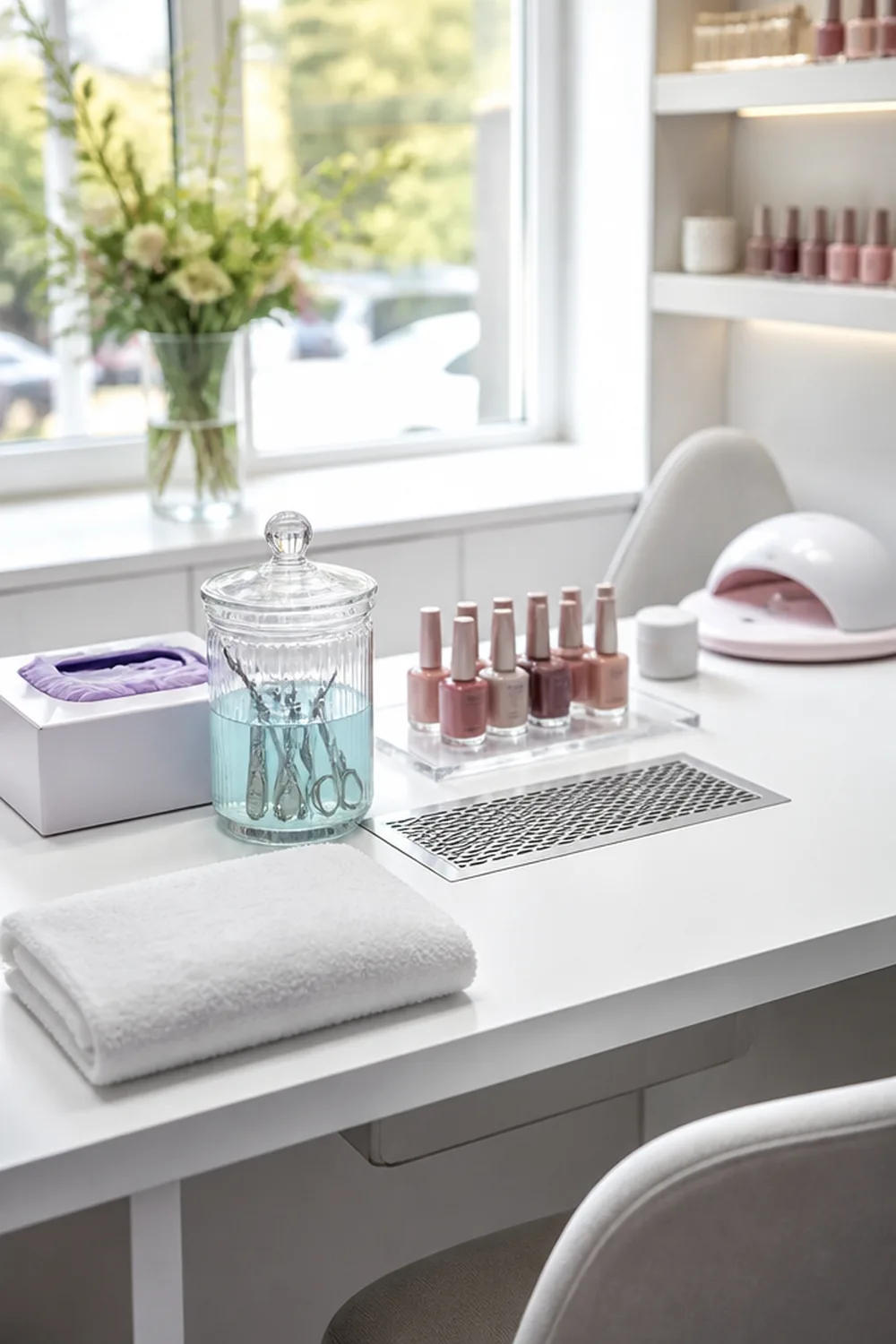
Nail salons run on products that need careful handling: solvents, acrylic liquids, disinfectants and dust. This guide collects what OSHA, NIOSH, the EPA, the FDA and state boards actually say about keeping nail technicians and clients safe, in plain English, with a source on every claim.
It is written for three readers: nail techs and salon owners, cosmetology students and their teachers, and clients who want to know what a clean, well-run salon looks like. If something here differs from your state board’s rules, your board’s rules win; you can find every board in our state-by-state license guide.
The chemicals to know
Nail salon workers can be exposed by breathing vapors, dusts or mists, by skin or eye contact, or by swallowing product that ends up on food or cigarettes.3 Exposures add up when many products are used at once, day after day, or with poor ventilation.3 Three polish ingredients are known in the industry as the toxic trio.3
Toluene
- Found in
- Some nail polishes and nail glue
- What it can do
- Dry or cracked skin, headaches, dizziness and numbness; OSHA also lists liver and kidney damage and harm to unborn children in pregnancy.3
Formaldehyde
Dibutyl phthalate (DBP)
- Found in
- Some nail polishes
- What it can do
- Nausea and irritation; OSHA says long-term high exposures may cause other serious effects.3
Methyl methacrylate (MMA)
Ethyl methacrylate (EMA)
- Found in
- Most artificial nail liquids
- What it can do
- Asthma, irritation and difficulty concentrating; exposure in pregnancy may affect the child.3
Two more show up in everyday work: methacrylic acid in nail primers can burn skin,3 and quaternary ammonium disinfectants can irritate skin and nose and may cause asthma.3 Every salon product with a hazardous ingredient comes with a safety data sheet (SDS), and employers must keep SDSs near the product and train workers on the hazards.3
Worth knowing
A “3-free” label is not a guarantee. A California DTSC study found some products claiming to be free of the toxic trio tested positive for them.3
Masks, respirators and gloves: what actually protects you
This is the most misunderstood part of salon safety. A mask that stops dust does nothing for vapors, and vapors are what solvents and acrylic liquids give off.
| Protection | Dust | Vapors | What to know |
|---|---|---|---|
| Surgical mask | No | No | Helps keep germs from spreading, but not dust or vapors.3,5 |
| N95 (NIOSH-approved) | Yes | No | Good for filing and buffing dust. Employers who allow voluntary use must give workers Appendix D of OSHA’s respirator standard.3 |
| Half-face respirator with cartridges | Yes | Yes | Can protect against vapors like formaldehyde, but needs a full respiratory protection program, including fit testing.3 |
| Ventilated table or local exhaust | Reduces | Reduces | OSHA’s first choice. With good ventilation and work practices, most nail work won’t need respirators.3 |
For gloves, nitrile protects against many nail chemicals, and the EPA recommends disposable nitrile or the type the product’s safety sheet names. OSHA notes latex or vinyl is appropriate for acetone. Replace any glove with a cut, tear or hole right away, and wear goggles with gloves when pouring or transferring products.3,5
Ventilation, in order of what works best
OSHA calls ventilation the best way to lower chemical levels in a salon, and NIOSH lab tests suggest exhaust ventilation can cut a worker’s exposure by at least half.3 In one NIOSH field study, a downdraft table vented outdoors cut technicians’ acrylic-liquid exposure from 8.7 ppm to 0.6 ppm.6
- Exhaust at the workstation. Use a ventilated table or a portable unit that captures vapors and dust where they’re made, ideally vented outdoors. General room air turns over too slowly on its own.1,5
- Keep ventilated tables working. Leave them on, change charcoal filters at least monthly, clean the catch basin at least weekly, and keep towels and clutter off the vent.3,5
- Run the building air all day. With no exhaust system, keep the HVAC on during work hours with the fan set to “on”, not “auto”.3 Skip ozone-generating air cleaners.5
- Keep vapors in the bottle. Close containers, use small pump dispensers, and put product-soaked cotton in a metal can with a tight, self-closing lid.1,3
- Dispose of acetone properly. Never pour used acetone down the drain; store it in a fire department-approved metal container for hazardous waste pickup.3 No smoking anywhere in the salon.5
Small salons can get free, confidential help measuring exposures through OSHA’s On-site Consultation Program.3
Clean tools and safe foot spas
Nail work can expose workers to bloodborne pathogens such as hepatitis B, hepatitis C and HIV, and OSHA’s Bloodborne Pathogens Standard covers nail salons.7 Employers must offer the hepatitis B vaccine free to workers likely to be exposed to blood.7 OSHA’s cleaning steps for reusable metal tools:
- Wash with soap and water to remove debris.
- Soak in an EPA-registered disinfectant for the label time, usually 10 to 30 minutes.
- Rinse with clean water.
- Dry completely.
- Store covered until the next client.
Those steps come from OSHA.7 Items that can’t be disinfected, like buffers, pumice stones, emery boards, toe separators and cotton, are single-use in California and get thrown away after each client;8 New York bars sharing an emery board between clients.9
Myth
“The UV box sterilizes my tools.”
Fact
OSHA says UV boxes do not disinfect tools. Use them only to store tools that are already cleaned and disinfected.7
Foot spas need the most care. Their screens and pipes collect bacteria that form biofilms, which can be very hard to remove.10 California spells out the steps in detail, and they make a good model for any salon:8
After every client
Drain and disinfect
Drain, scrub with a brush and soap, rinse, refill and circulate an EPA-registered hospital disinfectant for the label time, usually 10 minutes.8,10
End of every day
Take it apart
Remove the screen and parts, scrub behind them, circulate detergent for 10 minutes, then disinfectant for 10 minutes.8
Once a week
The long soak
Leave disinfectant standing in the unit for at least six hours, and record every cleaning in a log clients can ask to see.8
Look for a label that says “Disinfectant” with “Hospital”, “Medical” or “Health Care” and an EPA registration number.10 Don’t service skin that is inflamed, broken or infected.7,8
Shaving legs before the pedicure was a risk factor in that outbreak,11 and similar cases have been reported in southern California and North Carolina.14,15
MMA: what’s banned, and by whom
Common claim
“MMA is banned by the FDA.”
What the FDA says
No federal regulation specifically prohibits MMA monomer in cosmetics. In the 1970s, the FDA removed 100% MMA products from the market through court actions, seizures and recalls after injury reports.4
The bans are state rules. California bars MMA monomer from any salon or school premises,8 Minnesota prohibits MMA liquid monomer in salons,16 and Florida bars using or possessing liquid nail monomer with any trace of MMA.17 The FDA says MMA is still occasionally used in some artificial nail products,4 and a California study found MMA in salon air despite the ban.18 The EPA advises salon owners not to buy or use any product containing liquid MMA monomer.5
Even legal acrylic liquids can cause allergies. Traces of methacrylate monomers can cause redness, swelling and pain around the nail in people who have become allergic,4 and researchers report rising acrylate allergy among both nail technicians and clients.19
Your body: posture, pregnancy and your doctor
Leaning over tables, hunching for pedicures and repetitive filing are the usual causes of muscle, joint and nerve injuries in nail work.1,20 OSHA’s fixes are simple: an adjustable chair with back support, feet flat or on a footrest, the client’s hand or foot raised so you don’t bend, padded table edges, padded tool handles, and short breaks to stretch.20
If you’re pregnant or planning to be, tell your doctor what chemicals you work with.3 A NIOSH-led study found nail technician work in early pregnancy was associated with certain congenital heart defects; it was a study of 61 nail technician mothers and shows an association, not proof of cause.1,21
Your rights as a nail technician
A safety checklist for clients
You don’t need to know any chemistry to spot a careful salon. Before your appointment and in the chair:
- Look for a current establishment license posted at reception.25
- Don’t shave or wax your legs for 24 hours before a pedicure.25
- Skip the foot spa if you have cuts, scabs, bug bites or broken skin on your legs or feet.10,25
- If you have diabetes, lupus or another condition that weakens your immune system, ask your doctor first.25
- Ask how the foot spas are cleaned and how often. In California you can ask to see the cleaning log.10,25
- Watch for metal tools that come out of disinfectant or covered storage, and new files and buffers for each client.7,8
- If anything looks dirty, it’s fine to leave.25
- If a sore that looks like a spider bite appears after a pedicure, see a doctor, mention the foot spa, and report it to your state board.25
Some cities and counties recognize salons that go further, using polishes without the toxic trio, nitrile gloves and ventilation; San Francisco and Alameda County both run Healthy Nail Salon programs.26,27
Frequently asked questions
Do N95 masks protect nail technicians from fumes? No. An N95 helps with dust from filing and buffing, but it does not protect against chemical vapors or gases. Surgical masks protect against neither. For vapors, the main fix is ventilation; a cartridge respirator can protect against vapors but needs a full respiratory program with fit testing.3
Is MMA banned for nails? Not by a federal rule. The FDA says no regulation specifically prohibits MMA monomer in cosmetics, though it removed 100% MMA products from the market in the 1970s through court actions and recalls. Bans are state rules: California, Minnesota and Florida all prohibit MMA liquid monomer in salons.4,8,16,17
Do UV sterilizer boxes disinfect nail tools? No. OSHA says UV boxes do not disinfect tools and should only be used to store tools that have already been cleaned and disinfected.7
How often should a pedicure foot spa be disinfected? EPA and CDC say between every customer and again at night, with the disinfectant left for its full label contact time, usually 10 minutes. California also requires a weekly 6-hour disinfectant soak and keeps a cleaning log you can ask to see.8,10,25
Can you get an infection from a pedicure? It's uncommon but documented. In 2000, 110 customers of one California salon developed skin boils from mycobacteria growing in whirlpool footbaths, and shaving your legs beforehand raised the risk. California advises no shaving or waxing for 24 hours before a pedicure.11,25
Are '3-free' nail polishes really free of the toxic trio? Not always. A California DTSC study found some products labeled free of the toxic trio tested positive for those chemicals, so a label is not a guarantee.3
Sources
Every claim above links to one of these official or peer-reviewed sources. We checked each one on October 2, 2026. If a link has moved or a rule has changed, email hello@polishedandprettynails.com and we’ll update this page.
- NIOSH, Nail Technicians
- OSHA, Nail Salons
- OSHA, Nail Salons: Chemical Hazards
- FDA, Nail Care Products
- EPA, Protecting the Health of Nail Salon Workers
- NIOSH, Appl Occup Environ Hyg 1997 (ventilated table study)
- OSHA, Nail Salons: Biological Hazards
- California Board of Barbering and Cosmetology, Act and Regulations
- New York 19 NYCRR 160.18
- EPA and CDC, Preventing Pedicure Foot Spa Infections (EPA archive)
- Winthrop et al., N Engl J Med 2002 (footbath outbreak)
- Redbord et al., Clin Infect Dis 2003 (outbreak follow-up)
- Vugia et al., Emerg Infect Dis 2005 (footbath survey)
- Gira et al., Clin Infect Dis 2003 (southern California cases)
- Stout et al., Clin Infect Dis 2011 (North Carolina surveillance)
- Minnesota Rule 2105.0377
- Florida Statutes 477.0265
- Quach et al., J Occup Environ Hyg 2011 (salon air study)
- Contact Dermatitis review 2023 ((meth)acrylate allergy)
- OSHA, Nail Salons: Positions and Motions
- Siegel et al., NBDPS 2021 (pregnancy study)
- OSHA 3542, Stay Healthy and Safe While Giving Manicures and Pedicures (2025 revision)
- OSHA, File a Complaint
- California Board of Barbering and Cosmetology, Worker Rights
- California Board of Barbering and Cosmetology, Footspa Fact Sheet
- Alameda County Healthy Nail Salon Program
- San Francisco Healthy Nail Salon Program
This guide is general safety information, not medical or legal advice. For a health concern, talk to a doctor; for the rules that apply to your salon, check with your state board and OSHA.